Composting Reading Answers
The answers for "Composting Reading Answers" include 7 questions and are part of the assessment framework for the IELTS General Reading test. Candidates are allotted 10 minutes to complete the reading responses concerning "Composting Reading Answers." This portion of the IELTS reading exam consists of various question formats, including choosing no more than two words.
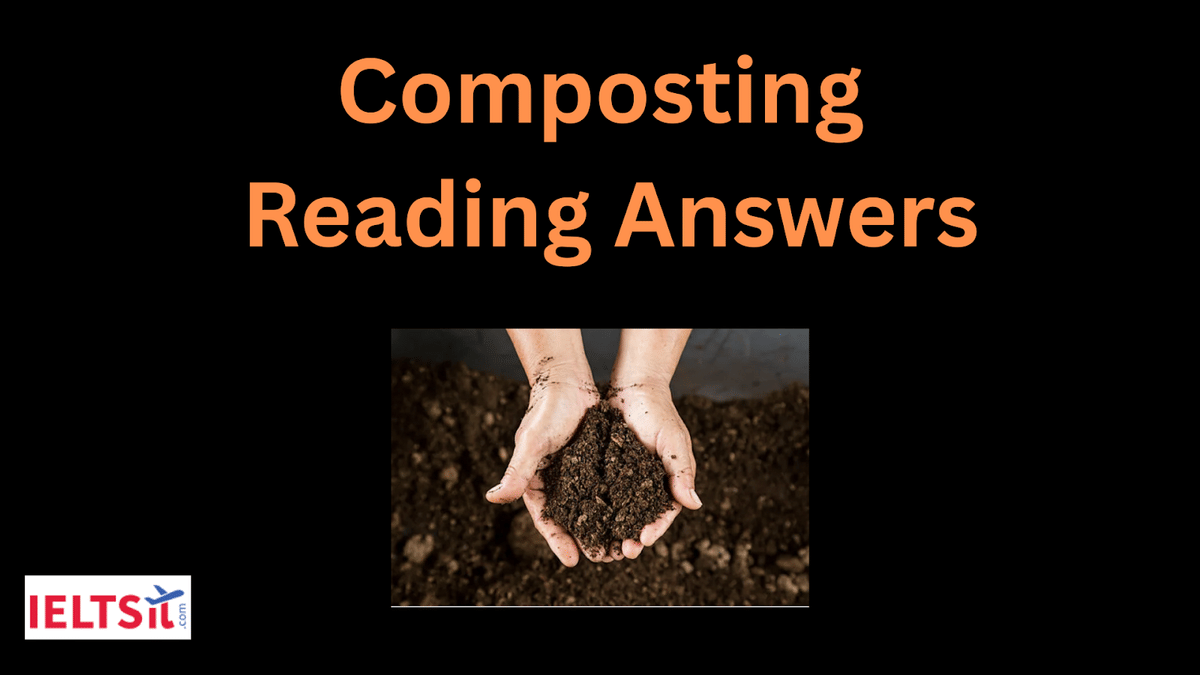
The answers for "Composting Reading Answers" offer a comprehensive overview of the benefits of Composting, which turns kitchen and garden waste into nutrient-rich soil by letting greens and browns decompose naturally over about a year. It reduces landfill waste and methane emissions, offering an easy, sustainable way to manage everyday waste. For additional practice with similar reading assessments, candidates can refer to the IELTS Reading Practice Test section.
Check: Get 10 Free Sample Papers
Check: Register for IELTS Coaching - Join for Free Trial Class Now
Topic:
Composting Reading Answers
Composting step-by-step guide
• Select a relatively sunny spot on bare soil for your compost. In case you have to place your compost bin on concrete, add a layer of twigs and paper. If there is existing compost at the bottom, even better.
• Take a container such as an old ice cream tub and fill it with fruit and vegetable peelings.
Tea bags and eggshells can also be added. Try not to add any meat or fish as they would attract pests.
• Empty the container into your compost bin along with your garden waste. The ratio of 50:50 for the greens and the browns is considered to be the best for a good compost.
• You need to wait for at least 12 months before your compost becomes ready for use. You can keep adding to the greens and browns meanwhile.
• After almost a year, your compost should ideally look like crumbly dark soil that is thick and moist. Using a spade or a trowel you can now remove the compost by lifting the bin slightly.
• Your compost is ready for use.
Why compost?
Did you know that almost half of the food waste from your rubbish bins can be composted?
A sustainable method of waste management, composting is a natural process that converts your kitchen and garden waste into a nutrient-rich fertilizer for your garden. Composting, moreover, contributes to reducing the amount of waste that is sent to the landfills. Once waste is dumped into a landfill, it breaks down and emits a harmful greenhouse gas, methane. On the other hand, organic waste when composted does not break down on its own. Oxygen helps the ingredients to decompose, resulting in the production of valuable food for your garden.
Want to know more about composting?
Visit our website or call 2611 4904 to talk to our experts.
Questions 1-7
Choose NO MORE THAN TWO WORDS AND/OR A NUMBER for each answer.
COMPOSTING GUIDE
- Select a suitable spot for composting and (1)................ a layer of twigs and paper or
Answer: add
Supporting statement: “add a layer of twigs and paper”
Keywords: add a layer
Keyword Location: Paragraph 1, Line 1
Explanation: The guide instructs that if composting on concrete, you must add a layer of twigs and paper. This word fits the blank describing the required action. It clearly explains what must be placed as the first step when preparing the site.
(2).............. Compost.
Answer: existing
Supporting statement: “If there is existing compost at the bottom, even better.”
Keywords: existing compost
Keyword Location: Paragraph 1, Lines 2–3
Explanation: The text states that if there is existing compost, it can be used instead of twigs and paper. This directly matches the blank where the second option is required.
- Empty your kitchen and garden (3)..................... into the compost bin.
Answer: waste
Supporting statement: “Empty the container into your compost bin along with your garden waste.”
Keywords: garden waste
Keyword Location: Paragraph 3, Line 1
Explanation: The text explains that both kitchen scraps and garden waste must be emptied into the compost bin. Therefore, the correct one-word answer is “waste.”
- It takes at least (4)..................... months for the compost to be ready.
Answer: 12
Supporting statement: “You need to wait for at least 12 months before your compost becomes ready.”
Keywords: 12 months
Keyword Location: Paragraph 4, Line 1
Explanation: The guide specifies that compost requires a minimum of 12 months to be ready. Thus, this number correctly fills the blank.
- Good compost looks like (5)...................... soil that is thick and moist.
Answer: crumbly dark
Supporting statement: “your compost should ideally look like crumbly dark soil”
Keywords: crumbly dark soil
Keyword Location: Paragraph 5, Lines 1–2
Explanation: The text describes finished compost as resembling “crumbly dark soil.” The two-word phrase “crumbly dark” correctly completes the description.
Composting prevents (6)...................... Of waste into harmful greenhouse gases and is a
Answer: breakdown
Supporting statement: “reducing the amount of waste that is sent to landfills. Once waste is dumped… it breaks down and emits methane.”
Keywords: breaks down
Keyword Location: Paragraph 7, Lines 3–4
Explanation: The passage highlights that landfilled waste breaks down into harmful gases. Composting prevents this breakdown, fitting the blank perfectly.
sustainable method which leads to production of valuable (7).................... for your garden.
Answer: fertilizer
Supporting statement: “converts your kitchen and garden waste into a nutrient-rich fertilizer for your garden.”
Keywords: nutrient-rich fertilizer
Keyword Location: Paragraph 7, Lines 1–2
Explanation: Composting creates valuable fertilizer for gardening. This aligns directly with the blank asking what composting produces.
Check IELTS reading samples:
- Nushu — A Secret Language IELTS Reading Answers
- When Conversations Flow IELTS Reading Answers
- The Birth of Blue Reading Answers
- Clothing Stores in South Australia Reading Answers
- Cleanliness of Public Transportation Reading Answers
- Ways of Reading Reading Answers
- The Science of Color Reading Answers
- Homes made of Mud Reading Answers
- Travelling on the London Underground Reading Answers Reading Answers
- Recruitment Process for a Personal Assistant Reading Answers
- Staff Training Reading Answers
- Eco Holidays in Costa Rica Reading Answers
- Tourism New Zealand Website Reading Answers
- A Good Teacher Reading Answers
- The Central Library Announcement Reading Answers
- Medical Detection Dogs Reading Answers
- The Royal National Lifeboat Institution at Lyme Regis Reading Answers
- Paul Allen The ideal man Reading Answers
- Four Ways to Manage a Difficult Boss Reading Answers
- Our company employee policy Reading Answers
- A Museum of Failed Romance Reading Answers
- Chimpanzees Reading Answers
- Online Advertising and Marketing Reading Answers
- Some Well Known Public Schools of India Reading Answers
- 10 Cell Phone Etiquette Rules You Should be Following But Arent Reading Answers
- Short Shrift Reading Answers
- What if Gender Equality Could Change the Face of Poverty Reading Answers
- The Causes Diagnosis and Prevention of Stress Reading Answers
- You dont have to be Squillionaire to buy Art Reading Answers
- The Evolution of Human Species Reading Answers
- The Wellington Physiotherapy centre Reading Answers
- Have a greener garden Reading Answers
- Grammatical Rules Reading Answers
- Being Bilingual Reading Answers
- Dinosaurs Reading Answers
- The History of Right and left Hand Reading Answers
- Monitoring employees Reading Answers
- The Glendowen Photography Club Reading Answers
- Team Building Day Friday 17th June Reading Answers
- Risk Assessment Reading Answers
- Sports Activities For Children During School Holidays Reading Answers
- Dry farming in California Reading Answers
- Oceanic Dead Zones Reading Answers
- Your Local Post Office Services Reading Answers
- Pyramid of Cheops Reading Answers
- William Morris and the Arts and Crafts Movement Reading Answers
- Nelson Mandela Reading Answers
- When its time to go back to school Reading Answers
- Negotiating with suppliers Reading Answers
- Taphonomists Reading Answers
Comments