The Megafires of California Reading Answers
The answers for "The Megafires of California " include 13 questions and are part of the assessment framework for the IELTS General Reading test. Candidates are allotted 20 minutes to complete the reading responses concerning "The Megafires of California." This portion of the IELTS reading exam consists of various question formats, including choose ONE WORD AND/OR A NUMBER from the reading passage, and do the following statements agree with the information given.
The answers for "The Megafires of California" offer a comprehensive overview of the passage, explaining that the passage describes Wildfires in the western United States, especially Southern California, that are becoming larger and more intense due to drought, climate change, housing expansion, and fuel buildup. However, improved firefighting equipment, planning, and coordination have helped authorities respond more effectively and reduce loss of life. For additional practice with similar reading assessments, candidates can refer to the IELTS Reading Practice Test section.
Check: Get 10 Free Sample Papers
Check: Register for IELTS Coaching - Join for Free Trial Class Now
Topic:
The Megafires of California Reading Answers
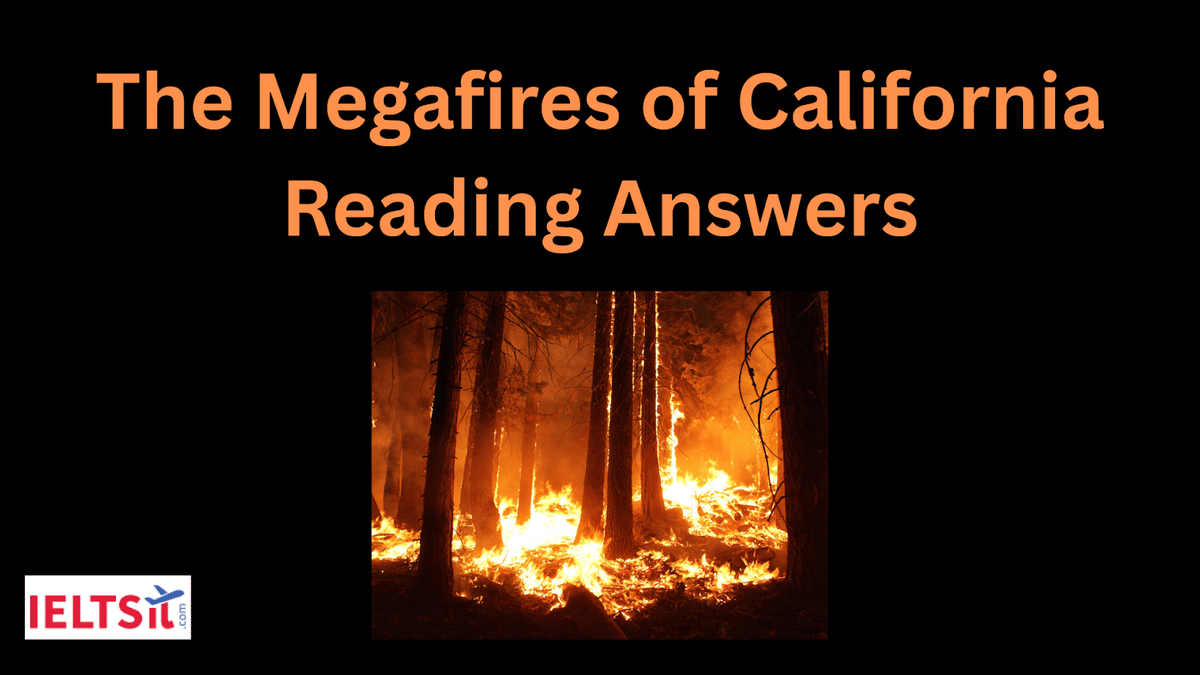
Drought, housing expansion, and oversupply of tinder make for bigger, hotter fires in the western United States Wildfires are becoming an increasing menace in the western United States, with Southern California being the hardest hit area. There's a reason fire squads battling more frequent blazes in Southern California are having such difficulty containing the flames, despite better preparedness than ever and decades of experience fighting fires fanned by the 'Santa Ana Winds' The wildfires themselves, experts say, are generally hotter, faster, and spread more erratically than in the past. Megafires, also called 'siege fires',
', are the increasingly frequent blazes that burn 500,000 acres or more - 10 times the size of the
average forest fire of 20 years ago. Some recent wildfires are among the biggest ever in California in terms of acreage burned, according to state figures and news reports. One explanation for the trend to more superhot fires is that the region, which usually has dry summers, has had significantly below normal precipitation in many recent years. Another reason, experts say, is related to the century- long policy of the US Forest Service to stop wildfires as quickly as possible. The unintentional consequence has been to halt the natural eradication of underbrush, now the primary fuel for megafires.
Three other factors contribute to the trend, they add. First is climate change, marked by a 1-degree Fahrenheit rise in average yearly temperature across the western states. Second is fire seasons that on average are 78 days longer than they were 20 years ago. Third is increased construction of homes in wooded areas.'We are increasingly building our homes in fire-prone ecosystems, says Dominik Kulakowski, adjunct professor of biology at Clark University Graduate School of Geography in Worcester, Massachusetts. 'Doing that in many of the forests of the western US is like building homes on the side of an active volcano.'In California, where population growth has averaged more than 600,000 a year for at least a decade, more residential housing is being built. 'What once was open space is now residential homes providing fuel to make fires burn with greater intensity,' says Terry McHale of the California Department of Forestry firefighters' union. 'With so much dryness, so many communities to catch fire, so many fronts to fight, it becomes an almost incredible job.' That said, many experts give California high marks for making progress on preparedness in recent years, after some of the largest fires in state history scorched thousands of acres, burned thousands of homes, and killed numerous people. Stung in the past by criticism of bungling that allowed fires to spread when they might have been contained, personnel are meeting the peculiar challenges of neighborhood - and canyon- hopping fires better than previously, observers say.
State promises to provide more up-to-date engines, planes, and helicopters to fight fires have been fulfilled. Firefighters' unions that in the past complained of dilapidated equipment, old fire engines, and insufficient blueprints for fire safety are now praising the state's commitment, noting that funding for firefighting has increased, despite huge cuts in many other programs. 'We are pleased that the current state administration has been very proactive in its support of us, and [has] come through with budgetary support of the infrastructure needs we have long sought,' says Mr. McHale of the firefighters' union.
Besides providing money to upgrade the fire engines that must traverse the mammoth state and wind along serpentine canyon roads, the state has invested in better command-and-control facilities as well as in the strategies to run them. 'In the fire sieges of earlier years, we found that other jurisdictions and states were willing to offer mutual-aid help, but we were not able to communicate adequately with them,' says Kim Zagaris, chief of the state's Office of Emergency Services Fire and Rescue Branch. After a commission examined and revamped communications procedures, the statewide response 'has become far more professional and responsive, he says. There is a sense among both government officials and residents that the speed, dedication, and coordination of firefighters from several states and jurisdictions are resulting in greater efficiency than in past 'siege fire' situations.
In recent years, the Southern California region has improved building codes, evacuation procedures, and procurement of new technology. 'I am extraordinarily impressed by the improvements we have witnessed,' says Randy Jacobs, a Southern California- based lawyer who has had to evacuate both his home and business to escape wildfires.' Notwithstanding all the damage that will continue to be caused by wildfires, we will no longer suffer the loss of life endured in the past because of the fire prevention and firefighting measures that have been put in place,
he says.
Questions 1-6
Choose ONE WORD AND/OR A NUMBER from the reading passage for each answer.
Wildfires
• Characteristics of wildfires and wildfire conditions
today compared to the past:
- occurrence: more frequent
- temperature: hotter
- speed: faster
- movement: 1…………………more unpredictably
Answer: spread
Supporting statement: “The wildfires themselves… spread more erratically than in the past.”
Keywords: spread, erratically
Keyword Location: Paragraph 1, line 4
Explanation: The passage states that modern wildfires spread more erratically than earlier fires. “Erratically” means unpredictably, which matches the statement in the question. Therefore, the missing word is “spread.”
- size of fires: 2………………….greater on average than two decades ago
Answer: 10 times
Supporting statement: “Megafires… burn 500,000 acres or more – 10 times the size of the average forest fire of 20 years ago.”
Keywords: 10 times, size
Keyword Location: Paragraph 1, line 6
Explanation: The passage clearly compares the size of modern megafires with fires from two decades ago. It states that current fires can be ten times larger. Hence, the correct answer is “10 times.”
• Reasons wildfires cause more damage today compared to the past:
- rainfall: 3…………… average
Answer: below normal
Supporting statement: “the region… has had significantly below normal precipitation in many recent years.”
Keywords: below normal, precipitation
Keyword Location: Paragraph 1, line 8
Explanation: The text explains that rainfall levels have been significantly lower than usual in recent years. This lack of rainfall contributes to drier conditions and more severe wildfires. Therefore, “below normal” is correct.
- more brush to act as 4………………
Answer: fuel
Supporting statement: “underbrush, now the primary fuel for megafires.”
Keywords: underbrush, fuel
Keyword Location: Paragraph 1, line 10
Explanation: The passage explains that underbrush, which accumulated due to fire prevention policies, now acts as fuel for large fires. Thus, the correct word describing what brush acts as is “fuel.”
- increase in yearly temperature
- extended fire 5………………
Answer: seasons
Supporting statement: “fire seasons that on average are 78 days longer than they were 20 years ago.”
Keywords: fire seasons, longer
Keyword Location: Paragraph 2, line 2
Explanation: The passage mentions that fire seasons are now longer than before, which contributes to increased wildfire damage. Therefore, the correct answer is “seasons.”
- more building of 6……………….in vulnerable places
Answer: homes
Supporting statement: “increased construction of homes in wooded areas.”
Keywords: construction, homes
Keyword Location: Paragraph 2, line 3
Explanation: The passage states that more homes are being built in forested and fire-prone areas. This increases wildfire damage risks. Hence, the correct answer is “homes.”
Questions 7-13
Do the following statements agree with the information given in the Reading Passage? write
TRUE if the statement agrees with the information
FALSE if the statement contradicts the information
NOT GIVEN if there is no information on this
7. The amount of open space in California has diminished over the last ten years.
Answer: TRUE
Supporting statement: “What once was open space is now residential homes…”
Keywords: open space, residential homes
Keyword Location: Paragraph 3, line 3
Explanation: The passage states that areas which were once open space are now occupied by residential buildings. This clearly shows that open space has decreased, making the statement true.
8. Many experts believe California has made little progress in readying itself to fight fires.
Answer: FALSE
Supporting statement: “many experts give California high marks for making progress on preparedness in recent years.”
Keywords: high marks, progress
Keyword Location: Paragraph 3, line 6
Explanation: The statement claims experts believe little progress has been made. However, the passage says experts give California high marks for improvements. Therefore, the statement contradicts the passage.
9. Personnel in the past have been criticised for mishandling fire containment.
Answer: TRUE
Supporting statement: “Stung in the past by criticism of bungling that allowed fires to spread…”
Keywords: criticism, bungling
Keyword Location: Paragraph 3, line 7
Explanation: The passage clearly states that firefighters were criticised earlier for poor handling of fires. This directly supports the statement, making it true.
10. California has replaced a range of firefighting tools.
Answer: TRUE
Supporting statement: “State promises to provide more up-to-date engines, planes, and helicopters… have been fulfilled.”
Keywords: engines, planes, helicopters
Keyword Location: Paragraph 4, line 1
Explanation: The passage explains that California has updated firefighting equipment, including engines, planes, and helicopters. This confirms that tools have been replaced or upgraded.
11. More firefighters have been hired to improve fire-fighting capacity.
Answer: NOT GIVEN
Supporting statement: No specific reference to hiring more firefighters.
Keywords: hired firefighters
Keyword Location: Not mentioned in passage
Explanation: The passage discusses equipment upgrades, funding increases, and improved coordination but does not mention whether more firefighters were hired. Therefore, the correct answer is Not Given.
12. Citizens and government groups disapprove of the efforts of different states and agencies working together.
Answer: FALSE
Supporting statement: “There is a sense… that the speed, dedication, and coordination of firefighters… are resulting in greater efficiency.”
Keywords: coordination, greater efficiency
Keyword Location: Paragraph 5, last lines
Explanation: The passage states that cooperation among firefighters from different states has improved efficiency. This contradicts the claim that citizens and government groups disapprove of joint efforts.
13. Randy Jacobs believes that loss of life from fires will continue at the same levels, despite changes made.
Answer: FALSE
Supporting statement: “we will no longer suffer the loss of life endured in the past…”
Keywords: no longer suffer, loss of life
Keyword Location: Paragraph 6, last line
Explanation: Randy Jacobs believes that improved prevention and firefighting measures will reduce deaths from wildfires. This contradicts the statement that loss of life will remain the same, making the answer false.
Check IELTS reading samples:
- Tap project reading answers
- A Red Nose Bird: Tocu Toucan Reading Answers
- Need for Paternity Leave Reading Answers
- Companies and the State Reading Answers
- A Day in the Life of a Care Worker Reading Answers
- McDonalds and KFC Reading Answers
- A Day in the Life of a Care Worker Reading Answers
- Homestays Feel like Home Reading Answers
- Piano Reading Answers
- Sell Your Used Furniture Online Reading Answers
- Writing an Inquiry Letter Reading Answers
- All Clear Signal Reading Answers
- Local Campsites Reading Answers
- The Forgotten role of Women in Medieval Arts Reading Answers
- NTropy Reading Answers
- Palvins Restaurant Reading Answers
- Film Reviews Reading Answers
- What to do if You are Made Redundant Reading Answers
- Science Museum Special Exhibition Science of Sport Reading Answers
- Recycling So Simple Its Easy Reading Answers
- How to Apply for a Course at College Reading Answers
- How to become a Great Leader Reading Answers
- Adorable Knitwear Online Customer Reviews Reading Answers
- Golbridge Tramlink Reading Answers
- The Importance of Outdoor Activities for Kids Reading Answers
- Smartphones Blessings or Curse Reading Answers
- A better way to Travel Reading Answers
- Percil Training Institute Reading Answers
- Divided Opinions about letting Farmland return to its Natural state Reading Answers
- Customer Reviews of Cafes in the Town of Artingly Reading Answers
- Frog Valley Development Reading Answers
- LGN Energy Code of Conduct Reading Answers
- Penguins Reading Answers
- Grammatical Rules Reading Answers
- Ada Lovelace Reading Answers
- Is Science Dangerous Reading Answers
- General Information for Students Reading Answers
- Bacteria Winning the War Reading Answers
- Diamonds of the Kitchen Reading Answers
- Its Dangerous at the Top Reading Answers
- Negotiating a Higher Salary Reading Answers
- Tower Bridge Reading Answers
- Saturday March 5th Reading Answers
- England Summer Holiday Coach tours Reading Answers
- Is Global Warming harmful to Health IELTS Reading Answers
- An Ordinary Miracle Reading Answers
- Lemur Species Reading Answers
- The Persuaders Reading Answers
- Callisthenics Reading Answers
- Genetically Modified Crops Accepting the Inevitable Reading Answers
Comments