Smoke Alarms in the Home Reading Answers
The answers for "Smoke Alarms in the Home Reading Answers" include 7 questions and are part of the assessment framework for the IELTS General Reading test. Candidates are allotted 10 minutes to complete the reading responses concerning "Smoke Alarms in the Home Reading Answers." This portion of the IELTS reading exam consists of various question formats, including Do the following statements agree with the information given.
The answers for "Smoke Alarms in the Home Reading Answers" offer a comprehensive overview of Smoke alarms, which are required in Australian homes to detect fires, with ionization alarms best for fast flames and photoelectric alarms for slow-burning fires. They require proper installation, monthly testing, correct disposal, and timely battery replacement to ensure safety. For additional practice with similar reading assessments, candidates can refer to the IELTS Reading Practice Test section.
Check: Get 10 Free Sample Papers
Check: Register for IELTS Coaching - Join for Free Trial Class Now
Topic:
Smoke Alarms in the Home Reading Answers
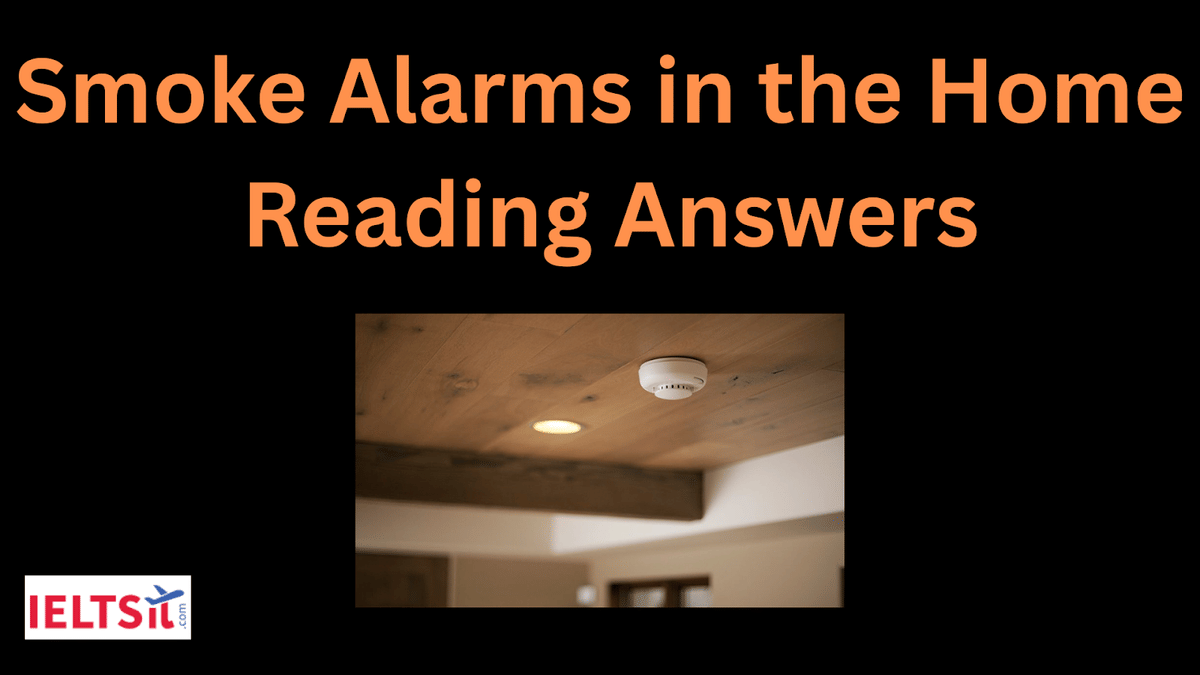
Smoke alarms are now a standard feature in Australian homes and are required by the National Building Code in any recently built properties. They are installed to detect the presence of smoke and emit a clear sound to alert you in the event of fire to give you time to escape.
There are two principal types of smoke alarms. Ionization alarms are the cheapest and most readily available smoke alarms. They are also very sensitive to flaming fires - fires that burn fiercely - and will detect them before the smoke gets too thick. However, photoelectric alarms are more effective at detecting slow-burning fires. They are less likely to go off accidentally and so are best for homes with one floor. For the best protection, you should install one of each.
Most battery-powered smoke alarms can be installed by the home owner and do not require professional installation. For the installation of hard-wired smoke alarms, powered from the mains electricity supply, however, you will need the services of a licensed professional. Smoke alarms are usually most effective when located on the ceiling, near or in the middle of the room or hall.
Photoelectric smoke alarms in any quantity may be disposed of in domestic waste. If you have fewer than ten ionization alarms to get rid of, you may put them in your domestic waste. If you have more than ten to dispose of, you should contact your local council.
Your battery-powered smoke alarm will produce a short beep every 60 second to alert you when the battery is running out and needs replacing. Nevertheless, it should be tested every month to ensure that the battery and the alarm sounder are working. Note that the sensitivity in all smoke alarms will reduce over time.
Questions 1-7
Do the following statements agree with the information given in the Reading Passage?
In boxes 1-7 on your answer sheet, write
TRUE if the statement agrees with the information
FALSE if the statement contradicts the information
NOT GIVEN if there is no information on this
1. All new houses in Australia must have smoke alarms.
Answer: TRUE
Supporting statement: “Smoke alarms are now a standard feature in Australian homes and are required by the National Building Code in any recently built properties.”
Keywords: required, recently built properties
Keyword Location: Paragraph 1, lines 1–2
Explanation: The passage clearly states that newly built Australian homes must have smoke alarms, so the statement is correct.
2. Photoelectric smoke alarms cost less than ionization smoke alarms.
Answer: FALSE
Supporting statement: “Ionization alarms are the cheapest and most readily available smoke alarms.”
Keywords: ionization alarms, cheapest
Keyword Location: Paragraph 2, line 1
Explanation: Ionization alarms are described as the cheapest, not photoelectric alarms, so the statement contradicts the passage.
3. It takes a short time to fit most smoke alarms.
Answer: TRUE
Supporting statement: “Most battery-powered smoke alarms can be installed by the home owner and do not require professional installation.”
Keywords: installed by the home owner
Keyword Location: Paragraph 3, lines 1–2
Explanation: If homeowners can install them themselves, fitting them clearly takes a short amount of time compared to professional installation.
4. Any hard-wired smoke alarm must be fitted by a specialist technician.
Answer: TRUE
Supporting statement: “For the installation of hard-wired smoke alarms… you will need the services of a licensed professional.”
Keywords: licensed professional
Keyword Location: Paragraph 3, lines 2–3
Explanation: The passage states directly that hard-wired alarms must be installed by a professional.
5. You should get in touch with your local council before placing any ionisation smoke alarms in household rubbish.
Answer: FALSE
Supporting statement: “If you have fewer than ten ionization alarms to get rid of, you may put them in your domestic waste.”
Keywords: fewer than ten, domestic waste
Keyword Location: Paragraph 4, lines 2–3
Explanation: You only need to contact the council if you have more than ten, not for any amount. So the statement is incorrect.
6. Smoke alarms give a warning sound to indicate that battery power is low.
Answer: TRUE
Supporting statement: “Your battery-powered smoke alarm will produce a short beep every 60 seconds to alert you when the battery is running out…”
Keywords: short beep, alert, battery running out
Keyword Location: Paragraph 5, lines 1–2
Explanation: The passage clearly confirms that smoke alarms make a sound when battery power is low.
7. Old smoke alarms need to be checked more than once a month.
Answer: NOT GIVEN
Supporting statement: No information in the passage mentions checking old smoke alarms more than once a month.
Keywords: check more than once a month
Keyword Location: —
Explanation: The passage states all smoke alarms should be tested monthly, but it does not say old alarms need more frequent checks.
Check IELTS reading samples:
- Tap project reading answers
- A Red Nose Bird: Tocu Toucan Reading Answers
- Need for Paternity Leave Reading Answers
- Companies and the State Reading Answers
- A Day in the Life of a Care Worker Reading Answers
- McDonalds and KFC Reading Answers
- A Day in the Life of a Care Worker Reading Answers
- Homestays Feel like Home Reading Answers
- Piano Reading Answers
- Sell Your Used Furniture Online Reading Answers
- Writing an Inquiry Letter Reading Answers
- All Clear Signal Reading Answers
- Local Campsites Reading Answers
- The Forgotten role of Women in Medieval Arts Reading Answers
- NTropy Reading Answers
- Palvins Restaurant Reading Answers
- Film Reviews Reading Answers
- What to do if You are Made Redundant Reading Answers
- Science Museum Special Exhibition Science of Sport Reading Answers
- Recycling So Simple Its Easy Reading Answers
- How to Apply for a Course at College Reading Answers
- How to become a Great Leader Reading Answers
- Adorable Knitwear Online Customer Reviews Reading Answers
- Golbridge Tramlink Reading Answers
- The Importance of Outdoor Activities for Kids Reading Answers
- Smartphones Blessings or Curse Reading Answers
- A better way to Travel Reading Answers
- Percil Training Institute Reading Answers
- Divided Opinions about letting Farmland return to its Natural state Reading Answers
- Customer Reviews of Cafes in the Town of Artingly Reading Answers
- Frog Valley Development Reading Answers
- LGN Energy Code of Conduct Reading Answers
- Penguins Reading Answers
- Grammatical Rules Reading Answers
- Ada Lovelace Reading Answers
- Is Science Dangerous Reading Answers
- General Information for Students Reading Answers
- Bacteria Winning the War Reading Answers
- Diamonds of the Kitchen Reading Answers
- Its Dangerous at the Top Reading Answers
- Negotiating a Higher Salary Reading Answers
- Tower Bridge Reading Answers
- Saturday March 5th Reading Answers
- England Summer Holiday Coach tours Reading Answers
- Is Global Warming harmful to Health IELTS Reading Answers
- An Ordinary Miracle Reading Answers
- Lemur Species Reading Answers
- The Persuaders Reading Answers
- Callisthenics Reading Answers
- Genetically Modified Crops Accepting the Inevitable Reading Answers
Comments