A Penny that Saved a Life Reading Answers
The answers for "A Penny that Saved a Life" include 7 questions and are part of the assessment framework for the IELTS General Reading test. Candidates are allotted 10 minutes to complete the reading responses concerning "A Penny that Saved a Life." This portion of the IELTS reading exam consists of various question formats, including Do the following statements agree with the information given in the text.
The answers for "A Penny that Saved a Life" offer a comprehensive overview of the passage, explaining that John Trickett survived World War I when a penny in his pocket deflected a bullet that would have killed him, unlike his two brothers, who died in the war. The bent penny and his medals were later auctioned in 2019 and bought by his grandson to keep the remarkable family story alive. For additional practice with similar reading assessments, candidates can refer to the IELTS Reading Practice Test section.
Check: Get 10 Free Sample Papers
Check: Register for IELTS Coaching - Join for Free Trial Class Now
Topic:
A Penny that Saved a Life Reading Answers
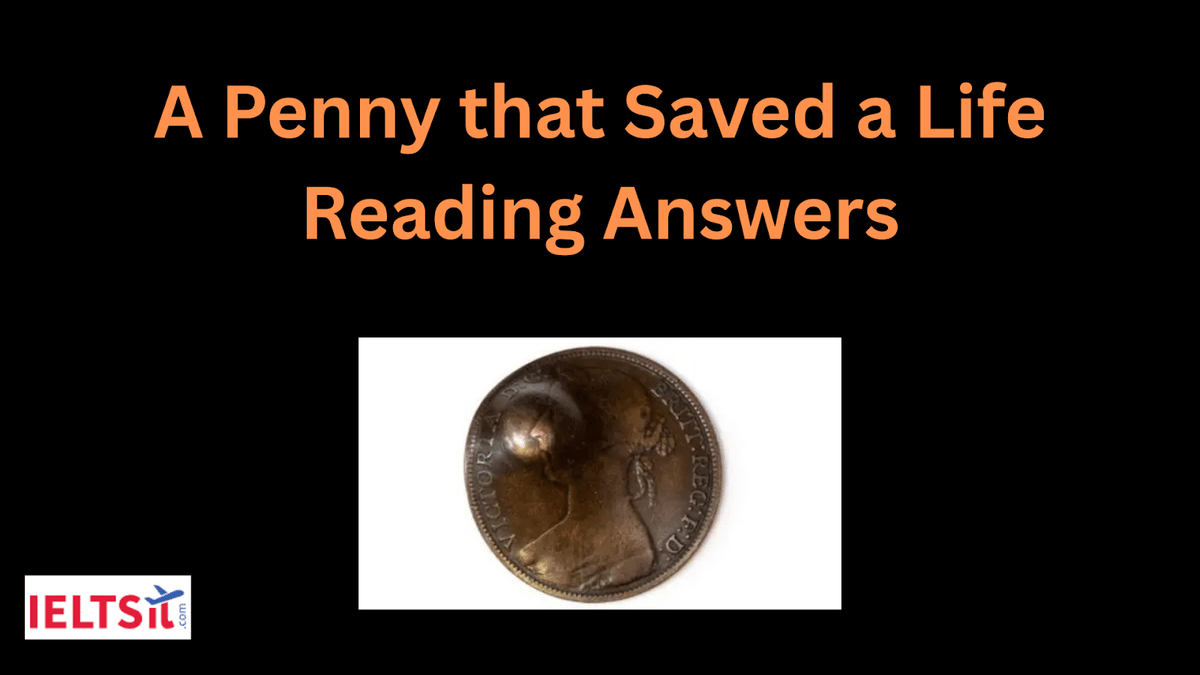
Of the three Trickett brothers who left their home in Lincolnshire to fight for the UnitedKingdom in the First World War, only John would survive. Horace and Billy were among the more than eight million soldiers killed in the Great War, which saw casualties on an unprecedented scale due to the advent of new, more advanced weapons. John, however, was saved by the most ordinary and rudimentary equipment on the entire battlefield: a penny in his breast pocket that deflected a bullet intended for his heart.
The penny, issued in 1889 (10 years before John was born) and severely bent from the bullet's impact, was sold on March 22, 2019, in Hansons Auctioneers' Medals and MilitariaAuction. Initially, the highest bid was £1,700, vastly exceeding Hansons' initial estimate of between £100 and £200. Ultimately, it sold for £4500.
The lot included a British victory medal as well as Trickett's 1918 discharge certificate, among other items.
Six phone bidders as well as internet bidders battled to own the collection but it was sold to a buyer in the room - Mr. Nigel Trickett, 55, of Owston Ferry, near Doncaster. Mr. Trickett, owner of a carpet business, said:
"Private Trickett was my grand-dad and we wanted to keep the medals and penny in the family. It will be handed down. It's where it belongs and we'll take a lot of pride in showing it to family members.
"When the story went viral it brought 50 members of the family together - we all got in touch with each other. My grand-dad's story is very interesting and true. Everything wouldn't have happened in our family the way it has without that penny.
While we don't know precisely when and where Private Trickett had his brush with death, Adrian Stevenson, Hansons' military expert, says that the incident occurred in 1917, on the war's Western Front. The bullet, fired by a German soldier, ricocheted off Trickett's penny and traveled up through Trickett's nose, exiting through his left ear. Trickett lost hearing in that ear for the rest of his life, his granddaughter Maureen Coulson toid Hansons. Trickett received an honorable discharge from the military in September 1918. After coming home, he got married, had eight children, and worked as a postmaster and switchboard operator.
Coulson answered Hanson's advertisement for a routine valuation event, bringing the penny and Trickett's other effects to Stevenson. Ironically, the coin was "one of those real impossible things to value," says Stevenson, who eventually settled on a relatively low estimate for the item due to the "very modest" value of the metal itself. It's not the first time in Stevenson's career that he's heard of an everyday item blocking a bullet and making the difference between life and death. Bibles, shaving mirrors, and cigarette cases, he says, have all done the same and during the war, some manufacturers even began advertising thicker mirrors, explicitly pitching their life-saving potential.
"It's strange to think," said Coulson, "that, but for that penny, (Trickett's] children would not have been born and I wouldn't be here." There could be many more families throughout the world who could say the same about other objects: Since Coulson delivered the coin to Hansons, the auction house has also acquired a shrapnel-damaged flask and belt buckle that may have saved their carriers.
"I was born after my grand-dad died but I remember seeing the penny when I was seven. We plan to visit my grand-dad's grave in Bolton upon Dearne, Yorkshire, on the way home." The medal was sold by Private Trickett's grand-daughter Mrs. Maureen Coulson, 63, from Duffield, Derbyshire, who plans to give some of the proceeds to charity.
Questions 1-7
Do the following statements agree with the information given in the text? In boxes on your answer sheet, write
TRUE If the statement agrees with the information
FALSE If the statement contradicts the information
NOT GIVEN If there is no information on this
1. The penny was a piece of equipment issued to all soldiers.
Answer: FALSE
Supporting statement: “John, however, was saved by the most ordinary and rudimentary equipment on the entire battlefield: a penny in his breast pocket”
Keywords: penny, breast pocket
Keyword Location: Paragraph 1, lines 3–4
Explanation:
The passage explains that the penny was an ordinary personal item carried by John Trickett. It was not issued by the army or supplied as official military equipment. The phrase “most ordinary and rudimentary equipment” highlights how unusual it was. Therefore, the statement that the penny was issued to all soldiers is incorrect. Hence, the answer is FALSE.
2. The penny that saved Trickett's life was bought by his grand-son.
Answer: TRUE
Supporting statement: “it was sold to a buyer in the room – Mr. Nigel Trickett… ‘Private Trickett was my grand-dad’”
Keywords: buyer, grand-dad, Nigel Trickett
Keyword Location: Paragraph 4, lines 1–3
Explanation:
The passage clearly states that the buyer of the penny was Mr. Nigel Trickett. He explicitly mentions that Private Trickett was his grandfather. This confirms that the penny was bought by Trickett’s grandson. Since the information directly supports the statement, the correct answer is TRUE.
3. John Trickett served in the British Army till 1918.
Answer: TRUE
Supporting statement: “Trickett received an honorable discharge from the military in September 1918.”
Keywords: discharge, 1918
Keyword Location: Paragraph 6, line 4
Explanation:
The text clearly mentions that John Trickett was discharged from the military in September 1918. This confirms that he served until that year. There is no information contradicting this detail. Therefore, the statement agrees with the information given in the passage. The correct answer is TRUE.
4. The auction house set a low initial price for the penny because it was made of a metal which was not very expensive.
Answer: TRUE
Supporting statement: “he eventually settled on a relatively low estimate… due to the ‘very modest’ value of the metal itself.”
Keywords: low estimate, modest value
Keyword Location: Paragraph 7, lines 2–3
Explanation:
The auction expert explains that the penny was difficult to value and that its estimate was kept low. The reason given was the modest value of the metal used to make the coin. This directly matches the statement in the question. Therefore, the answer is TRUE.
5. But for the penny, there would have been no Mr. Coulson.
Answer: FALSE
Supporting statement: “‘that, but for that penny, [Trickett’s] children would not have been born and I wouldn’t be here.’”
Keywords: Coulson, wouldn’t be here
Keyword Location: Paragraph 8, lines 1–2
Explanation:
The quotation refers specifically to Maureen Coulson, John Trickett’s granddaughter. The statement in the question mentions “Mr. Coulson,” which is incorrect. Since the person referred to in the passage is female and not Mr. Coulson, the statement contradicts the text. Hence, the correct answer is FALSE.
6. Thicker shaving mirrors helped to save lives during the war.
Answer: NOT GIVEN
Supporting statement: “some manufacturers even began advertising thicker mirrors, explicitly pitching their life-saving potential.”
Keywords: thicker mirrors, advertising
Keyword Location: Paragraph 7, lines 4–5
Explanation:
The passage states that thicker mirrors were advertised as having life-saving potential. However, it does not specifically confirm that thicker shaving mirrors actually saved lives. The statement goes beyond the information provided in the text. Therefore, it is impossible to confirm its accuracy. The correct answer is NOT GIVEN.
7. The auction house had acquired a shrapnel damaged flask that helped save the life of its owner.
Answer: TRUE
Supporting statement: “the auction house has also acquired a shrapnel-damaged flask and belt buckle that may have saved their carriers.”
Keywords: shrapnel-damaged flask, acquired
Keyword Location: Paragraph 8, lines 3–4
Explanation:
The passage clearly states that the auction house acquired a shrapnel-damaged flask. It also mentions that this item may have saved the life of its owner. This directly supports the statement in the question. Therefore, the correct answer is TRUE.
Check IELTS reading samples:
- Tap project reading answers
- A Red Nose Bird: Tocu Toucan Reading Answers
- Need for Paternity Leave Reading Answers
- Companies and the State Reading Answers
- A Day in the Life of a Care Worker Reading Answers
- McDonalds and KFC Reading Answers
- A Day in the Life of a Care Worker Reading Answers
- Homestays Feel like Home Reading Answers
- Piano Reading Answers
- Sell Your Used Furniture Online Reading Answers
- Writing an Inquiry Letter Reading Answers
- All Clear Signal Reading Answers
- Local Campsites Reading Answers
- The Forgotten role of Women in Medieval Arts Reading Answers
- NTropy Reading Answers
- Palvins Restaurant Reading Answers
- Film Reviews Reading Answers
- What to do if You are Made Redundant Reading Answers
- Science Museum Special Exhibition Science of Sport Reading Answers
- Recycling So Simple Its Easy Reading Answers
- How to Apply for a Course at College Reading Answers
- How to become a Great Leader Reading Answers
- Adorable Knitwear Online Customer Reviews Reading Answers
- Golbridge Tramlink Reading Answers
- The Importance of Outdoor Activities for Kids Reading Answers
- Smartphones Blessings or Curse Reading Answers
- A better way to Travel Reading Answers
- Percil Training Institute Reading Answers
- Divided Opinions about letting Farmland return to its Natural state Reading Answers
- Customer Reviews of Cafes in the Town of Artingly Reading Answers
- Frog Valley Development Reading Answers
- LGN Energy Code of Conduct Reading Answers
- Penguins Reading Answers
- Grammatical Rules Reading Answers
- Ada Lovelace Reading Answers
- Is Science Dangerous Reading Answers
- General Information for Students Reading Answers
- Bacteria Winning the War Reading Answers
- Diamonds of the Kitchen Reading Answers
- Its Dangerous at the Top Reading Answers
- Negotiating a Higher Salary Reading Answers
- Tower Bridge Reading Answers
- Saturday March 5th Reading Answers
- England Summer Holiday Coach tours Reading Answers
- Is Global Warming harmful to Health IELTS Reading Answers
- An Ordinary Miracle Reading Answers
- Lemur Species Reading Answers
- The Persuaders Reading Answers
- Callisthenics Reading Answers
- Genetically Modified Crops Accepting the Inevitable Reading Answers
Comments