The Re-Emergence of Mary Seacole Reading Answers
The Re-Emergence of Mary Seacole Reading Answers is an academic reading answers topic. The Re-Emergence of Mary Seacole Reading Answers has a total of 13 IELTS questions. In the first question set, you have to choose which paragraph contains the given information. In the next question set, you have to choose the correct letter. In the last question, set you have to choose NO MORE THAN TWO WORDS for each.
The IELTS Reading section is an essential part of the test that evaluates a candidate's comprehension and analysis of various passage types. You will work through several IELTS reading practice problems in this section that resemble actual test situations. These questions are designed to help you improve your ability to recognise essential concepts, extract particular facts, and make inferences. Practising these IELTS reading problems can help you get comfortable with the structure and increase your confidence for the exam, regardless of whether you are studying for the Academic or General Training module.
Check: Get 10 Free Sample Papers
Check: Register for IELTS Coaching - Join for Free Trial Class Now
Section 1
THE RE-EMERGENCE OF MARY SEACOLE
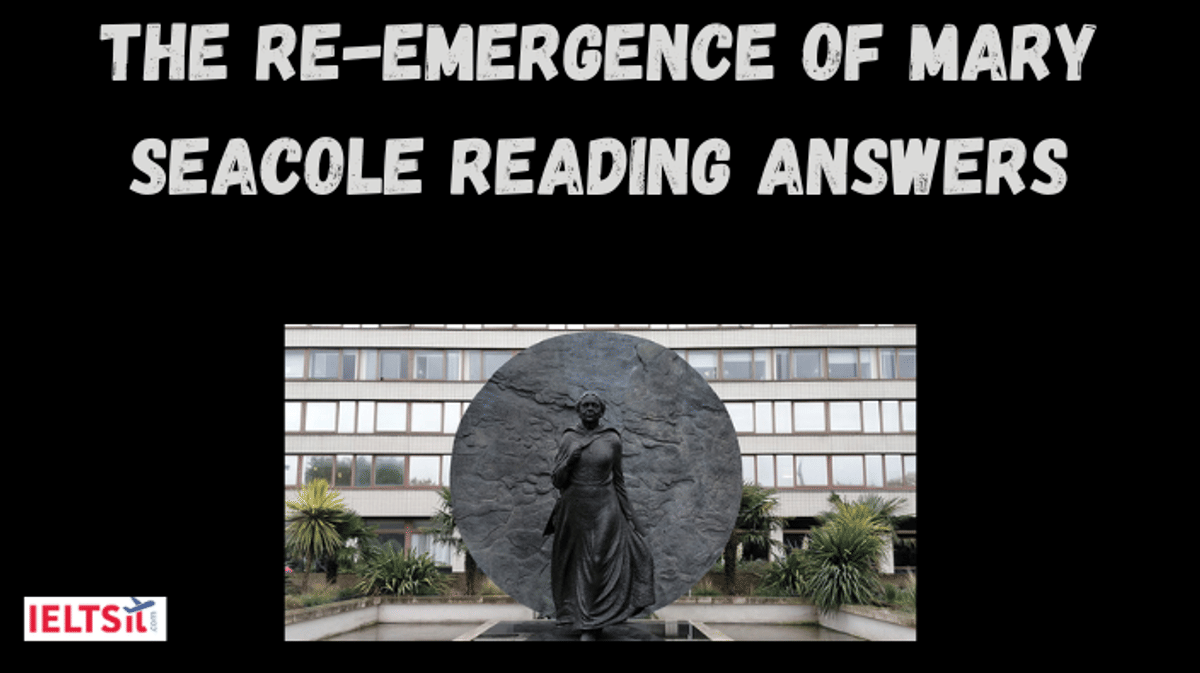
A.You could be forgiven for not knowing the name of Mary Seacole, but due to direct comparisons with her well-known and highly respected counterpart, Florence Nightingale, her story and influence are now taking its place in the narrative of British history. Seacole was a Jamaican-born British nurse who, with no formal qualifications, gave healing and sustenance to wounded soldiers near the battlefields of the Crimean War. Her story was largely forgotten for a century, but recently she was voted the most influential black Briton and is now commemorated with a statue which stands outside St Thomas' Hospital in London.
B.Mary Seacole was born Mary Jane Grant to a Scottish army officer and a Jamaican mother in 1805 in Jamaica. She was brought up with two siblings while her mother ran a boarding house for locals, and often military officers. on the island. As her mother ran a respectable business and her father was an officer, it is likely that Mary would have had a relatively high social status in Jamaican society. It was in the boarding house that Mary learned healing Skills from her mother and where she started to understand how traditional Caribbean medicine worked. After helping her mother to run the boarding house, the fifteen-year-old Mary travelled to England with relatives, where she would learn more about European medical practices, which would complement her existing knowledge.
C.In 1823, Mary returned to England, bearing West Indian pickles and preserves to sell. It was unusual for a young woman to travel unaccompanied in these times, even more so with business propositions. She remained in England for around two years, then returned to the Caribbean, where she would embark on travels to Cuba, the Bahamas, and Haiti. She married Edwin Seacole in 1836 in Jamaica and, soon after, the couple set up a store selling provisions. Unfortunately, the shop was unsuccessful and soon closed down. To add to this bad luck, a fire destroyed some of her mother's boarding house in 1843, and the following year, both Mary's mother and husband died.
D.Determined to carry on, Mary had the boarding house rebuilt and continued to run it, increasingly looking after military patients. In 1850, Jamaica suffered a terrible cholera outbreak in which approximately 32,000 Jamaicans succumbed to the disease. Mary contracted the
disease but managed to cure herself of it. Her cure involved the use of mustard, both as an Ingredient In plasters and taken orally to induce vomiting. In addition to this, she used a mineral called calomel, as well as warm cloths, to help beat the disease. She continued using her
cholera cures during a visit to see her half-brother in Panama in 1851, which experienced an outbreak soon after she arrived.
E.After Mary had set up a restaurant in Panama and assisted Jamaican authorities with other epidemics, she travelled to England once again in 1853 because she had heard about the Crimean War and wanted to offer her nursing services. So once she was in London, she applied to the War Office. Thousands of soldiers were suffering from cholera, and with her personal experience of having suffered from the disease. Mary believed she could be of use. The War Office refused her application, but, undaunted, Mary travelled to the Crimea region independently. There, with the help of a relative of her late husband's, she set up the British Hotel, which offered food, drink, beds, and nursing care to wounded soldiers. Mary sourced the location of the hotel and asked locals to help find any discarded building materials they could reuse. The hotel was finished at a cost of only Z800. Due to her kindly nature and caring attitude, she was often referred to as Mother Seacole while she tended to the wounded.
F.Mary Seacole remained in the Crimea until the end of the war in 1856. When she returned to England, she was in poor health and possessed very little money. Soldiers who had received Mary's care and attention first-hand wrote to British newspapers praising her efforts during the war, and a fund was set up to help Mary survive and continue her work. Although some money was raised, it was not enough to send Mary to India, where she wished to continue her healing. At some point, Mary returned to Jamaica for a while, where she became a prominent member of Jamaican society. However, she ran short of money again, and the fund was restarted. As a result of the funds, she bought some land in London and returned to England. She eventually passed away there in 1881, leaving a small amount of money as a legacy.
G.Mary Seacole was nearly erased from the history books, but when her grave was rediscovered in 1973, a society was set up to ensure her memory is never forgotten. The publication of her autobiography in 1983, The Wonderful Adventures of Mrs Seacole in Many Lands, also helped bring her to the attention of a wider audience. Although criticism still resonates over the fact that she had no formal training, her endeavours in healing and providing for soldiers deserve recognition. More recently, her Story has been added to the UK national curriculum, and numerous buildings now bear her name, alongside a statue which was erected in 2016.
Questions 27-32
Reading Passage 3 has seven paragraphs, A-G. Which paragraph contains the following information? Write the correct letter, A-G.
NB You may use any letter more than once.
27. an example of witness accounts of Mary's nursing style
Answer: F
Supporting statement: Soldiers who had received Mary's care and attention first-hand wrote to British newspapers praising her efforts during the war, and a fund was set up to help Mary survive and continue her work.
Keywords: Soldiers, first-hand, praising her efforts
Keyword Location: Para F, Lines 2-3
Explanation: Paragraph F mentions that soldiers who were direct recipients of her care ("witness accounts") publicly praised her work in newspapers.
28. a reference to traveling with family members
Answer: B
Supporting statement: After helping her mother to run the boarding house, the fifteen-year-old Mary travelled to England with relatives, where she would learn more about European medical practices
Keywords: travelled to England with relatives
Keyword Location: Para B, Lines 7-8
Explanation: Paragraph B describes Mary's first trip to England as an adolescent, specifically stating she traveled "with relatives."
29. a refusal from a higher authority
Answer: E
Supporting statement: The War Office refused her application, but, undaunted, Mary travelled to the Crimea region independently.
Keywords: War Office, refused her application
Keyword Location: Para E, Lines 5-6
Explanation: Paragraph E details Mary's application to the War Office (a higher authority), which refused her request to serve as a nurse.
30. a reference to Mary's place in British education
Answer: G
Supporting statement: More recently, her Story has been added to the UK national curriculum, and numerous buildings now bear her name
Keywords: UK national curriculum
Keyword Location: Para G, Lines 6-7
Explanation: Paragraph G mentions that her story is now part of the UK national curriculum, demonstrating her inclusion in British education.
31. an explanation of a nickname given to Mary
Answer: E
Supporting statement: Due to her kindly nature and caring attitude, she was often referred to as Mother Seacole while she tended to the wounded.
Keywords: Mother Seacole, kindly nature and caring attitude
Keyword Location: Para E, Lines 10-11
Explanation: Paragraph E gives the affectionate nickname (Mother Seacole) and explains that it was given due to her "kindly nature and caring attitude."
32. details of a failed business venture
Answer: C
Supporting statement: She married Edwin Seacole in 1836 in Jamaica and, soon after, the couple set up a store selling provisions. Unfortunately, the shop was unsuccessful and soon closed down.
Keywords: set up a store, unsuccessful and soon closed down
Keyword Location: Para C, Lines 5-6
Explanation: Paragraph C describes the store she opened with her husband, and explicitly states that the shop was "unsuccessful and soon closed down."
Questions 33-38
Choose the correct letter.
33. Florence Nightingale and Mary Seacole
A. worked together in a hospital.
B. are often compared to each other.
C. were born in the same place.
D. have largely been ignored by history.
Answer: B
Supporting statement: You could be forgiven for not knowing the name of Mary Seacole, but due to direct comparisons with her well-known and highly respected counterpart, Florence Nightingale, her story and influence are now taking its place
Keywords: direct comparisons, highly respected counterpart, Florence Nightingale
Keyword Location: Para A, Lines 1-3
Explanation: The passage explicitly states that Mary Seacole's story is being brought to attention due to "direct comparisons" with Florence Nightingale.
34. Why was Mary likely to have been respected as a child?
A. Because she knew how to heal people.
B. Because she had a Scottish father
C. Because she understood European medicine.
D. Because of her parents' positions.
Answer: D
Supporting statement: As her mother ran a respectable business and her father was an officer, it is likely that Mary would have had a relatively high social status in Jamaican society.
Keywords: respectable business, father was an officer
Keyword Location: Para B, Lines 3-4
Explanation: The text attributes her likely "high social status" (respect) directly to her mother's respected business and her father's position as an officer.
35. Mary set up a shop in Jamaica
A. before she got married.
B. after her mother died.
C. When the boarding house burned down.
D. with her husband.
Answer: D
Supporting statement: She married Edwin Seacole in 1836 in Jamaica and, soon after, the couple set up a store selling provisions.
Keywords: couple set up a store
Keyword Location: Para C, Line 5
Explanation: The passage states that she and her husband ("the couple") set up the store together after they were married.
36. Mary was able to effectively treat soldiers suffering from cholera
A. because of her work during the Jamaican outbreak.
B. thanks to her understanding of European medicine.
C. as a result of having had the disease herself.
D. due to new medicines becoming available.
Answer: C
Supporting statement: Thousands of soldiers were suffering from cholera, and with her personal experience of having suffered from the disease. Mary believed she could be of use.
Keywords: personal experience, suffered from the disease
Keyword Location: Para E, Lines 4-5
Explanation: Mary felt she could be useful in the Crimea because she had personal experience, having contracted and cured herself of cholera during the Jamaican outbreak (Para D).
37. Before she went to England in 1853, Mary
A. applied to serve as a nurse in the war.
A. received formal nursing training
A. helped officials treat other Illnesses.
A. opened a hotel in Panama.
Answer: C
Supporting statement: After Mary had set up a restaurant in Panama and assisted Jamaican authorities with other epidemics, she travelled to England once again in 1853 because she had heard about the Crimean War
Keywords: assisted Jamaican authorities, other epidemics
Keyword Location: Para E, Lines 1-2
Explanation: The sequence of events shows that before her 1853 trip to England for the Crimean War, she had already "assisted Jamaican authorities with other epidemics."
38. The British Hotel in the Crimea region
A. provided beds for local people.
B. was built from brand-new materials.
C. was built by Mary alone.
D. offered a variety of services.
Answer: D
Supporting statement: There, with the help of a relative of her late husband's, she set up the British Hotel, which offered food, drink, beds, and nursing care to wounded soldiers.
Keywords: offered food, drink, beds, and nursing care
Keyword Location: Para E, Line 8
Explanation: The hotel provided a list of diverse services, including food, drink, lodging, and medical treatment ("nursing care").
Questions 39 and 40
Choose NO MORE THAN TWO WORDS for each.
39. Where did Mary want to go after the Crimea?
Answer: INDIA
Supporting statement: Although some money was raised, it was not enough to send Mary to India, where she wished to continue her healing.
Keywords: Mary to India, wished to continue her healing
Keyword Location: Para F, Line 5
Explanation: The passage explicitly states that she wished to continue her work in India, but the funds were insufficient to send her there.
40. What do critics believe Mary Seacole lacked?
Answer: FORMAL TRAINING
Supporting statement: Although criticism still resonates over the fact that she had no formal training, her endeavours in healing and providing for soldiers deserve recognition.
Keywords: criticism, no formal training
Keyword Location: Para G, Lines 4-5
Explanation: The text directly addresses the criticism against her, which is the lack of "formal training."
Read More IELTS Reading Related Samples
- National Parks Reading Answers
- Use of Websites for Projects Reading Answers
- Discoveries on the basis of Deductive Reasoning Reading Answers
- Successions and Ecosystems Reading Answers
- How to prepare for a Presentation Reading Answers
- Professional Credentials Reading Answers
- An Early Cultural Tourist The Journey of Cyriacus of Ancona
- Train Travel Information Reading Answers
- The Importance of Business Cards Reading Answers
- The Young Persons Railcard Reading Answers
- Keele University Services for Students Reading Answers
- Introduction to the Grounds of Keele University Reading Answers
- A Young Italian Tradition Reading Answers
- Tuning up Your Leadership Skills Reading Answers
- Water Stress and Scarcity Reading Answers
- What are they Doing Up there Reading Answers
- Hard Languages Reading Answers
- What are they Doing Up there Reading Answers
- Registering as an Apprentice Reading Answers
- North Sydney Council Reading Answers
- A Brief History of Automata Reading Answers
- Working Time Regulation for Mobile Workers Reading Answers
- Marketing Advice for New Businesses Reading Answers
- Migrants and Refugees Racial Discrimination and Xenophobia Reading Answers
- Special Olympics Condition of Participation Reading Answers
- Social Smiling Reading Answer
- The History of Steel Reading Answer
- Why are we Ticklish Reading Answers
- Holiday Homes Online Ltd Technical Support Officer Reading Answers
- The Origin of Paper Reading Answers
- The Voynich Manuscript Reading Answers
- Creative Problem Solving Reading Answers
- Sorry Who Are You Reading Answers
- Miles Davis Icon and Iconoclast Reading Answers
- Global Response to Covid 19 Reading Answers
- Contact Lenses Reading Answers
- A buzz in the world of chemistry Reading Answers
- The Pick of This Summers Outdoor Music Festivals Reading Answers
- Newspapers Reading Answers
- Polo Reading Answers
- The Reindeer Reading Answers
- Drive on Low Beam in Fog Reading Answers
- Are You Being Bullied Reading Answers
- Theatre Reading Answers
- Can you Do Them at the Same Time Reading Answers
- Numeracy in Animals Reading Answers
- Non Pesticide Management of Crop in India Reading Answers
- Swordfish Reading Answers
- Mojito Reading Answers
- Calculating the Risk Reading Answers
Comments