Gritting Britain's Roads Reading Answers
Gritting Britain's Roads Reading Answers is an academic reading answers topic. Gritting Britain's Roads Reading Answers has a total of 14 IELTS questions, such as Write NO MORE THAN TWO WORDS for each. Choose NO MORE THAN THREE WORDS.
The IELTS Reading section is an essential part of the test that evaluates a candidate's comprehension and analysis of various passage types. You will work through a number of IELTS reading practice problems in this section that resemble actual test situations. These questions are designed to help you improve your ability to recognise essential concepts, extract particular facts, and make inferences. Practising these IELTS reading problems can help you get comfortable with the structure and increase your confidence for the exam, regardless of whether you are studying for the Academic or General Training module.
Check: Get 10 Free Sample Papers
Check: Register for IELTS Coaching - Join for Free Trial Class Now
Section 1
GRITTING BRITAIN'S ROADS
In winter, plunging temperatures combined with a notoriously high chance of rain cause chaos on Britain's roads. When rainwater freezes on the road surface, it forms a layer of ice that is extremely treacherous to drive over. The Highway Code warns drivers that in rainy weather, stopping distances are ice the length they would be on dry roads. On ice, this stopping distance becomes ten times greater. Similarly, in heavy snow, most road vehicles struggle to grip adequately, making steering and braking less controlled, causing skidding and leading to many road accidents. In 2003, the 1980 Highways Act was amended to place a legal obligation on local councils to keep their roads clear.
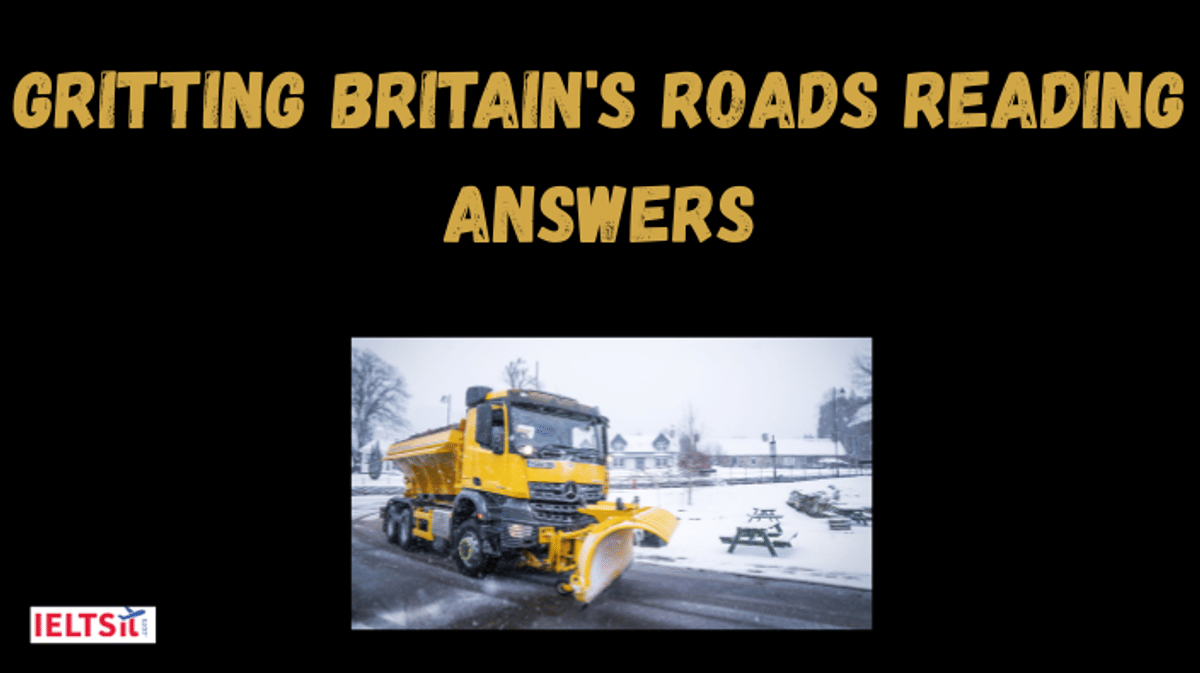
The primary way that Ice Is prevented from forming on Britain's roads is through the use of what is commonly known as 'salt' or 'grit'. This brownish substance is dispersed along roads and motorways in cold weather by vehicles known as 'salt spreaders' or ‘gritters', which are large trucks and Lorries equipped with grit dispersing apparatus. Prior to the 1970s, these trucks would have dumped the grit into a pile in the middle of the road, which would then have been spread evenly across the tarmac by men. Now, however, grit trucks distribute the grit evenly on the road through the use of an impeller
which is attached to a hydraulic drive.
As its names suggest, the ‘grit' or ‘salt' used on roads is made up of a mixture of crushed grit and rock salt. It is the rock salt that is the main active ingredient, the grit being there simply to aid traction and tyre grip on the asphalt. The rock salt works by dissolving into the road surface water, lowering the freezing point and preventing ice from forming. Rock salt can effectively prevent ice from forming at temperatures as low as -50 °C, but its effectiveness drops off when temperatures decrease further. Any lower than -106 °C, and the rock salt has no effect at all. Not only that, the rock salt needs to be crushed by vehicle tyres into smaller particles to allow it to dissolve into the moisture on the road. It is this saline slush that prevents freezing, and
stops snow from settling onto the roads.
The UK has two major rock salt mines, one in Cleveland, Country Antrim, and the Other in Winsford, Cheshire; although in times of need, rock salt is also imported from the continent. Upwards of 30,000 tonnes of rock salt can be mined from the UK salt mines per week. In total, over 2 million tonnes of salt is used on Britain's roads every year, at a Cost of some £150 million. Local councils now stockpile rock salt throughout the year in preparation for the freezing temperatures during the coldest months.
Councils install weather monitoring stations across their region, and also keep an eye on meteorology reports in order to be aware of current and sudden drops in temperature. The monitoring carried out must be precise and detailed, because the timing of gritting is crucial. The main aim of gritting is to prevent freezing in order to prevent road accidents. The rock salt itself cannot melt snow or ice after it has formed, so it has to be spread before water freezes or snow falls. This means that if a stretch of road is gritted too early, the road will still be dry, and the rock salt will just be blown away by air drafts from passing vehicles. If the road is gritted too late, snow, rain or hail may have already frozen onto the road, creating dangerous driving
conditions, As the rock salt itself would still need to be crushed by tyres to allow it to dissolve, salting roads which are already too dangerous to drive on is significantly less effective at not only dissolving the ice already on the road, but also from preventing more ice from forming. Gritting late in the day can also lead to gritting machines getting caught up in rush hour traffic, delaying the vehicles and preventing them from reaching all the routes they need to spread grit over. Not only this, the rock salt on the roads needs to be topped up throughout the day as it dilutes which decreases its effectiveness.
A London borough can use up to 85 tonnes of rock salt in a single day over the course of four or more gritting runs. The US is experiencing a further issue caused by using grit on roads. In the states in America that typically experience colder weather, large amounts of rock salt are used each year in order to prevent the roads from becoming dangerously icy. Much of this salt is carried into the local environment, where some eventually finds its way into lakes, streams, and rivers. Over the years, the saline (or salt) levels in these waters have increased, and continue
to increase. Over all lakes in the US, the concentration of chloride ranged from 0.18 to 240 milligrams per litre. This is still quite low (seawater, for instance, contains around 35 grams of chloride per litre), but the levels of salt are certainly rising. Biologists are concerned that if bodies of water continue to become saltier. Freshwater fish and amphibians will steadily be replaced by saltwater animals, which could cause havoc to ecosystems. In the UK, there is less knowledge concerning the effects of grit on our local wildlife. So far, no populations seem to have been directly affected by the increase in salt caused by gritting. Still, gritting remains an imperfect precaution against ice roads, though at the moment, it remains the best solution to an impractical issue.
Questions 1-4
Write NO MORE THAN TWO WORDS for each.
Please familiarise yourself with the following road safety precautions for icy weather:
- Ensure windows and mirrors are adequately defrosted to allow complete visibility before driving.
- Be aware that while driving on ice, normal stopping distances become 1…………. greater.
Answer: TEN TIMES
Supporting statement: On ice, this stopping distance becomes ten times greater.
Keywords: stopping distance, ten times
Keyword Location: Para 1, Lines 4-5
Explanation: The text specifies that the stopping distance on ice is ten times the normal length.
- In heavy snow, reduced ability to grip creates a lack of control on roads. which can lead
to 2……………… and an increased risk of collision.
Answer: SKIDDING
Supporting statement: making steering and braking less controlled, causing skidding and leading to many road accidents.
Keywords: steering and braking, skidding
Keyword Location: Para 1, Line 6
Explanation: The passage directly links poor grip, lack of control, and accidents to "skidding."
- Make sure your roads are safe, local councils have a 3…………..to ensure their roads are free
of ice and snow.
Answer: LEGAL OBLIGATION
Supporting statement: In 2003, the 1980 Highways Act was amended to place a legal obligation on local councils to keep their roads clear.
Keywords: 2003, legal obligation
Keyword Location: Para 1, Line 7
Explanation: The text states that the amendment placed a "legal obligation" on councils to clear roads.
- Salt spreaders will prevent ice from forming by 4…………. grit on the roads.
Answer: DISPERSING
Supporting statement: This brownish substance is dispersed along roads and motorways in cold weather by vehicles known as 'salt spreaders' or ‘gritters
Keywords: brownish substance, dispersed
Keyword Location: Para 2, Line 2
Explanation: The method used by salt spreaders is described as "dispersed" along roads.
Questions 5-14
Choose NO MORE THAN THREE WORDS.
5. Crushed grit is used in road salt in order to…………..to prevent tyres from skidding.
Answer: AID TRACTION
Supporting statement: It is the rock salt that is the main active ingredient, the grit being there simply to aid traction and tyre grip on the asphalt.
Keywords: rock salt, active ingredient, asphalt
Keyword Location: Para 3, Lines 2-3
Explanation: The text explains that the grit is included solely to "aid traction and tyre grip."
6. Rock salt is totally ineffective at combating ice at temperatures below…………..
Answer: -10 °C
Supporting statement: Any lower than -10 °C, and the rock salt has no effect at all.
Keywords: lower than -10 °C, no effect at all
Keyword Location: Para 3, Line 6
Explanation: The passage explicitly states that once the temperature drops below 10 °C, the rock salt cannot prevent ice from forming.
7. Rock salt needs to ................... in order to be effective. This generally happens when it is driven over by vehicle tyres:
Answer: DISSOLVE
Supporting statement: The rock salt works by dissolving into the road surface water... Not only that, the rock salt needs to be crushed by vehicle tyres into smaller particles to allow it to dissolve into the moisture on the road.
Keywords: dissolving, dissolve into the moisture
Keyword Location: Para 3, Lines 3 & 8
Explanation: The core mechanism is the salt dissolving into the surface moisture.
8. When rock salt supplies in the UK are low,…………can provide further supplies.
Answer: (THE) CONTINENT
Supporting statement: although in times of need, rock salt is also imported from the continent.
Keywords: imported from the continent
Keyword Location: Para 4, Line 2
Explanation: The text states that rock salt is imported from "the continent" when UK supplies are insufficient.
9. More than ………… of rock salt is used each year, costing local councils hundreds of millions.
Answer: 2 MILLION TONNES
Supporting statement: In total, over 2 million tonnes of salt is used on Britain's roads every year, at a cost of some £150 million.
Keywords: over 2 million tonnes
Keyword Location: Para 4, Line 4
Explanation: The precise figure given for the amount used annually is over 2 million tonnes.
10. ……………… can warn councils of impending drops in temperature, alongside the use of weather monitoring stations.
Answer: METEOROLOGY REPORTS
Supporting statement: Councils install weather monitoring stations... and also keep an eye on meteorology reports in order to be aware of current and sudden drops in temperature.
Keywords: meteorology reports, sudden drops
Keyword Location: Para 5, Line 2
Explanation: Meteorology reports are listed as the secondary method, alongside monitoring stations, for forecasting temperature drops.
11. If a road is gritted too early, rock salt can be propelled off the road by ................ from cars.
Answer: AIR DRAFTS
Supporting statement: If a stretch of road is gritted too early... the rock salt will just be blown away by air drafts from passing vehicles
Keywords: air drafts, passing vehicles
Keyword Location: Para 5, Lines 6-7
Explanation: Air drafts created by passing vehicles are cited as the cause of rock salt being blown away if applied too early.
12. If a road is gritted after ice has already frozen onto the road, its defrosting abilities
are much .…….
Answer: LESS EFFECTIVE
Supporting statement: salting roads which are already too dangerous to drive on is significantly less effective at not only dissolving the ice already on the road, but also from preventing more ice from forming.
Keywords: dangerous, significantly less effective
Keyword Location: Para 5, Lines 10-11
Explanation: The text states that late gritting is "significantly less effective" because the salt needs to be crushed to work.
13. The amount of…………… in America's lakes is rising, though at the moment it does
not pose a serious risk to the environment.
Answer: CHLORIDE
Supporting statement: Over all lakes in the US, the concentration of chloride ranged from 0.18 to 240 milligrams per litre.
Keywords: concentration of chloride
Keyword Location: Para 6, Line 7
Explanation: The element whose concentration is stated to be rising in US waters is chloride.
14. Though gritting roads is the most common solution to icy roads, in the UK, it can be described as an…………..
Answer: IMPERFECT PRECAUTION
Supporting statement: Still, gritting remains an imperfect precaution against ice roads, though at the moment, it remains the best solution to an impractical issue.
Keywords: imperfect precaution, impractical issue
Keyword Location: Para 6, Line 14
Explanation: The final paragraph summarizes the practice as an "imperfect precaution."
Read More IELTS Reading Related Samples
- National Parks Reading Answers
- Use of Websites for Projects Reading Answers
- Discoveries on the basis of Deductive Reasoning Reading Answers
- Successions and Ecosystems Reading Answers
- How to prepare for a Presentation Reading Answers
- Professional Credentials Reading Answers
- An Early Cultural Tourist The Journey of Cyriacus of Ancona
- Train Travel Information Reading Answers
- The Importance of Business Cards Reading Answers
- The Young Persons Railcard Reading Answers
- Keele University Services for Students Reading Answers
- Introduction to the Grounds of Keele University Reading Answers
- A Young Italian Tradition Reading Answers
- Tuning up Your Leadership Skills Reading Answers
- Water Stress and Scarcity Reading Answers
- What are they Doing Up there Reading Answers
- Hard Languages Reading Answers
- What are they Doing Up there Reading Answers
- Registering as an Apprentice Reading Answers
- North Sydney Council Reading Answers
- A Brief History of Automata Reading Answers
- Working Time Regulation for Mobile Workers Reading Answers
- Marketing Advice for New Businesses Reading Answers
- Migrants and Refugees Racial Discrimination and Xenophobia Reading Answers
- Special Olympics Condition of Participation Reading Answers
- Social Smiling Reading Answer
- The History of Steel Reading Answer
- Why are we Ticklish Reading Answers
- Holiday Homes Online Ltd Technical Support Officer Reading Answers
- The Origin of Paper Reading Answers
- The Voynich Manuscript Reading Answers
- Creative Problem Solving Reading Answers
- Sorry Who Are You Reading Answers
- Miles Davis Icon and Iconoclast Reading Answers
- Global Response to Covid 19 Reading Answers
- Contact Lenses Reading Answers
- A buzz in the world of chemistry Reading Answers
- The Pick of This Summers Outdoor Music Festivals Reading Answers
- Newspapers Reading Answers
- Polo Reading Answers
- The Reindeer Reading Answers
- Drive on Low Beam in Fog Reading Answers
- Are You Being Bullied Reading Answers
- Theatre Reading Answers
- Can you Do Them at the Same Time Reading Answers
- Numeracy in Animals Reading Answers
- Non Pesticide Management of Crop in India Reading Answers
- Swordfish Reading Answers
- Mojito Reading Answers
- Calculating the Risk Reading Answers
Comments