Why Africa continues to go Hungry Reading Answers
Why Africa continues to go Hungry Reading Answers is an academic reading answers topic. Why Africa continues to go Hungry Reading Answers has a total of 13 IELTS questions in total.
- From the list of headings below, choose the most suitable headings for paragraphs B - G. Write the appropriate number (i - xi). NB There are more headings than paragraphs, so you will not use them all.
- In boxes 33 - 40 on your answer sheet, write: True, False, or Not given
The candidate's understanding and assessment of academic and general texts are examined in the IELTS Reading Section. Using IELTS Reading Practice Questions, you can increase your vocabulary, sharpen your critical reading skills, and become more familiar with the various question types in reading tasks. Furthermore, practice enhances vocabulary and improves analytical reading skills, both of which are necessary for success. It's crucial to understand the guidelines for each question type and develop effective strategies to manage time and achieve excellent band scores.
Check: Get 10 Free Sample Papers
Check: Register for IELTS Coaching - Join for Free Trial Class Now
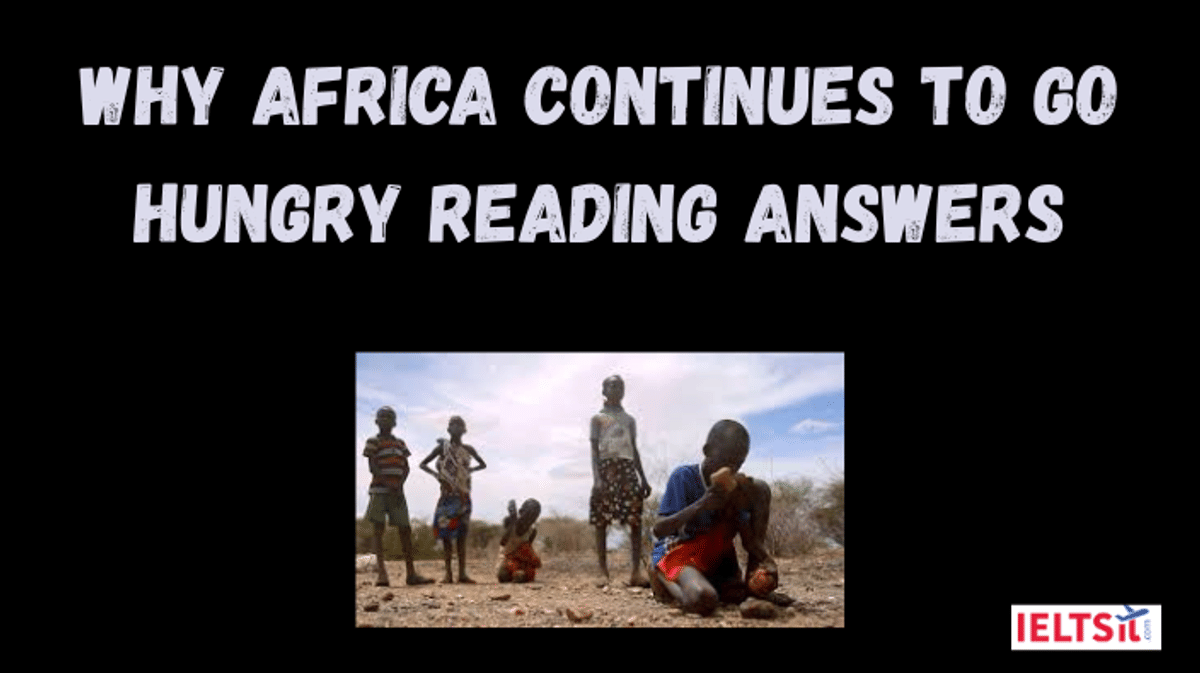
Topic:
WHY AFRICA CONTINUES TO GO HUNGRY
A. Over the last twenty or thirty years, all of us have seen the television famine pictures from Africa. We know people there are starving, and many organisations have responded generously with food aid. A natural disaster or act of God, we tell ourselves, as if the famine has been a freak, one-off event. We assume that when the rains come again, everything will be all right. But it won't.
B. The truth is that millions of Africans, from Mauritania across to Somalia, face starvation. And the underlying reason is not drought. The actual roots of the food shortages lie with the people and the way they have used and abused the land. The recent drought has simply aggravated what is largely a political and economic problem. Even in Kenya, one of the more wealthy African nations, food shortage is a growing problem. In fact, the tragedy that is unfolding in Kenya is typical of what's happening in an estimated twenty other countries on the southern fringes of the Sahara. The popular image of Kenya - lions, avocados, coffee - implies grasslands and good farming. But less than 20% of Kenya's land has high or moderate agricultural potential. Even so, there is enough good farmland to meet the nation's growing food needs. So what has gone wrong?
C. One reason is that cash-cropping is increasing. A large proportion of farmland is devoted to coffee. tea, pyrethrum, pineapples, and to raise other cash crops in order to earn much-needed foreign exchange on the export market. These cash crops are the backbone of Kenya's economy; tea and coffee alone account for more than half the country's export earnings. They provide employment — in Kenya, only about one adult in ten has a regular wage — and pay for Nairobi's impressive development. But here's the first catch in the story. Over the past 15 years, while the cost of tractors, fertilizers, and fuel — all imported commodities — has risen sharply, the real value of coffee and tea has fallen. Kenya's lifeline to stability has been threatened. so. to keep up the income from the exports, the government has encouraged yet more cash-cropping. Tens of thousands of shamba farmers (smallholders) contribute to Kenya's exports by planting coffee. To them, it looks, at first, an attractive proposition. A shamba is usually an acre or two in Size: typically, it grows a mixture of food crops. usually coffee. In a good year, the coffee can earn the farmer a few hundred pounds with which he'll pay for clothing and education for his children. But if the world prices fall, or if there's a bad harvest, these
farmers suffer.
D. During the last decade, according to the World Bank, prices for many commodities fell to their lowest levels since World War Two. They climbed back a little, but by 1989, average prices were still lower than in 1980. So, poor countries like Uganda and Kenya, which export coffee, are faced with more mouths to feed and less money to pump into their economies to help their people. This dependence on the price of a few commodities on the world market is no accident. It dates from imperial times when colonies were used as resource bases by their industrialised rulers. Economic ideas about specialisation and the laws of comparative advantage bolstered a Western View that Africa was best suited to growing crops such as tea, cocoa, and coffee, while North America had wheat and corn production sewn up. The problem with this is that Ghana and the Ivory Coast, for example, struggle against each other for cocoa buyers. If they both boost production, markets become glutted and prices fall. Yet if they cut production, other countries will take up the slack. Only the buyers, the producers, and consumers of chocolate in the rich world end up benefiting.
E. The population explosion in Kenya means that shamba land is bursting at the seams. All the productive land that isn't already growing cash crops has been taken for shambas, which get divided and subdivided among the growing families. When suitable land runs out, the farmers get squeezed out down to the arid bush country or up to the hill slopes. Hill slopes are cleared of forest to make way for crops, but this only accelerates the crisis. Kenya has already lost half its natural woodland since independence in 1963. There's a desperate scramble for cleared
land and for firewood. Almost all Kenyans use wood, or wood charcoal, as a cooking and heating fuel. Everywhere you go, women carry huge bunches of firewood strapped to their backs.
F. This deforestation has grave results. It leads to soil erosion, which was an underlying cause of Ethiopia's famine. Crops of maize are planted on 45-degree slopes without terraces. Within three or four seasons, the topsoil has been washed away by the torrential rains, and the hill is useless for farming. Another consequence is more subtle. Forests hold on to moisture and are essential creators of rainfall through transpiration. Extensive deforestation may have exacerbated the drought in Africa: fewer forests mean less rainfall, and less rainfall means drought and desertification.
G. In a sense, the problem has arisen because of the short-sightedness of many African governments. They want industrial development and the trappings of growth and wealth. But they've overlooked the golden rule: development can only take place on a foundation of agricultural surplus. You must feed your people first.
Questions 27 - 32
From the list of headings below, choose the most suitable headings for paragraphs B - G.
Write the appropriate number (i - xi)
NB There are more headings than paragraphs, so you will not use them all.
i. A False Way to Riches
ii. Kenyans Search for New Farmland
iii. Poverty Leads to War
iv. The First TV Famine
v. The Wrong Choice
vi. Western Aid
vii. Serious Consequences
viii. Birth Control the Answer?
ix. The Effects of the Colonial Exploitation
x. Alternatives to Cash Cropping
xi. Famine not Plenty
27. Paragraph B
Answer: XI
Supporting statement: The truth is that millions of Africans... face starvation... The popular image of Kenya — lions, avocados, coffee — implies grasslands and good farming. But less than 20% of Kenya's land has high or moderate agricultural potential.
Keywords: starvation, food shortage, less than 20%, agricultural potential
Keyword Location: Para B, Lines 2-8
Explanation: The paragraph contrasts the "popular image" of a lush, productive land with the harsh reality of food shortages and limited arable land.
28. Paragraph C
Answer: I
Supporting statement: To them, it looks, at first, an attractive proposition... In a good year, the coffee can earn the farmer a few hundred pounds... But if the world prices fall, or if there's a bad harvest, these farmers suffer.
Keywords: attractive proposition, earn, prices fall, suffer
Keyword Location: Para C, Lines 11-13
Explanation: The "false way" refers to cash-cropping. While it seems like a way to make money (riches), the fluctuating world market and rising costs of imports make it a trap for small farmers.
29. Paragraph D
Answer: IX
Supporting statement: This dependence on the price of a few commodities on the world market is no accident. It dates from imperial times when colonies were used as resource bases by their industrialised rulers.
Keywords: imperial times, colonies, resource bases
Keyword Location: Para D, Lines 5-6
Explanation: This paragraph explains how the current economic focus on exporting specific raw crops is a direct result of the structures set up during the colonial (imperial) era.
30. Paragraph E
Answer: II
Supporting statement: When suitable land runs out, the farmers get squeezed out down to the arid bush country or up to the hill slopes.
Keywords: land runs out, squeezed out, hill slopes
Keyword Location: Para E, Line 4
Explanation: Due to population growth and cash-cropping, the paragraph describes the physical movement of people searching for any available land to farm, even in unsuitable areas.
31. Paragraph F
Answer: VII
Supporting statement: This deforestation has grave results. It leads to soil erosion... Another consequence is more subtle... fewer forests mean less rainfall, and less rainfall means drought
Keywords: grave results, consequence, soil erosion, drought
Keyword Location: Para F, Lines 1-6
Explanation: The paragraph outlines the environmental disasters (the "serious consequences") caused by the search for land described in the previous paragraph.
32. Paragraph G
Answer: V
Supporting statement: In a sense, the problem has arisen because of the short-sightedness of many African governments... they've overlooked the golden rule: development can only take place on a foundation of agricultural surplus.
Keywords: short-sightedness, overlooked, golden rule
Keyword Location: Para G, Line 1
Explanation: This concludes that governments made the "wrong choice" by prioritizing industrial growth over the fundamental need to ensure their people could feed themselves first.
Questions 33 — 40
In boxes 33 - 40 on your answer sheet, write:
TRUE if the statement is true
FALSE if the statement is false
NOT GIVEN if the information is not given
33. Recently, surveys have been conducted to find out the causes of African starvation.
Answer: NOT GIVEN
Explanation: While the text discusses the causes of starvation in detail, it never mentions specific "surveys" being conducted to find this information.
34. The 20% of Kenyan land that is good for farming has the potential to produce enough
food for the country's inhabitants.
Answer: TRUE
Supporting statement: But less than 20% of Kenya's land has high or moderate agricultural potential. Even so, there is enough good farmland to meet the nation's growing food needs.
Keywords: 20%, enough, meet, food needs
Keyword Location: Para B, Lines 8-9
Explanation: The text explicitly states that the 20% of land with agricultural potential is sufficient to feed the population.
35. Cash cropping became really popular in Kenya in the mid 20th Century.
Answer: NOT GIVEN
Explanation: The text mentions that cash-cropping is "increasing" and has been a factor for the "past 15 years," but it does not specify when it first became popular or mention the mid-20th century specifically.
36.10% of the Kenyan population works in agriculture.
Answer: NOT GIVEN
Explanation: The text states that 10% (one in ten) of adults have a regular wage. It does not say that 10% work in agriculture
37. The origins of cash cropping come from Western colonialism.
Answer: TRUE
Supporting statement: This dependence on the price of a few commodities... dates from imperial times when colonies were used as resource bases by their industrialised rulers. Economic ideas about specialisation and the laws of comparative advantage bolstered a Western View
Keywords: imperial times, colonies, Western view
Keyword Location: Para D, Line 6 -8
Explanation: "Imperial times" and "colonies" are direct references to Western colonialism, which established the cash-cropping system.
38. Lack of terracing in Kenyan hill farms has led to rain destroying the hills' agricultural potential.
Answer: TRUE
Supporting statement: Crops of maize are planted on 45-degree slopes without terraces. Within three or four seasons, the topsoil has been washed away by the torrential rains, and the hill is useless for farming
Keywords: without terraces, washed away, useless
Keyword Location: Para F, Lines 2-4
Explanation: The text confirms that the lack of terracing allows rain to wash away topsoil, destroying the land's ability to be farmed.
39. The program for cutting down trees in Africa can eventually lead to the formation of deserts
Answer: TRUE
Supporting statement: Extensive deforestation may have exacerbated the drought in Africa... less rainfall means drought and desertification.
Keywords: deforestation, drought, desertification
Keyword Location: Para F, Lines 6-7
Explanation: "Desertification" is the process of fertile land becoming desert, and the text links this directly to the cutting down of trees (deforestation).
40. The writer blames the problem wholly on the governments of African countries.
Answer: FALSE
Supporting statement: The problem with this is that Ghana and the Ivory Coast... struggle against each other... Only the buyers, the producers, and consumers of chocolate in the rich world end up benefiting
Keywords: buyers, producers, rich world, short-sightedness
Keyword Location: Para D, Line 12 & Para G, Line 1
Explanation: While the writer does blame African governments for "short-sightedness" in Paragraph G, he also blames the international market, colonial history, and Western consumers. Therefore, he does not blame the governments wholly (entirely).
Read More IELTS Reading Related Samples
- How to Live Life Perspectives of Meaningful Living Reading Answers
- How to Succeed in Exams Reading Answers
- The History of Wimbledon Tennis Reading Answers
- New Seven Wonders of the World Reading Answers
- Creature Sleeps Reading Answers
- Seeing The Future in With Video Conferencing Reading Answers
- Sports Science in Australia Reading Answers
- The Impact of Social Media on our Lives Reading Answers
- Comet Missions Reading Answers
- Sea Change for Salinity Reading Answers
- Sydney Opera House Tours Reading Answers
- Pterosaurs Reading Answers
- Using Direct Mail to Sell Your Product Reading Answers
- Study Centre Courses Reading Answers
- Self Study Tips Reading Answers
- Stanfield Theatre Reading Answers
- The Amazing Tuna Fish Reading Answers
- Your Guide to Entertainment in Westhaven Reading Answers
- Research on Improving Agricultural Yields in Africa Reading Answers
- Good Customer Service in Retail Reading Answers
- Its Almost Time for the Next Ripton Festival Reading Answers
- Helping Pupils to Choose Optional Subjects Reading Answers
- National Parks Reading Answers
- Use of Websites for Projects Reading Answers
- Discoveries on the basis of Deductive Reasoning Reading Answers
- Successions and Ecosystems Reading Answers
- How to prepare for a Presentation Reading Answers
- Professional Credentials Reading Answers
- An Early Cultural Tourist The Journey of Cyriacus of Ancona
- Train Travel Information Reading Answers
- The Importance of Business Cards Reading Answers
- The Young Persons Railcard Reading Answers
- Keele University Services for Students Reading Answers
- Introduction to the Grounds of Keele University Reading Answers
- A Young Italian Tradition Reading Answers
- Tuning up Your Leadership Skills Reading Answers
- Water Stress and Scarcity Reading Answers
- What are they Doing Up there Reading Answers
- Hard Languages Reading Answers
- What are they Doing Up there Reading Answers
- Registering as an Apprentice Reading Answers
- North Sydney Council Reading Answers
- Drive on Low Beam in Fog Reading Answers
- Are You Being Bullied Reading Answers
- Theatre Reading Answers
- Can you Do Them at the Same Time Reading Answers
- Numeracy in Animals Reading Answers
- When Death Comes Reading Answers
- Savanna Rain The Lifeblood of Grassland Ecosystem Reading Answers
- Why Do Some Cultures Avoid Eye Contact Reading Answers
Comments