Trends in the Indian Fashion and Textile Industries Reading Answers
Trends in the Indian Fashion and Textile Industries Reading Answers is an academic reading answers topic. Trends in the Indian Fashion and Textile Industries Reading Answers has a total of 13 IELTS questions
- Choose ONE WORD ONLY from the passage for each answer.
- Do the following statements agree with the information given in the Reading Passage? Write true, false, or not given.
The IELTS Reading section is an essential part of the test that evaluates a candidate's comprehension and analysis of various passage types. You will work through a number of IELTS reading practice problems in this section that resemble actual test situations. These questions are designed to help you improve your ability to recognise essential concepts, extract particular facts, and make inferences. Practising these IELTS reading problems can help you get comfortable with the structure and increase your confidence for the exam, regardless of whether you are studying for the Academic or General Training module.
Check: Get 10 Free Sample Papers
Check: Register for IELTS Coaching - Join for Free Trial Class Now
Section 1
Trends in the Indian fashion and textile industries
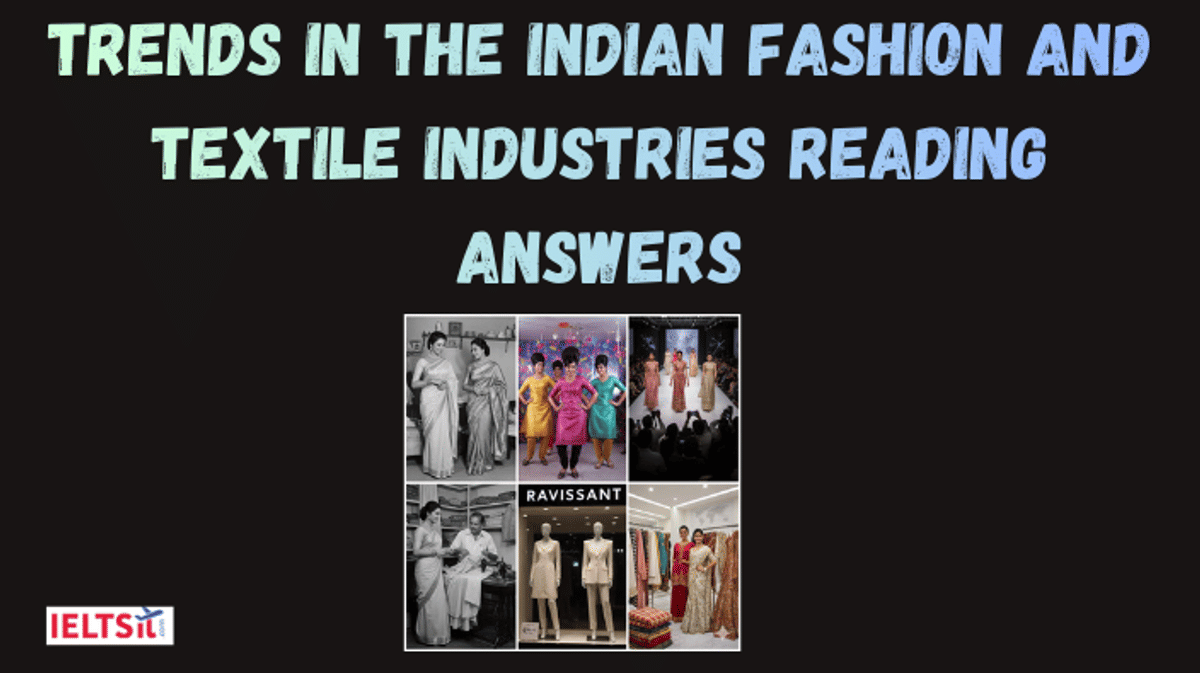
During the 1950s, the Indian fashion scene was exciting, stylish, and very graceful. There were no celebrity designers or models, nor were there any labels that were widely recognised. The value of a garment was judged by its style and fabric rather than by who made it. It was regarded as perfectly acceptable, even for high-society women, to approach an unknown tailor who could make a garment for a few rupees, providing the perfect fit, finish, and style. They were proud of getting a bargain and of giving their own name to the end result.
The 1960s was an era full of mischievousness and celebration in the arts, music, and cinema. The period was characterised by freedom from restrictions and, in the fashion world, an acceptance of innovative types of material such as plastic and coated polyester. Tight-fitting kurtas [1] and churidars 12] and high coiffures were a trend among women. The following decade witnessed an increase in the export of traditional materials and the arrival in India of international fashion. Synthetics became trendy, and the disco culture affected the fashion scene.
It was in the early 80s when the first fashion store 'Ravissant' opened in Mumbai. At that time, garments were retailed for a four-figure price tag. American designers like Calvin Klein became popular. In India, too, contours became more masculine, and even the salwar kameez 131 was designed with shoulder pads.
With the evolution of designer stores came the culture of designer fashion, along with its hefty price tags. Whatever a garment was like, consumers were convinced that a higher price tag signified elegant designer fashion, so garments were sold at unbelievable prices. Meanwhile, designers decided to get themselves noticed by making showy outfits and associating with
the right celebrities. Soon, fashion shows became competitive, each designer attempting to outdo the other in theme, guest list and media coverage.
In the last decade of the millennium, the market shrank, and ethnic wear made a comeback. During the recession, there was a push to sell at any cost. With fierce competition. The inevitable occurred: the once hefty price tags began their downward journey, and the fashion-show industry followed suit. However, the liveliness of the Indian fashion scene had not ended - it had merely reached a stable level.
At the beginning of the 21st century, with new designers and models and more sensible designs, the fashion industry accelerated once again. As far as the global fashion industry is concerned, Indian ethnic designs and materials are currently in demand from fashion houses and garment manufacturers. India is the third largest producer of cotton, the second largest
producer of silk, and the fifth largest producer of man-made fibres in the world.
The Indian garment and fabric industries have many fundamental advantages, in terms of a cheaper, skilled workforce, cost-effective production, raw materials, flexibility, and a wide range of designs with sequins, beadwork, and embroidery. In addition, India provides garments to international fashion houses at competitive prices, with a shorter lead time, and an effective monopoly on certain designs, is accepted the whole world over. India has always been regarded as the default source in the embroidered garments segment, but changes in the rate of exchange between the rupee and the dollar have further depressed prices, thereby attracting more buyers. So the international fashion houses walk away with customised goods, and craftwork is sold at very low rates.
As far as the fabric market is concerned, the range available in India can attract as well as confuse the buyer. Much of the production takes place in the small town of Chapa in the eastern State of Bihar, a name one might never have heard of. Here, fabric-making is a family industry: the range and quality of raw silks churned out here belie the crude production methods and equipment. Surat in Gujarat is the supplier of an amazing set of jacquards, moss crêpes, and georgette sheers - all fabrics in high demand. Another Indian fabric design that has been adopted by the fashion industry is the 'Madras check', originally utilised for the universal lungi, a simple lower-body wrap worn in southern India. This design has now found its way onto bandannas, blouses, home furnishings, and almost anything one can think of.
Ethnic Indian designs with batik and hand-embroidered motifs have also become popular across the world. Decorative beadwork is another product in demand in the international market. Beads are used to prepare accessory items like belts and bags, and beadwork is now available for haute couture evening wear, too.
[1] knee-length tunics
[2] trousers
[3] trouser suit
Questions 1-7
Choose ONE WORD ONLY from the passage for each answer.
Indian fashion: 1950-2000
1950s
No well-known designers, models, or 1……………..
Answer: LABELS
Supporting statement: There were no celebrity designers or models, nor were there any labels that were widely recognised
Keywords: No, widely recognised, designers, models
Keyword Location: Para 1, Line 2
Explanation: The text explicitly lists designers, models, and labels as things that were not widely known or recognized during this decade.
Elegant clothing cost little
Women were pleased to get clothes for a 2…………….. price
Answer: BARGAIN
Supporting statement: They were proud of getting a bargain and of giving their own name to the end result.
Keywords: Proud, getting, price
Keyword Location: Para 1, Line 6
Explanation: The text mentions women were "proud of getting a bargain," which aligns with the prompt's mention of being "pleased" with the cost.
1960s
New materials, e.g., 3………and polyester
Fitted clothing and tall hairstyles
Answer: PLASTIC
Supporting statement: an acceptance of innovative types of material such as plastic and coated polyester.
Keywords: material, innovative, polyester
Keyword Location: Para 2, Line 3
Explanation: Plastic is listed alongside polyester as one of the innovative materials accepted during the 1960s.
1970s
Overseas sales of 4…………….fabrics rose
Influence of international fashion
Answer: TRADITIONAL
Supporting statement: The following decade witnessed an increase in the export of traditional materials and the arrival in India of international fashion.
Keywords: Export, increase, materials
Keyword Location: Para 2, Line 5
Explanation: "Export" is a synonym for "overseas sales," and "traditional" describes the materials (fabrics) that saw an increase in sales.
1980s
Opening of a fashion store in Mumbai
Popularity of American designers
Clothing had a 5…………..shape
Answer: MASCULINE
Supporting statement: In India, too, contours became more masculine, and even the salwar kameez was designed with shoulder pads.
Keywords: Contours, shape, shoulder pads
Keyword Location: Para 3, Line 4
Explanation: The text uses the word "contours" (which refers to shape) and explicitly describes them as becoming more "masculine."
Designers tried to attract attention by presenting 6……………. clothes and mixing with stars
Answer: SHOWY
Supporting statement: Meanwhile, designers decided to get themselves noticed by making showy outfits and associating with the right celebrities.
Keywords: Noticed, showy outfits, celebrities
Keyword Location: Para 4, Line 4
Explanation: According to the text, Designers opted to stand out by creating striking outfits and mingling with influential celebrities.
1990s
Fall in demand for expensive fashion wear
Return to 7 ...........clothing.
Answer: ETHNIC
Supporting statement: In the last decade of the millennium, the market shrank, and ethnic wear made a comeback.
Keywords: Last decade, comeback, wear
Keyword Location: Para 5, Line 1
Explanation: According to the text, in the millennium's closing decade, the market declined as ethnic clothing regained popularity.
Questions 8-13
Do the following statements agree with the information given in Reading Passage 1.
In boxes 8-13 on your answer sheet, write
TRUE if the statement agrees with the information
FALSE if the statement contradicts the information
NOT GIVEN if there is no information on this
8. At the start of the 21st century, key elements in the Indian fashion industry changed.
Answer: TRUE
Supporting statement: At the beginning of the 21st century, with new designers and models and more sensible designs, the fashion industry accelerated once again
Keywords: 21st century, new designers, sensible designs
Keyword Location: Para 6, Line 1
Explanation: The text mentions several changes at the turn of the century, including new talent and a shift toward more sensible designs.
9. India now exports more than half of the cotton it produces.
Answer: NOT GIVEN
Explanation: While the text provides India's ranking as a global producer of cotton, it does not mention the specific percentage or ratio of cotton that is exported versus used domestically.
10. Conditions in India are generally well-suited to the manufacture of clothing.
Answer: TRUE
Supporting statement: The Indian garment and fabric industries have many fundamental advantages, in terms of a cheaper, skilled workforce, cost-effective production, raw materials, flexibility...
Keywords: Fundamental advantages, cost-effective, raw materials
Keyword Location: Para 7, Line 1
Explanation: The text lists numerous "fundamental advantages" and positive factors (skilled workforce, raw materials) that make India ideal for clothing manufacture.
11. Indian clothing exports have suffered from changes in the value of its currency.
Answer: FALSE
Supporting statement: changes in the rate of exchange between the rupee and the dollar have further depressed prices, thereby attracting more buyers
Keywords: Rate of exchange, depressed prices, attracting more buyers
Keyword Location: Para 7, Lines 6-7
Explanation: The text indicates that currency changes made products cheaper for foreigners, which actually attracted more buyers rather than causing the industry to "suffer" (in terms of sales volume).
12. Modern machinery accounts for the high quality of Chapa's silk.
Answer: FALSE
Supporting statement: the range and quality of raw silks churned out here belie the crude production methods and equipment.
Keywords: Raw silks, quality, crude, equipment
Keyword Location: Para 8, Lines 3-4
Explanation: The word "belie" means that the high quality contradicts the reality of the equipment. The text explicitly describes the production methods and equipment as "crude," not modern.
13. Some types of Indian craftwork, which are internationally popular, had humble origins.
Answer: TRUE
Supporting statement: Another Indian fabric design that has been adopted by the fashion industry is the 'Madras check', originally utilised for the universal lungi, a simple lower-body wrap worn in southern India.
Keywords: Adopted, Madras check, originally, simple lower-body wrap
Keyword Location: Para 8, Lines 7-8
Explanation: The "Madras check" is now used globally on everything from blouses to home furnishings, but it started as a "simple lower-body wrap" (humble origins).
Read More IELTS Reading Related Samples
- Use of Websites for Projects Reading Answers
- Discoveries on the basis of Deductive Reasoning Reading Answers
- Successions and Ecosystems Reading Answers
- How to prepare for a Presentation Reading Answers
- Professional Credentials Reading Answers
- An Early Cultural Tourist The Journey of Cyriacus of Ancona
- Train Travel Information Reading Answers
- The Importance of Business Cards Reading Answers
- The Young Persons Railcard Reading Answers
- Keele University Services for Students Reading Answers
- Introduction to the Grounds of Keele University Reading Answers
- A Young Italian Tradition Reading Answers
- Tuning up Your Leadership Skills Reading Answers
- Water Stress and Scarcity Reading Answers
- What are they Doing Up there Reading Answers
- Hard Languages Reading Answers
- What are they Doing Up there Reading Answers
- Registering as an Apprentice Reading Answers
- North Sydney Council Reading Answers
- A Brief History of Automata Reading Answers
- Working Time Regulation for Mobile Workers Reading Answers
- Marketing Advice for New Businesses Reading Answers
- Uncovering Ecological Treasure Reading Answers
- A New Voyage Around the World Reading Answers
- Australias Megafauna Controversy Reading Answers
- The First Coca Cola Bottle Reading Answers
- The Outbreak of World War 2 Reading Answers
- Racing Pigeons Reading Answers
- Cleopatra Reading Answers
- The History of Wimbledon Tennis Reading Answers
- New Seven Wonders of the World Reading Answers
- Creature Sleeps Reading Answers
- Seeing The Future in With Video Conferencing Reading Answers
- Sports Science in Australia Reading Answers
- The Impact of Social Media on our Lives Reading Answers
- Comet Missions Reading Answers
- Sea Change for Salinity Reading Answers
- Sydney Opera House Tours Reading Answers
- Pterosaurs Reading Answers
- Using Direct Mail to Sell Your Product Reading Answers
- Study Centre Courses Reading Answers
- Self Study Tips Reading Answers
- Stanfield Theatre Reading Answers
- The Amazing Tuna Fish Reading Answers
- Your Guide to Entertainment in Westhaven Reading Answers
- Research on Improving Agricultural Yields in Africa Reading Answers
- Good Customer Service in Retail Reading Answers
- Its Almost Time for the Next Ripton Festival Reading Answers
- Helping Pupils to Choose Optional Subjects Reading Answers
- National Parks Reading Answers
Comments