Sea Turtle Reading Answers
Sea Turtle Reading Answers is an academic reading answers topic. Sea Turtle Reading Answers has a total of 6 IELTS questions, such as Write NO MORE THAN FOUR WORDS/OR A NUMBER from the above passage.
The IELTS Reading section is an essential part of the test that evaluates a candidate's comprehension and analysis of various passage types. You will work through a number of IELTS reading practice problems in this section that resemble actual test situations. These questions are designed to help you improve your ability to recognise essential concepts, extract particular facts, and make inferences. Practising these IELTS reading problems can help you get comfortable with the structure and increase your confidence for the exam, regardless of whether you are studying for the Academic or General Training module.
Check: Get 10 Free Sample Papers
Check: Register for IELTS Coaching - Join for Free Trial Class Now
Section 1
SEA TURTLE
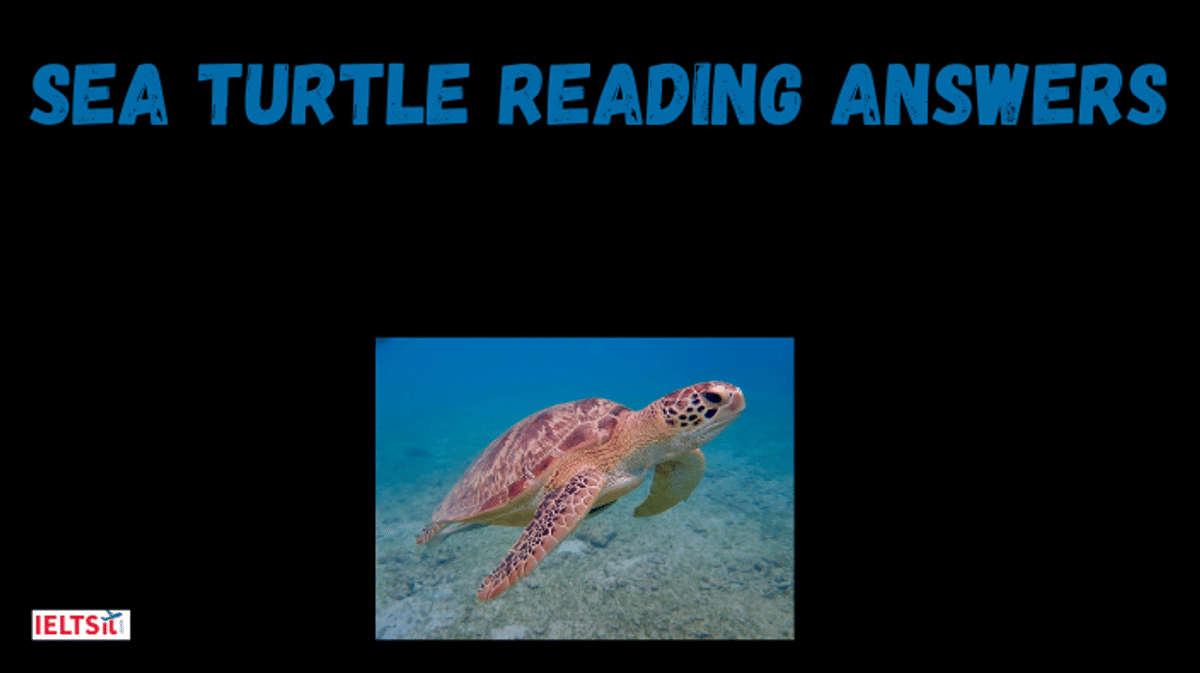
From leatherbacks to loggerheads, six of the seven species of sea turtles are threatened or endangered at the hands of humans. Sadly, the fact is that they face many dangers as they travel the seas, including accidental capture and entanglement in fishing gear (also known as bycatch), the loss of nesting and feeding sites to coastal development, poaching and ocean pollution, including plastic. These creatures are well-adapted to the ocean, though they require air to survive. Their size varies greatly, depending upon species, from the small Kemp's ridley, which weighs between 80 and 100 pounds, to the enormous leatherback, which can weigh more than 1,000 pounds.
Habitat & diet: Sea turtles live in almost every ocean basin throughout the world, nesting on tropical and subtropical beaches. They migrate long distances to feed, often crossing entire oceans. Some loggerheads nest in Japan and migrate to Baja California Sur, Mexico, to forage before returning home again. Leatherbacks are capable of withstanding the coldest water temperatures (often below 40F) and are found as far south as Chile and as far north as Alaska.
These reptiles spend their entire lives at sea, except when adult females come ashore to lay eggs several times per season every 2 to 5 years. After about sixty days, baby sea turtles (known as "hatchlings") emerge from their sandy nests and make their way to the ocean, attracted to the distant horizon. The juvenile turtles spend their first few years in the open oceans, eventually moving to protected bays, estuaries and other near-shore waters as adults.
Each species relies on a different diet: greens eat seagrasses, leatherbacks feed on jellyfish and soft-bodied animals, loggerheads eat heavy- shelled animals such as crabs and clams, hawksbills rely on sponges and other invertebrates, and the Kemp's ridley prefers crabs.
Human threats: These ancient creatures have been on Earth for more than 100 million years, even surviving the dinosaurs when they became extinct 65 million years ago. Among the threats these marine reptiles face are entanglement, habitat loss, and consumption of their eggs and meat. Sea turtles often drown when caught in fishing gear. Coastal development can destroy important nesting sites, impact coral reefs, and artificial light from houses and other buildings attracts hatchlings away from the ocean. Pollution like plastic bags is often mistaken for food, such as jellyfish, and ingested, which blocks their intestines and potentially kills them. In some countries, they are hunted for their meat and shells, and their eggs are eaten.
Questions 15-20
Write NO MORE THAN FOUR WORDS/OR A NUMBER from the above passage.
15. How many of the total species of sea turtles are endangered or threatened?
Answer: SIX OF THE SEVEN
Supporting statement: From leatherbacks to loggerheads, six of the seven species of sea turtles are threatened or endangered at the hands of humans.
Keywords: species, threatened, endangered
Keyword Location: Para 1, Lines 1-2
Explanation: The opening sentence explicitly states that six out of the total seven species are currently at risk.
16. The presence of what causes the ocean pollution leading to a decline in the populations of sea turtles?
Answer: PLASTIC
Supporting statement: Sadly, the fact is that they face many dangers as they travel the seas, including... ocean pollution, including plastic.
Keywords: pollution, plastic
Keyword Location: Para 1, Lines 2-4
Explanation: The text identifies plastic as a specific form of ocean pollution that poses a danger to these creatures.
17. Name the heaviest sea turtle with its weight on Earth?
Answer: LEATHERBACK, 1000 POUNDS
Supporting statement: to the enormous leatherback, which can weigh more than 1,000 pounds.
Keywords: enormous, leatherback, weigh
Keyword Location: Para 1, Line 7
Explanation: The text compares different species and identifies the leatherback as the largest, weighing over 1,000 pounds.
18. Which Southern and Northern state boasts of inhabiting sea turtles despite freezing temperatures?
Answer: CHILE & ALASKA
Supporting statement: Leatherbacks are capable of withstanding the coldest water temperatures (often below 40F) and are found as far south as Chile and as far north as Alaska.
Keywords: south, north, Chile, Alaska
Keyword Location: Para 2, Lines 4-5
Explanation: The passage names Chile as the southern location and Alaska as the northern location where leatherbacks can survive cold waters.
19. How many days do the hatchlings take for emergence before immediately moving to the seas?
Answer: SIXTY/60
Supporting statement: After about sixty days, baby sea turtles (known as "hatchlings") emerge from their sandy nests and make their way to the ocean
Keywords: sixty days, hatchlings, emerge
Keyword Location: Para 3, Line 3
Explanation: The text specifies the timeframe for incubation and emergence as approximately sixty days.
20. Sponges and other invertebrates constitute the diet of which species of sea turtles?
Answer: HAWKSBILLS
Supporting statement: hawksbills rely on sponges and other invertebrates
Keywords: hawksbills, sponges, invertebrates
Keyword Location: Para 3, Line 8
Explanation: The diet section lists various species and their specific food sources, linking hawksbills to sponges and invertebrates.
Read More IELTS Reading Related Samples
- Uncovering Ecological Treasure Reading Answers
- A New Voyage Around the World Reading Answers
- Australias Megafauna Controversy Reading Answers
- The First Coca Cola Bottle Reading Answers
- The Outbreak of World War 2 Reading Answers
- Racing Pigeons Reading Answers
- Cleopatra Reading Answers
- The History of Wimbledon Tennis Reading Answers
- New Seven Wonders of the World Reading Answers
- Creature Sleeps Reading Answers
- Seeing The Future in With Video Conferencing Reading Answers
- Sports Science in Australia Reading Answers
- The Impact of Social Media on our Lives Reading Answers
- Comet Missions Reading Answers
- Sea Change for Salinity Reading Answers
- Sydney Opera House Tours Reading Answers
- Pterosaurs Reading Answers
- Using Direct Mail to Sell Your Product Reading Answers
- Study Centre Courses Reading Answers
- Self Study Tips Reading Answers
- Stanfield Theatre Reading Answers
- The Amazing Tuna Fish Reading Answers
- Your Guide to Entertainment in Westhaven Reading Answers
- Research on Improving Agricultural Yields in Africa Reading Answers
- Good Customer Service in Retail Reading Answers
- Its Almost Time for the Next Ripton Festival Reading Answers
- Helping Pupils to Choose Optional Subjects Reading Answers
- National Parks Reading Answers
- Use of Websites for Projects Reading Answers
- Discoveries on the basis of Deductive Reasoning Reading Answers
- Successions and Ecosystems Reading Answers
- How to prepare for a Presentation Reading Answers
- Professional Credentials Reading Answers
- An Early Cultural Tourist The Journey of Cyriacus of Ancona
- Train Travel Information Reading Answers
- The Importance of Business Cards Reading Answers
- The Young Persons Railcard Reading Answers
- Keele University Services for Students Reading Answers
- Introduction to the Grounds of Keele University Reading Answers
- A Young Italian Tradition Reading Answers
- Tuning up Your Leadership Skills Reading Answers
- Water Stress and Scarcity Reading Answers
- What are they Doing Up there Reading Answers
- Hard Languages Reading Answers
- What are they Doing Up there Reading Answers
- Registering as an Apprentice Reading Answers
- North Sydney Council Reading Answers
- A Brief History of Automata Reading Answers
- Working Time Regulation for Mobile Workers Reading Answers
- Marketing Advice for New Businesses Reading Answers
Comments