Understanding Hares Reading Answers
The answers for "Understanding Hares" include 13 questions and are part of the assessment framework for the IELTS General Reading test. Candidates are allotted 20 minutes to complete the reading responses concerning "Understanding Hares." This portion of the IELTS reading exam consists of various question formats, including Choose the correct heading, Choose the correct letter, and Choose ONE WORD ONLY.
The answers for "Understanding Hares" offer a comprehensive overview of the passage, explaining that the UK’s brown hare is a fast, well-adapted animal with keen senses and strong breeding ability, living mainly in open farmland. However, modern farming, habitat loss, and reduced food diversity are causing a serious decline in its population despite its ability to reproduce quickly. For additional practice with similar reading assessments, candidates can refer to the IELTS Reading Practice Test section.
Check: Get 10 Free Sample Papers
Check: Register for IELTS Coaching - Join for Free Trial Class Now
Topic:
Understanding Hares Reading Answers
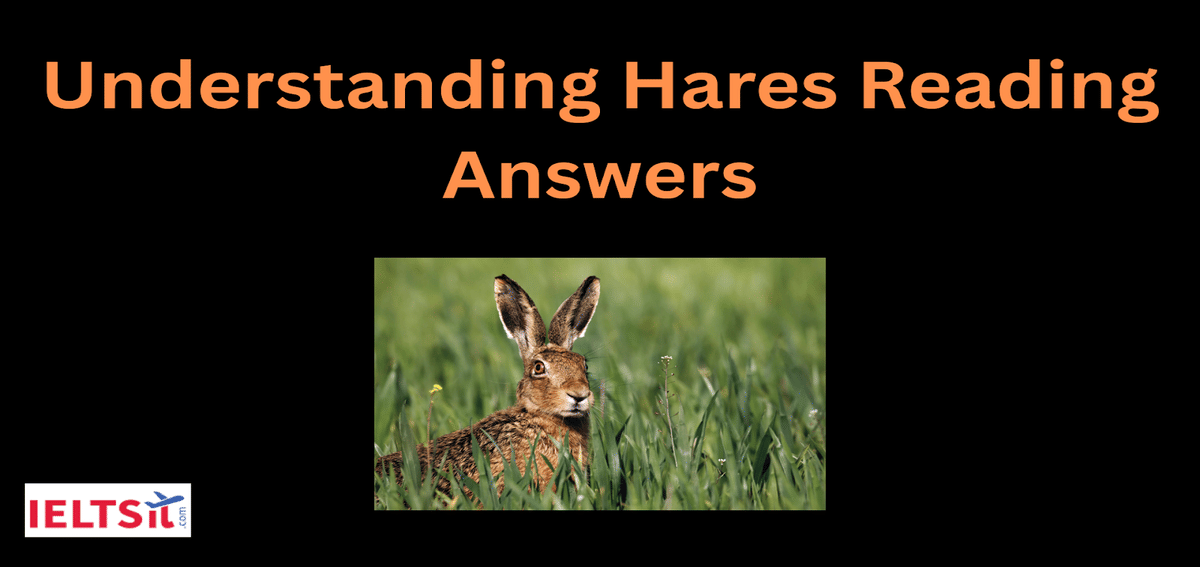
With its wild stare, swift speed and secretive nature, the UK's brown hare is the rabbit's mysterious cousin. Even in these days of agricultural intensification, the hare is still to be seen in open countryside, but its numbers are falling
A.Like many herbivores, brown hares spend a relatively large amount of their time feeding. They prefer to do this in the dark, but when nights are short, their activities do spill into daylight hours. Wherever they live, hares appear to have a fondness for fields with a variety of vegetation, for example, short as well as longer clumps of grasses. Studies have demonstrated that they benefit from uncultivated land and other unploughed areas on farms, such as field margins.
Therefore, if farmers provided patches of woodland in areas of pasture as well as assorted crops in arable areas, there would be year-round shelter and food, and this could be the key to turning round the current decline in hare populations.
B.Brown hares have a number of physical adaptations that enable them to survive in open countryside. They have exceptionally large ears that move independently, so that a range of sounds can be pinpointed accurately. Positioned high up on their heads, the hares' large golden eyes give them 360* vision, making it hard to take a hare by surprise.
Compared to mammals of a similar size, hares have a greatly enlarged heart and a higher volume of blood in their bodies, and this allows for superior speed and stamina. In addition, their legs are longer than those of a rabbit, enabling hares to run more like a dog and reach speeds of up to 70 kph.
C.Brown hares have unusual lifestyles for their large size, breeding from a young age and producing many leverets (babies). There are about three litters of up to four leverets every year. Both males and females are able to breed at about seven months old, but they have to be quick because they seldom live for more than two years. The breeding season runs from January to October, and by late February most females are pregnant or giving birth to their first litter of the year. So it seems strange, therefore, that it is in March, when the breeding season is already underway, that hares seemingly go mad boxing, dancing. running and fighting. This has given rise to the age old reference to mad March hares. In fact, boxing occurs throughout the breeding season, but people tend to see this behaviour more often in March. This is because in the succeeding months, dusk - the time when hares are most active - is later, when fewer people are about. Crops and vegetation are also taller, hiding the hares from view. Though it is often thought that they are males fighting over females, boxing hares are usually females fighting off males. Hares are mostly solitary, but a female fights off a series of males until she is ready to mate. This occurs several times theough the breeding season because, as soon as the female has given birth, she will be ready to mate again.
D.But how can females manage to do this while simultaneously feeding themselves and rearing their young? The reason is that hares have evolved such self-sufficient young. Unlike baby rabbits, leverets are born furry and mobile.
They weigh about 100 g at birth and are immediately left to their own devices by their mothers. A few days later, the members of the litter creep away to create their own individual resting places, known as forms', Incredibly, their mother visits them only once every 24 hours and, even then, she only suckles them for a maximum of five minutes each. This lack of family contact may seem harsh to us, but it is a strategy that draws less attention from predators. At the tender age of two weeks, leverets start to feed themselves, while still drinking their mother's milk. They grow swiftly and are fully weaned at four weeks, reaching adult weight at about six months.
E.Research has shown that hares' milk is extremely rich and fatty, so a little goes a long way. in order to produce such! nutritious milk, females need a high-quality, high-calorie diet. Hares are selective feeders at the best of times: unlike many herbivores, they can't sit around waiting to digest low-quality food - they need high- energy herbs and other leaves in order to sprint. This causes them problems when faced with the smallest alterations in food availability and abundance. So, as well as reductions in the diversity of farmland habitat, the decline in the range of food plants is njurious to hares.
F.The rapid turnaround in the breeding cycle suggests that hares should, in principle, be able to increase their populations quickly to exploit new habitats. They certainly used to: studies show that hares evolved on the open plains and spread rapidly westward from the Black Sea after the last ice age (though they were probably introduced to Britain as a species to be hunted for the pot by the Romans). But today's hares are thwarted by the lack of rich farmland habitat. When the delicate herbs and other plants they rely on are ploughed up or poisoned by herbicides, these wonderful, agile runners disappear too, taking with them some of the wildness from our lives.
Questions 28-33
The following text has six sections, A-F.
Choose the correct heading for each section from the list of headings below.
List of headings
I The need for population reduction
II The problem with being a fussy eater
III Reproductive patterns
iv The need for further research
v A possible solution to falling numbers
vi The fastest runners
vii A rather lonely beginning
viii A comparison between past and present survival rates
ix Useful physical features
28. Paragraph A
Answer: v (A possible solution to falling numbers)
Supporting statement: "…there would be year-round shelter and food, and this could be the key to turning round the current decline in hare populations."
Keywords: year-round shelter, food, key, decline, populations
Keyword Location: Paragraph A, final lines
Explanation: Paragraph A discusses what hares need in their habitat and suggests that providing woodland patches and varied crops could help stop their population decline. This clearly presents a solution to the falling numbers of hares. Therefore, heading v best matches the paragraph.
29. Paragraph B
Answer: ix (Useful physical features)
Supporting statement: "Brown hares have a number of physical adaptations that enable them to survive in open countryside."
Keywords: physical adaptations, survive, ears, eyes, speed
Keyword Location: Paragraph B, first line
Explanation: This paragraph describes the hare’s body features such as large ears, 360° vision, strong heart, and long legs, all of which help survival. The focus is entirely on physical characteristics. Hence, the most suitable heading is Useful physical features.
30. Paragraph C
Answer: iii (Reproductive patterns)
Supporting statement: "Brown hares have unusual lifestyles for their large size, breeding from a young age and producing many leverets."
Keywords: breeding, young age, litters, mating, season
Keyword Location: Paragraph C, first lines
Explanation: Paragraph C explains how often hares breed, their mating behaviour, and the “mad March hares” phenomenon. Since the paragraph focuses on reproduction and breeding cycles, the correct heading is Reproductive patterns.
31. Paragraph D
Answer: vii (A rather lonely beginning)
Supporting statement: "…their mother visits them only once every 24 hours…"
Keywords: left alone, individual resting places, visits once, little contact
Keyword Location: Paragraph D, middle lines
Explanation: This paragraph explains that leverets are born self-sufficient and are left alone most of the time, receiving minimal care from their mother. Their early life is solitary as a survival strategy. Therefore, the heading A rather lonely beginning fits best.
32. Paragraph E
Answer: ii (The problem with being a fussy eater)
Supporting statement: "Hares are selective feeders… This causes them problems when faced with the smallest alterations in food availability."
Keywords: selective feeders, problems, alterations, food availability
Keyword Location: Paragraph E, middle lines
Explanation: The paragraph highlights that hares require high-quality food and struggle when their preferred plants are scarce. Their selective eating habits create survival problems. Hence, the best heading is The problem with being a fussy eater.
33. Paragraph F
Answer: viii (A comparison between past and present survival rates)
Supporting statement: "They certainly used to… But today's hares are thwarted by the lack of rich farmland habitat."
Keywords: used to, spread rapidly, today’s hares, lack of habitat
Keyword Location: Paragraph F, middle lines
Explanation: Paragraph F contrasts how hares once expanded successfully with how modern hares struggle due to habitat loss. This comparison between past success and present decline matches the heading about past and present survival rates.
Questions 34
Choose the correct letter, A B, C or D.
34. According to the writer, what is the ideal habitat for hares?
A. open grassland which they can run across
B. densely wooded areas to breed in
C. areas which include a range of vegetation
D. land that has been farmed intensively for years
Answer: A
Supporting statement: "This lack of family contact may seem harsh to us, but it is a strategy that draws less attention from predators."
Keywords: lack of family contact, strategy, less attention, predators
Keyword Location: Paragraph D, lines 6–7
Explanation: The passage explains that the mother visits the leverets only briefly to avoid attracting predators. By staying away most of the time, she reduces the chance that other animals will notice the young. This behaviour is therefore a protective strategy rather than neglect. Hence, the correct reason is that it helps protect them from being eaten by predators.
Questions 35-36
Choose the correct letter, A B, C or D.
35. When leverets are living alone they are not visited often by their mother because
A. this helps to protect them from being eaten by other animals.
B. the forms' are so far apart.
C. they are very energetic from a surprisingly early age.
D. they know how to find their own food from birth.
Answer: A
Supporting statement: "This lack of family contact may seem harsh to us, but it is a strategy that draws less attention from predators."
Keywords: lack of family contact, strategy, less attention, predators
Keyword Location: Paragraph D, lines 6–7
Explanation: The passage explains that the mother visits the leverets only briefly to avoid attracting predators. By staying away most of the time, she reduces the chance that other animals will notice the young. This behaviour is therefore a protective strategy rather than neglect. Hence, the correct reason is that it helps protect them from being eaten by predators.
36. What does the writer suggest about the adult hares' diet?
A. They need some plants with a high fat content.
B. They need time to digest the plants that they eat.
C. It is difficult for them to adapt to changes in vegetation.
D. It is vital for them to have a supply of one particular herb.
Answer: C
Supporting statement: "This causes them problems when faced with the smallest alterations in food availability and abundance."
Keywords: problems, alterations, food availability, abundance
Keyword Location: Paragraph E, lines 5–6
Explanation: The writer states that hares are selective feeders and require high-energy plants. Because of this, even small changes in vegetation create difficulties for them. This shows they cannot easily adjust to changes in their food supply. Therefore, the correct option is that it is difficult for them to adapt to changes in vegetation.
Questions 37-40
Choose ONE WORD ONLY from the text for each answer.
Brown hares
The brown hare is well known for its ability to run fast, at speeds of up to 70 kph, langely due to the length of its legs as well as the unusual size of its heart. An increased amount of blood also gives it the necessary 37 …………….
Answer: stamina
Supporting statement: "…this allows for superior speed and stamina."
Keywords: superior speed, stamina
Keyword Location: Paragraph B, lines 4–5
Explanation: The summary mentions the hare’s ability to keep running fast for a long time. In Paragraph B, this endurance is explained as being due to the hare’s enlarged heart and greater blood volume, which provide “stamina.” Hence, this word correctly completes the sentence.
to continue running fast for some time. A running hare resembles the 38……………..
Answer: dog
Supporting statement: "…enabling hares to run more like a dog…"
Keywords: run, like a dog
Keyword Location: Paragraph B, lines 6–7
Explanation: The summary states that a running hare resembles another animal more than a rabbit. The passage clearly says hares run more like a dog due to their long legs. Therefore, “dog” is the correct word.
more closely than its relative, the rabbit. The hare has some other characteristics that help it to avoid capture. The first is its excellent all-round 30 ………....
Answer: vision
Supporting statement: "…the hares' large golden eyes give them 360° vision…"
Keywords: 360°, vision, eyes
Keyword Location: Paragraph B, lines 2–3
Explanation: The summary refers to the hare’s excellent all-round ability to detect danger behind it. This matches the description of 360-degree vision provided by its eye placement. Thus, “vision” correctly fills the blank.
This means that predators cannot easily creep up behind it. Another feature is its ability to position its massive ……………. separately, to sense the slightest indication of danger.
Answer: ears
Supporting statement: "They have exceptionally large ears that move independently…"
Keywords: large ears, move independently
Keyword Location: Paragraph B, lines 1–2
Explanation: The final blank refers to the hare’s ability to position a body part separately to sense danger. The passage explains that their large ears move independently to detect sounds accurately. Therefore, the correct word is “ears.”
Check IELTS reading samples:
- Volunteering with Open Doors Reading Answers
- How to Live Life Perspectives of Meaningful Living Reading Answers
- How to Succeed in Exams Reading Answers
- The Changing Role of Housewives in Modern Society Reading Answers
- Altius Offer Letter of Employment Reading Answers
- Employment Verification Information Reading Answers
- New Library Services at Brookdale Community Library Reading Answers
- The Mammals Reading Answers
- Recharger Reading Answers
- The Rise of Urban Gardening Reading Answers
- Sustainable Fashion A Shift in the Clothing Industry Reading Answers
- The Benefits of Workplace Volunteering Programs Reading Answers
- LLEWYN The Troubadour of a Lost Age Reading Answers
- Combining Passion with Work Reading Answers
- Internal Complaint Review An Understanding Reading Answers
- Understanding Economic Investments and Development Reading Answers
- The Secret Language of Trees Reading Answers
- Leaflet City Library Summer Reading Challenge Reading Answers
- Email From A Travel Agency Holiday Package Information Reading Answers
- Rental Agreement Greenlane Apartments Reading Answers
- Parkside Community Swimming Pool Guidelines Reading Answers
- Cognitive Decline and Aging Understanding the Process Reading Answers
- The Complexities of Human Memory Reading Answers
- Riverdale Textiles Employee Benefits Guide Reading Answers
- The Impact of Urban Green Spaces on Health and Society Reading Answers
- The Disappearing Art of Letter Writing Reading Answers
- Renting a Property Guidelines for Tenants Reading Answers
- Quantum Entanglement Reading Answers
- Out of Africa The Tobacco Wars New Battleground Reading Answers
- Latin Influence in English Down Reading Answers
- Beauty Through the Ages Reading Answers
- Family Transformations From Traditional to Chosen Reading Answers
- Transportation Shapes Cities Reading Answers
- Russian Archaeology Reading Answers
- Economizing the Poor Reading AnswersEconomizing the Poor Reading Answers
- The Koala Reading Answers
- Aswan High Dam Reading Answers
- The Japanese Rock Garden Reading Answers
- Its a Boy Not an Old Wives Tale Reading Answers
- Wind Power Reading Answers
- The Art of the Perfect Nap Reading Answers
- 200 years of Australian Landscape at the Royal Academy in London Reading Answers
- How Sled Dogs and Pets Respond when the Clocks Change Reading Answers
- The Benefits of Natures Fires Reading Answers
- Chilies Reading Answers
- Yoruba Town Reading Answers
- Delights of Mass Tourism reach Galapagos Reading Answers
- Damascus Reading Answers
- Fruit Picking Work in Australia Reading Answers
- Hasst Legal Services Reading Answers
Comments