Understanding Bee Behaviour Reading Answers
The answers for "Understanding Bee Behaviour " include 13 questions and are part of the assessment framework for the IELTS General Reading test. Candidates are allotted 20 minutes to complete the reading responses concerning "Understanding Bee Behaviour." This portion of the IELTS reading exam consists of various question formats, including write NO MORE THAN THREE WORDS for each, choose one word only, and choose the correct heading.
The answers for "Understanding Bee Behaviour" offer a comprehensive overview of the passage, explaining that the passage describes how bees communicate the location and quality of food through special dances, discovered by Karl von Frisch, which convey distance and direction to other bees. His research revealed that bees use scent, movement patterns, and even the sun or gravity as guides, revolutionizing the understanding of animal communication. For additional practice with similar reading assessments, candidates can refer to the IELTS Reading Practice Test section.
Check: Get 10 Free Sample Papers
Check: Register for IELTS Coaching - Join for Free Trial Class Now
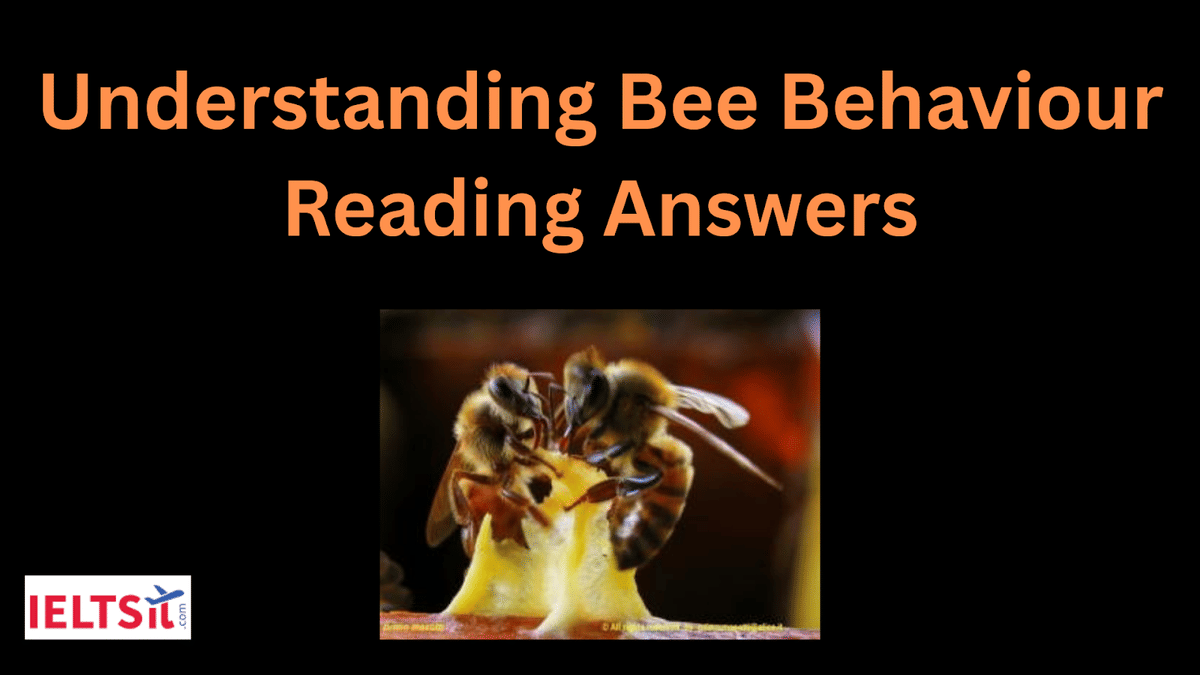
Topic:
Understanding Bee Behaviour Reading Answers
A. A bee's brain is the size of a grass seed, yet in this tiny brain are encoded some of the most complex and amazing behavioural patterns witnessed outside humankind.For bees are arguably the only animals apart from humans which have their own language. Earlier this century Karl von Frisch, a professor of Zoology at Munich University, spent decades of 'the purest joy of discovery' unravelling the mysteries of bee behaviour. For his astonishing achievements he was awarded the Nobel Prize and it is from his work that most of today's knowledge of what bees say to each other derives.
B. It started simply enough. Von Frisch knew from experiments by an earlier researcher that if he put out a bowl of sweet sugar syrup, bees might at first take some time to find it but, once they had done so, within the hour, hundreds of other bees would be eagerly taking the syrup. Von Frisch realised that, in some way, messages were being passed on back at the hive1"
', messages which said, 'Out there, at this spot, you're going to find food.'
C. But how was it happening? To watch the bees, von Frisch constructed a glass-sided hive. He found that, once the scout bees arrived back at the hive, they would perform one of three dance types. In the first type, a returning scout scampered in circles, alternating to right and left, stopping occasionally to regurgitate food samples to the excited bees chasing after her. In the second dance, clearly an extended version of this round dance, she performed a sickle-shaped figure-of-eight pattern instead. In the third, distinctly different dance, she started by running a short distance in a straight line, waggling her body from side to side, and returning in a semi-circle to the starting point before repeating the process. She also stopped from time to time to give little bits of food to begging bees. Soon the others would excitedly leave the hive in search of food. Minutes later, many of them, marked by von Frisch, could be seen eating at the bowls of sugar syrup.
D. Experimenting further, von Frisch unravelled the mystery of the first two related types, the round and the sickle dances.
These dances, he concluded, told the bees simply that, within quite short distances of the hive there was a food source worth chasing. The longer and more excitedly the scout danced, the richer the promise of the food source. The scent she carried in her samples and on her body was a message to the other bees that this particular food was the one they were looking for. The others would then troop out of the hive and fly in spiralling circles 'sniffing' in the wind for the promised food.
E. At first, von Frisch thought the bees were responding only to the scent of the food. But what did the third dance mean?
And if bees were responding only to the scent, how could they also 'sniff down' food hundreds of metres away from the hive, food which was sometimes downwind? On a hunch, he started gradually moving the feeding dish further and further away and noticed as he did so, that the dances of the returning scout bees also started changing. If he placed the feeding dish over nine metres away, the second type of dance, the sickle version, came into play. But once he moved it past 36 metres, the scouts would then start dancing the third, quite different, waggle dance. The measurement of the actual distance too, he concluded, was precise. For example, a feeding dish 300 metres away was indicated by 15 complete runs through the pattern in 30 seconds. When the dish was moved to 60 metres away, the number dropped to 11.
F. Von Frisch noted something further. When the scout bees came home to tell their sisters about the food source, sometimes they would dance outside on the horizontal entrance platform of the hive, and sometimes on the vertical wall inside. And, depending on where they danced, the straight portion of the waggle dance would point in different directions.
The outside dance was fairly easy to decode: the straight portion of the dance pointed directly to the food source, so the bees would merely have to decode the distance message and fly off in that direction to find their food.
G. But by studying the dance on the inner wall of the hive, von Frisch discovered a remark-able method which the dancer used to tell her sisters the direction of the food in relation to the sun. When inside the hive, the dancer cannot use the sun, so she uses gravity instead. The direction of the sun is represented by the top of the hive wall. If she runs straight up, this means that the feeding place is in the same direction as the sun. However, if, for example, the feeding place is 40° to the left of the sun, then the dancer would run 40° to the left of the vertical line. This was to be the first of von Frisch's remarkable discoveries. Soon he would also discover a number of other remarkable facts about how bees communicate and, in doing so, revolutionise the study of animal behaviour generally.
1. Hive - a 'house. for bees; the place where they build a nest and live.
Questions 28-34
The following reading pages has seven sections A-G.
Choose the correct heading for each section from the list of headings below.
List of Headings
i Bee behaviour is a mystery
il Communicating direction when outside a hive
ili How bees carry food on their bodies
iv Von Frisch discovers that bees communicate
v How bees communicate direction when inside a hive
vi The special position of bee language
vii Expressing distance by means of dance
viii The purpose of the two simple dances
ix The discovery that bees have a special scent
x Von Frisch discovers three types of dance
28. Section A
Answer: vi
Supporting statement: “For bees are arguably the only animals apart from humans which have their own language.”
Keywords: only animals, own language
Keyword Location: Section A, line 2
Explanation: Section A focuses on the uniqueness of bee communication and highlights that bees are possibly the only animals apart from humans with their own language. This emphasises the special position of bee language among animals. Hence, heading vi best matches this section.
29. Section B
Answer: iv
Supporting statement: “Von Frisch realised that, in some way, messages were being passed on back at the hive.”
Keywords: messages passed on, realised
Keyword Location: Section B, last lines
Explanation: Section B describes how von Frisch observed bees sharing information about food sources. This led to his discovery that bees communicate with each other. Therefore, heading iv correctly summarises this section.
30. Section C
Answer: x
Supporting statement: “He found that… they would perform one of three dance types.”
Keywords: three dance types
Keyword Location: Section C, line 2
Explanation: Section C explains von Frisch’s observation of bees performing three different types of dances. It describes each dance in detail, which shows his discovery of three dance types. Thus, heading x is correct.
31. Section D
Answer: viii
Supporting statement: “These dances… told the bees simply that… there was a food source worth chasing.”
Keywords: told the bees, food source
Keyword Location: Section D, line 2
Explanation: Section D explains the function of the round and sickle dances. It states that these dances inform bees about nearby food sources and their quality. Therefore, the section describes the purpose of the two simple dances, making heading viii correct.
32. Section E
Answer: vii
Supporting statement: “The measurement of the actual distance too, he concluded, was precise.”
Keywords: measurement, distance, precise
Keyword Location: Section E, line 7
Explanation: Section E explains how the waggle dance communicates the exact distance of the food source. It describes how the number of dance runs changes according to distance. Hence, heading vii is the best match.
33. Section F
Answer: ii
Supporting statement: “The outside dance… pointed directly to the food source.”
Keywords: outside dance, pointed directly
Keyword Location: Section F, last lines
Explanation: Section F focuses on how bees communicate the direction of food when dancing outside the hive. It explains that the straight portion of the dance indicates direction. Therefore, heading ii is correct.
34. Section G
Answer: v
Supporting statement: “When inside the hive… she uses gravity instead.”
Keywords: inside the hive, uses gravity
Keyword Location: Section G, line 2
Explanation: Section G explains how bees communicate direction while inside the hive using gravity and angles instead of the sun. This clearly matches heading v.
Questions 35-37
The writer mentions THREE kinds of bee dance identified by von Frisch. List the name the writer gives to each dance. Use ONE WORD ONLY for each answer.
35. Answer: round
Supporting statement: “the first two related types, the round and the sickle dances.”
Keywords: round dance
Keyword Location: Section D, line 1
Explanation: The passage clearly names the first type of dance as the round dance. It is one of the three dances identified by von Frisch.
36. Answer: sickle
Supporting statement: “the round and the sickle dances.”
Keywords: sickle dance
Keyword Location: Section D, line 1
Explanation: The passage identifies the second dance as the sickle dance. It is described as an extended version of the round dance.
37. Answer: waggle
Supporting statement: “the third… waggle dance.”
Keywords: waggle dance
Keyword Location: Section E, line 5
Explanation: The passage explains that the third type of dance is the waggle dance. This dance communicates both direction and distance of food sources.
Questions 38-40
Complete the sentences below with words taken from the passage.
Write NO MORE THAN THREE WORDS for each answer.
Write your answers in boxes 38-40 on your answer sheet.
38. Von Frisch discovered the difference between dance types by changing the position of………………
Answer: feeding dish
Supporting statement: “he started gradually moving the feeding dish further and further away…”
Keywords: moving feeding dish
Keyword Location: Section E, line 3
Explanation: Von Frisch changed the location of the feeding dish to study how bees altered their dances. This helped him understand the difference between dance types.
39. The dance outside the hive points in the direction of…………………
Answer: food source
Supporting statement: “the straight portion of the dance pointed directly to the food source.”
Keywords: pointed directly, food source
Keyword Location: Section F, last line
Explanation: The passage clearly states that the dance outside the hive indicates the direction of the food source.
40. The angle of the dance from the vertical shows the angle of the food from……………….
Answer: the sun
Supporting statement: “the direction of the food in relation to the sun.”
Keywords: relation to the sun
Keyword Location: Section G, line 1
Explanation: The angle of the dance from the vertical represents the angle of the food source in relation to the sun, which helps bees locate the food accurately.
Check IELTS reading samples:
- Computer Games Reading Answers
- Gaston Community College Evening Classes Reading Answers
- Travelling Around the Country With Bus Passes Reading Answers
- Esito Dress Code Reading Answers
- Maritime Shippings Heavy Fuel Oil Debate Reading Answers
- Born to Trade Reading Answers
- Small Industry in Developing Countries
- Categorization between Monkeys and Chimpanzees Reading Answers
- Urgent Recall on Parkhurst Cat Food Reading Answers
- Human Empowerment Centre Memorandum Reading Answers
- The Price of Your Newspaper Reading Answers
- Bhimli Beach Reading Answers
- What to do When Moving Home Reading Answers
- Atlantis True Story or Cautionary Tale Reading Answer
- What Makes a Great Concert Hall Reading Answer
- DC Funds Reading Answers
- Avalanche Reading Answers
- Masley Pets Sale Reading Answers
- Workplace Harassment Reading Answers
- Poison Rain Reading Answers
- Miles Davis Icon and Iconoclast Reading Answers
- Global Response to Covid 19 Reading Answers
- Contact Lenses Reading Answers
- A buzz in the world of chemistry Reading Answers
- The Pick of This Summers Outdoor Music Festivals Reading Answers
- Newspapers Reading Answers
- Polo Reading Answers
- The Reindeer Reading Answers
- Drive on Low Beam in Fog Reading Answers
- Are You Being Bullied Reading Answers
- Theatre Reading Answers
- Can you Do Them at the Same Time Reading Answers
- Numeracy in Animals Reading Answers
- Non Pesticide Management of Crop in India Reading Answers
- Swordfish Reading Answers
- Mojito Reading Answers
- Calculating the Risk Reading Answers
- The Future of Getting Around in Cities Reading Answers
- Apollo 11 The First Moon Landing Reading Answers
- Potato Reading Answers
- Why Do Clocks go Clockwise Reading Answers
- Plastic Eating Worms Reading Answers
- Education To Be More Reading Answers
- Photosynthesis Reading Answers
- Giving Business presentations Reading Answers
- Business Continuity Planning Reading Answers
- Maintaining a Facility Reading Answers
- Roman Roads Reading Answers
- The Rise of Artificial Meat Reading Answers
- The Mystery of Monarch Butterfly Migration Reading Answers
Comments