The 2003 Heatwave Reading Answers
The answers for "The 2003 Heatwave Reading Answers" include 13 questions and are part of the assessment framework for the IELTS General Reading test. Candidates are allotted 20 minutes to complete the reading responses concerning "The 2003 Heatwave Reading Answers." This portion of the IELTS reading exam consists of various question formats, including Do the following statements agree with the information given, using no more than two words for each answer, using no more than three words for each answer and choosing the correct letter.
The answers for "The 2003 Heatwave Reading Answers" offer a comprehensive overview of the passage, explaining how the passage describes how the European summer of 2003 was the hottest on record, with extreme temperatures, deadly heatwaves, and unprecedented impacts across the continent. Scientists now believe this event marked clear evidence of human-caused global warming rather than natural climate variability. For additional practice with similar reading assessments, candidates can refer to the IELTS Reading Practice Test section.
Check: Get 10 Free Sample Papers
Check: Register for IELTS Coaching - Join for Free Trial Class Now
Topic:
The 2003 Heatwave Reading Answers
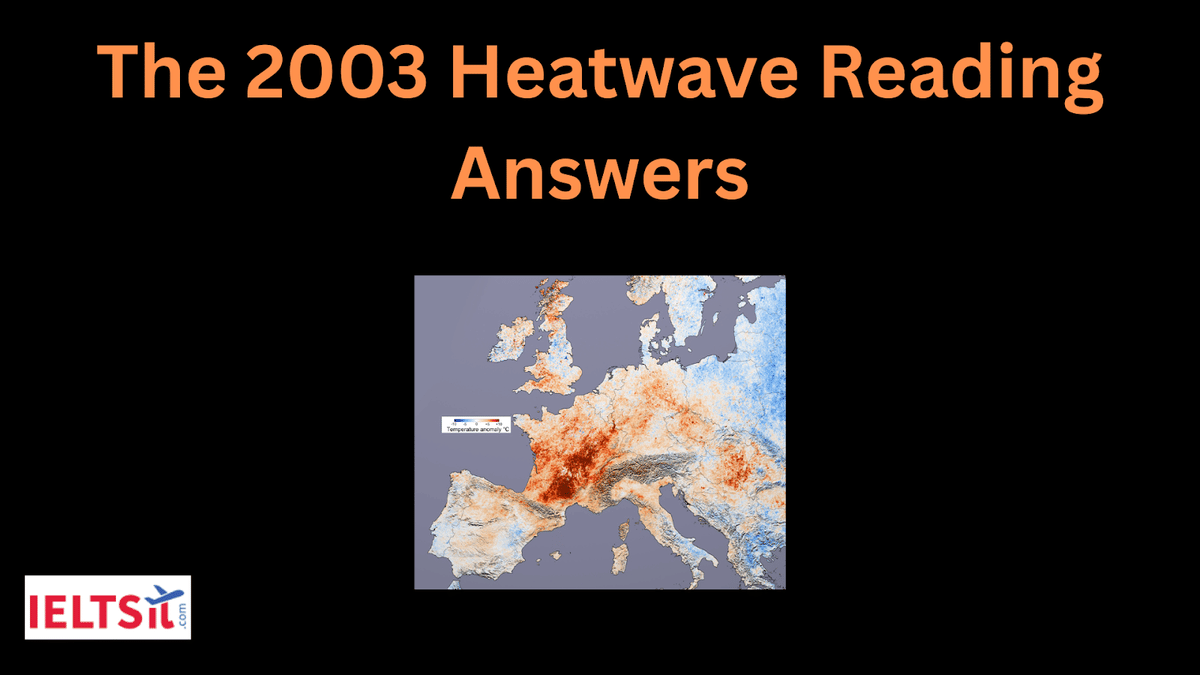
It was the summer, scientists now realise, when global warming, at last, made itself unmistakably felt. We knew that summer 2003 was remarkable: Britain experienced its record high temperature and continental Europe saw forest fires raging out of control, great rivers drying to a trickle and thousands of heat-related deaths. But just how remarkable is only now becoming clear. The three months of June, July and August were the warmest ever recorded in western and central Europe, with record national highs in Portugal, Germany and Switzerland as well as in Britain. And they were the warmest by a very long way. Over a great rectangular block of the earth stretching from west of Paris to northern Italy, taking in Switzerland and southern Germany, the average temperature for the summer months was 3.78° C above the long-term norm, said the Climatic Research Unit (CRU) of the University of East Anglia in Norwich, which is one of the world’s leading institutions for the monitoring and analysis of temperature records.
That excess might not seem a lot until you are aware of the context – but then you realise it is enormous. There is nothing like this in previous data, anywhere. It is considered so exceptional that Professor Phil Jones, the CRU’s director, is prepared to say openly – in a way few scientists have done before – that the 2003 extreme may be directly attributed, not to natural climate variability, but to global warming caused by human actions. Meteorologists have hitherto contented themselves with the formula that recent high temperatures are “consistent with predictions” of climate change. For the great block of the map – that stretching between 35–50N and 0–20E – the CRU has reliable temperature records dating back to 1781. Using as a baseline the average summer temperature recorded between 1961 and 1990, departures from the temperature norm, or “anomalies”, over the area as a whole can easily be plotted. As the graph shows, such is the variability of our climate that over the past 200 years, there have been at least half a dozen anomalies, in terms of excess temperature – the peaks on the graph denoting very hot years – approaching, or even exceeding, 2° C. But there has been nothing remotely like 2003, when the anomaly is nearly four degrees.
“This is quite remarkable,” Professor Jones told The Independent. “It’s very unusual in a statistical sense. If this series had a normal statistical distribution, you wouldn’t get this number. The return period [how often it could be expected to recur] would be something like one in a thousand years. If we look at an excess above the average of nearly four degrees, then perhaps nearly three degrees of that is natural variability, because we’ve seen that in past summers. But the final degree of it is likely to be due to global warming, caused by human actions.”
The summer of 2003 has, in a sense, been one that climate scientists have long been expecting. Until now, the warming has been manifesting itself mainly in winters that have been less cold than in summers that have been much hotter. Last week, the United Nations predicted that winters were warming so quickly that winter sports would die out in Europe’s lower-level ski resorts. But sooner or later, the unprecedented hot summer was bound to come, and this year it did.
One of the most dramatic features of the summer was the hot nights, especially in the first half of August. In Paris, the temperature never dropped below 23° C (73.4° F) at all between 7 and 14 August, and the city recorded its warmest-ever night on 11–12 August, when the mercury did not drop below 25.5° C (77.9° F). Germany recorded its warmest-ever night at Weinbiet in the Rhine Valley with the lowest figure of 27.6° C (80.6° F) on 13 August, and similar record-breaking nighttime temperatures were recorded in Switzerland and Italy. The 15,000 excess deaths in France during August, compared with previous years, have been related to the high night-time temperatures. The number gradually increased during the first 12 days of the month, peaking at about 2,000 per day on the night of 12–13 August, then fell off dramatically after 14 August when the minimum temperatures fell by about 5° C. The elderly were most affected, with a 70 per cent increase in mortality rate in those aged 75–94.
For Britain, the year as a whole is likely to be the warmest ever recorded, but despite the high temperature record on 10 August, the summer itself – defined as the June, July and August period – still comes behind 1976 and 1995, when there were longer periods of intense heat. “At the moment, the year is on course to be the third hottest ever in the global temperature record, which goes back to 1856, behind 1998 and 2002, but when all the records for October, November and December are collated, it might move into second place,” Professor Jones said. The ten hottest years in the record have now occurred since 1990. Professor Jones is in no doubt about the astonishing nature of European summer of 2003. “The temperatures recorded were out of all proportion to the previous record,” he said. “It was the warmest summer in the past 500 years and probably way beyond that. It was enormously exceptional.”
His colleagues at the University of East Anglia’s Tyndall Centre for Climate Change Research are now planning a special study of it. “It was a summer that has not been experienced before, either in terms of the temperature extremes that were reached, or the range and diversity of the impacts of the extreme heat,” said the centre’s executive director, Professor Mike Hulme. “It will certainly have left its mark on a number of countries, as to how they think and plan for climate change in the future, much as the 2000 floods have revolutionised the way the Government is thinking about flooding in the UK. The 2003 heatwave will have similar repercussions across Europe.”
Questions 14-19
Do the following statements agree with the information given in Reading Passage 2?
In boxes 14-19 on your answer sheet write:
YES if the statement agrees with the information
NO if the statement contradicts the information
NOT GIVEN if there is no information on this
14. The average summer temperature in 2003 is almost 4 degrees higher than the average temperature of the past.
Answer: YES
Supporting statement: “the average temperature for the summer months was 3.78° C above the long-term norm”
Keywords: average temperature, 3.78°C, long-term norm
Keyword Location: Paragraph 1, lines 8–10
Explanation:
The passage clearly states that the average summer temperature in 2003 was 3.78°C above the long-term average. This value is extremely close to four degrees and justifies the use of the phrase “almost 4 degrees.” The comparison is made directly with historical temperature norms. Since the numerical data strongly supports the statement, it accurately reflects the information in the passage. Therefore, the statement agrees with the writer’s view.
15. Global warming is caused by human activities.
Answer: YES
Supporting statement: “global warming caused by human actions”
Keywords: global warming, human actions
Keyword Location: Paragraph 2, lines 6–7
Explanation:
Professor Phil Jones explicitly attributes global warming to human actions rather than natural climate variability. The passage highlights that this opinion is stated openly, which was unusual for scientists at the time. This direct attribution confirms that human activity is responsible for global warming. Since the statement exactly matches this idea, it agrees with the information given in the passage.
16. Jones believes the temperature variation is within the normal range.
Answer: NO
Supporting statement: “There has been nothing remotely like 2003”
Keywords: exceptional, remotely like
Keyword Location: Paragraph 2, line 4
Explanation:
The passage emphasizes that the temperature anomaly of 2003 was extremely unusual and statistically rare. Professor Jones explains that such an event would be expected only once in a thousand years. This clearly shows that the temperature variation was not within the normal range. Since the statement claims the opposite, it contradicts the passage and is therefore incorrect.
17. The temperature is measured twice a day in major cities.
Answer: NOT GIVEN
Explanation:
While the passage provides detailed temperature records for several cities, it does not explain how frequently temperatures were measured. There is no mention of measurements being taken twice a day or at any specific intervals. Since this information is missing, the statement cannot be confirmed or denied. Therefore, the correct answer is NOT GIVEN.
18. There were milder winters rather than hotter summers before 2003.
Answer: YES
Supporting statement: “the warming has been manifesting itself mainly in winters”
Keywords: warming, winters
Keyword Location: Paragraph 4, line 1
Explanation:
The passage explains that before 2003, global warming was more noticeable in milder winters rather than extremely hot summers. Scientists had long expected a very hot summer to occur eventually. The summer of 2003 fulfilled that expectation. Since the statement reflects this explanation accurately, it agrees with the passage.
19. Governments are building new high-altitude ski resorts.
Answer: NO
Supporting statement: “winters were warming so quickly that winter sports would die out”
Keywords: winter sports, lower-level ski resorts
Keyword Location: Paragraph 4, lines 2–3
Explanation:
The passage states that winter sports may disappear from lower-level ski resorts due to warming winters. However, it does not say that governments are building new high-altitude ski resorts. No construction plans are mentioned anywhere in the text. Since the statement introduces information not supported by the passage, it contradicts the writer’s views.
Questions 20-21
Answer the questions below using NO MORE THAN TWO WORDS from the passage for each answer.
20. What are the other two hottest years in Britain besides 2003?
Answer: 1998 and 2002
Supporting statement: “behind 1998 and 2002”
Keywords: hottest, 1998, 2002
Keyword Location: Paragraph 6, lines 3–4
Explanation:
The passage states that Britain’s temperature record goes back to 1856 and compares recent years. Professor Jones explains that the year 2003 is likely to be the third hottest year recorded. He clearly mentions that only 1998 and 2002 were hotter than 2003. Since these two years are explicitly named, they are the correct answers according to the passage.
21. What will also influence government policies in the future like the hot summer in 2003?
Answer: floods
Supporting statement: “much as the 2000 floods have revolutionised the way the Government is thinking”
Keywords: floods, government
Keyword Location: Paragraph 7, lines 5–6
Explanation:
The passage compares the impact of the 2003 heatwave with another major climatic event. It specifically mentions the floods of the year 2000 and explains that they changed how the government plans for flooding. This comparison shows that floods influenced government policy in a similar way. Therefore, the correct answer taken directly from the passage is “floods.”
Questions 22-25
Complete the summary below using NO MORE THAN THREE WORDS from the passage for each answer.
22. The other two hottest years around the globe were ………….
Answer: 1998 and 2002
Supporting statement: “behind 1998 and 2002”
Keywords: hottest years, 1998, 2002
Keyword Location: Paragraph 6, lines 3–4
Explanation:
The summary refers to the hottest years around the globe. The passage clearly identifies 1998 and 2002 as the two years hotter than 2003. These years are used as reference points in global temperature records. Since the question asks for information taken directly from the text, these two years correctly complete the summary.
23. The ten hottest years on record all come after the year ……………
Answer: 1990
Supporting statement: “The ten hottest years in the record have now occurred since 1990”
Keywords: ten hottest years, since 1990
Keyword Location: Paragraph 6, line 6
Explanation:
The passage highlights a significant trend in global temperature records. It states clearly that all of the ten hottest years recorded have occurred since 1990. This information emphasizes the acceleration of global warming in recent decades. As the wording is exact and unambiguous, “1990” is the correct answer.
24. This temperature data has been gathered since ………………
Answer: 1781
Supporting statement: “the CRU has reliable temperature records dating back to 1781”
Keywords: temperature records, 1781
Keyword Location: Paragraph 2, lines 8–9
Explanation:
The passage explains the reliability and historical depth of temperature data used by the Climatic Research Unit. It clearly mentions that temperature records for the relevant area date back to 1781. This long data record is used to demonstrate how exceptional the 2003 heatwave was. Therefore, 1781 correctly completes the summary.
25. Thousands of people died in the country of ……………….
Answer: France
Supporting statement: “The 15,000 excess deaths in France during August”
Keywords: excess deaths, France
Keyword Location: Paragraph 5, line 5
Explanation:
The passage discusses the human impact of the extreme heat during the summer of 2003. It specifically mentions that France experienced around 15,000 excess deaths during August. These deaths are linked to unusually high night-time temperatures. Since the question asks where thousands of people died, France is the correct answer.
Question 26
Choose the correct letter A, B, C or D.
26. Which one of the following can be best used as the title of this passage?
A. Global Warming
B. What Caused Global Warming
C. The Effects of Global Warming
D. That Hot Year in Europe
Answer: D
Supporting statement: “the astonishing nature of European summer of 2003”
Keywords: European summer, exceptional
Keyword Location: Paragraphs 6–7
Explanation:
The entire passage focuses on the extraordinary summer of 2003 in Europe. It explains how temperatures were unprecedented and discusses their causes and impacts. While global warming is a key theme, the central focus is that particular year and its extreme heat. Therefore, “That Hot Year in Europe” best represents the overall content of the passage.
Check IELTS reading samples:
- Computer Games Reading Answers
- Gaston Community College Evening Classes Reading Answers
- Travelling Around the Country With Bus Passes Reading Answers
- Esito Dress Code Reading Answers
- Maritime Shippings Heavy Fuel Oil Debate Reading Answers
- Born to Trade Reading Answers
- Small Industry in Developing Countries
- Categorization between Monkeys and Chimpanzees Reading Answers
- Urgent Recall on Parkhurst Cat Food Reading Answers
- Human Empowerment Centre Memorandum Reading Answers
- The Price of Your Newspaper Reading Answers
- Bhimli Beach Reading Answers
- What to do When Moving Home Reading Answers
- Atlantis True Story or Cautionary Tale Reading Answer
- What Makes a Great Concert Hall Reading Answer
- DC Funds Reading Answers
- Avalanche Reading Answers
- Masley Pets Sale Reading Answers
- Workplace Harassment Reading Answers
- Poison Rain Reading Answers
- Miles Davis Icon and Iconoclast Reading Answers
- Global Response to Covid 19 Reading Answers
- Contact Lenses Reading Answers
- A buzz in the world of chemistry Reading Answers
- The Pick of This Summers Outdoor Music Festivals Reading Answers
- Newspapers Reading Answers
- Polo Reading Answers
- The Reindeer Reading Answers
- Drive on Low Beam in Fog Reading Answers
- Are You Being Bullied Reading Answers
- Theatre Reading Answers
- Can you Do Them at the Same Time Reading Answers
- Numeracy in Animals Reading Answers
- Non Pesticide Management of Crop in India Reading Answers
- Swordfish Reading Answers
- Mojito Reading Answers
- Calculating the Risk Reading Answers
- The Future of Getting Around in Cities Reading Answers
- Apollo 11 The First Moon Landing Reading Answers
- Potato Reading Answers
- Why Do Clocks go Clockwise Reading Answers
- Plastic Eating Worms Reading Answers
- Education To Be More Reading Answers
- Photosynthesis Reading Answers
- Giving Business presentations Reading Answers
- Business Continuity Planning Reading Answers
- Maintaining a Facility Reading Answers
- Roman Roads Reading Answers
- The Rise of Artificial Meat Reading Answers
- The Mystery of Monarch Butterfly Migration Reading Answers
Comments