Seven Wonders of the World Reading Answers
The answers for "Seven Wonders of the World" include 7 questions and are part of the assessment framework for the IELTS General Reading test. Candidates are allotted 10 minutes to complete the reading responses concerning "Seven Wonders of the World." This portion of the IELTS reading exam consists of various question formats, including Write A - G against each statement.
The answers for "Seven Wonders of the World" offer a comprehensive overview of the passage, explaining that the passage describes the Seven Wonders of the World, highlighting famous historical monuments from different civilizations across the globe. Each site is noted for its cultural, architectural, or historical significance and lasting global importance. For additional practice with similar reading assessments, candidates can refer to the IELTS Reading Practice Test section.
Check: Get 10 Free Sample Papers
Check: Register for IELTS Coaching - Join for Free Trial Class Now
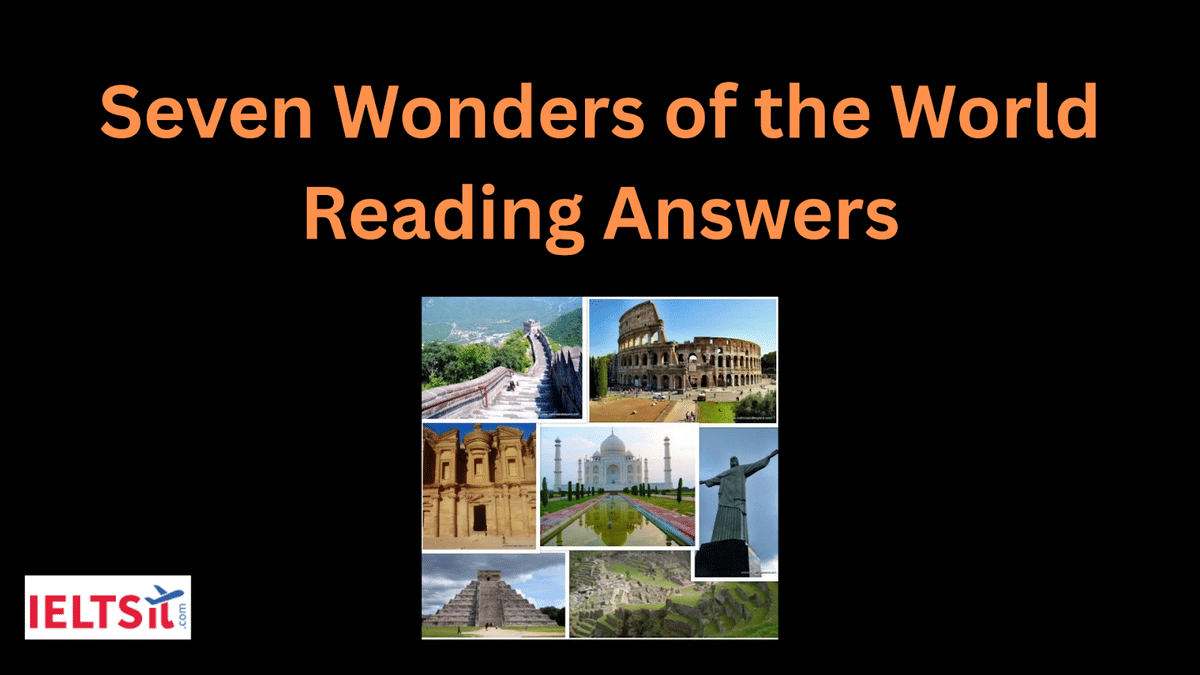
Topic:
Seven Wonders of the World Reading Answers
A. Great Wall of China: The Great Wall of China is a stone-and-earth fortification created to protect the borders of the Chinese Empire from invading Mongols. The Great Wall is actually a succession of multiple walls spanning approximately 4,000 miles, making it the world's longest manmade structure.
B. Christ the Redeemer Statue (Rio de Janeiro): This statue has been looming over the citizens of Rio : de Janeiro from upon Corcovado Mountain in an awe-inspiring state of eternal blessing since 1931.
The 130-foot reinforced concrete-and-soapstone statue was designed by Heitor da Silva Costa and cost approximately $250,000 to build.
C. Machu Picchu (Peru): Machu Picchu, an Incan city of sparkling granite is thought by scholars to have been a sacred archaeological center for the nearby Incan capital of Cusco. Built at the peak of the Incan Empire in the mid-1400s, this mountain citadel was later abandoned by the Incas. The site remained unknown except to locals until 1911, when it was rediscovered by archaeologist Hiram Bingham.
D. Chichen Itza (Yucatan Peninsula, Mexico): The genius and adaptability of Mayan culture can be seen in the splendid ruins of Chichen Itza. This powerful city, a trading center for cloth, slaves, honey and salt, flourished from approximately AD 800 to 1200, and acted as the political and economic hub of the Mayan civilization.
E. The Roman Colosseum (Rome): Rome's, if not Italy's, most enduring icon is undoubtedly its Colosseum.
Built between A.D. 70 and 80 A.D., the elliptical structure sat nearly 50,000 spectators, who gathered to watch the gladiatorial events as well as other public spectacles, including battle re-enactments, animal hunts and executions. Earthquakes and stone-robbers have left the Colosseum in a state of ruin.
F. Taj Mahal (Agra, India): A mausoleum commissioned for the wife of Mughal Emperor Shah Jahan, the Taj Mahal was built between 1632 and 1648. Considered the most perfect specimen of Muslim art in India, the white marble structure actually represents a number of architectural styles, including Persian, Islamic, Turkish and Indian. The Taj Mahal also encompasses formal gardens of raised pathways, sunken flower beds and a linear reflecting pool.
G. Petra (Jordan): Petra was the capital of the Nabataean empire of King Aretas V, and likely existed in its prime from 9 B.C. to A.D. 40. The members of this civilization proved to be early experts in manipulating water technology, constructing intricate tunnels and water chambers. A number of incredible structures carved into stone, a 4,000-seat amphitheater and the El-Deir monastery have also helped the site earn its fame.
Questions 8-14
Look at the descriptions of the Seven Wonders of the World. For which wonders are the following statements true? Write A - G against each statement.
8. It has for long been a symbol of not only the city, but also the country where it is located.
Answer: E
Supporting statement: “Rome's, if not Italy's, most enduring icon is undoubtedly its Colosseum.”
Keywords: enduring icon, Rome, Italy
Keyword Location: Paragraph E, line 1
Explanation:
The passage clearly describes the Roman Colosseum as an enduring icon. This indicates that it represents not only the city of Rome but also Italy as a whole. The phrase strongly suggests national as well as local symbolism. No other wonder is described in such representative terms. Therefore, the correct answer is E.
9. For a few hundred years, this city was a great commercial hub.
Answer: D
Supporting statement: “This powerful city, a trading center for cloth, slaves, honey and salt, flourished from approximately AD 800 to 1200.”
Keywords: trading center, flourished
Keyword Location: Paragraph D, lines 2–3
Explanation:
The description of Chichen Itza highlights its role as a major trading center. The mention of multiple traded goods indicates strong commercial activity. The city flourished for several centuries, which supports the idea of long-term economic importance. This makes it clear that the city was a great commercial hub. Hence, the answer is D.
10. This defensive structure protected a country's borders.
Answer: A
Supporting statement: “created to protect the borders of the Chinese Empire from invading Mongols.”
Keywords: protect borders, invading
Keyword Location: Paragraph A, line 1
Explanation:
The Great Wall of China is explicitly described as a defensive structure. Its purpose was to protect the borders of the Chinese Empire. The mention of invading Mongols reinforces its military function. No other structure in the passage has a similar defensive role. Therefore, the correct answer is A.
11. This structure encompasses several different styles of construction.
Answer: F
Supporting statement: “represents a number of architectural styles, including Persian, Islamic, Turkish and Indian.”
Keywords: architectural styles, Persian, Islamic
Keyword Location: Paragraph F, lines 2–3
Explanation:
The Taj Mahal is described as incorporating several architectural styles. These include Persian, Islamic, Turkish, and Indian influences. This clearly indicates a blend of different construction traditions. None of the other wonders mention such stylistic diversity. Thus, the correct answer is F.
12. This wonder arouses a sense of reverence and seems to be showering its blessings upon the city.
Answer: B
Supporting statement: “looming over the citizens of Rio de Janeiro… in an awe-inspiring state of eternal blessing.”
Keywords: eternal blessing, awe-inspiring
Keyword Location: Paragraph B, lines 1–2
Explanation:
The Christ the Redeemer statue is described as blessing the city. The language conveys reverence and spiritual symbolism. Its elevated position overlooking the city reinforces this impression. The sense of protection and blessing is unique to this wonder. Therefore, the correct answer is B.
13. This fortress had been deserted by its inhabitants.
Answer: C
Supporting statement: “this mountain citadel was later abandoned by the Incas.”
Keywords: abandoned, citadel
Keyword Location: Paragraph C, line 2
Explanation:
Machu Picchu is described as having been abandoned by its inhabitants. This indicates that the fortress was deserted after its period of use. The passage clearly states this fact without ambiguity. No other site is described as abandoned in this way. Hence, the correct answer is C.
14. The capital of an ancient empire, this site has a number of unbelievable structures.
Answer: G
Supporting statement: “Petra was the capital of the Nabataean empire… a number of incredible structures carved into stone.”
Keywords: capital, incredible structures
Keyword Location: Paragraph G, lines 1–3
Explanation:
Petra is identified as the capital of the Nabataean Empire. The passage highlights its remarkable stone-carved structures, amphitheater, and monastery. These features underline its architectural and historical importance. The description matches the statement exactly. Therefore, the correct answer is G.
Check IELTS reading samples:
- Computer Games Reading Answers
- Gaston Community College Evening Classes Reading Answers
- Travelling Around the Country With Bus Passes Reading Answers
- Esito Dress Code Reading Answers
- Maritime Shippings Heavy Fuel Oil Debate Reading Answers
- Born to Trade Reading Answers
- Small Industry in Developing Countries
- Categorization between Monkeys and Chimpanzees Reading Answers
- Urgent Recall on Parkhurst Cat Food Reading Answers
- Human Empowerment Centre Memorandum Reading Answers
- The Price of Your Newspaper Reading Answers
- Bhimli Beach Reading Answers
- What to do When Moving Home Reading Answers
- Atlantis True Story or Cautionary Tale Reading Answer
- What Makes a Great Concert Hall Reading Answer
- DC Funds Reading Answers
- Avalanche Reading Answers
- Masley Pets Sale Reading Answers
- Workplace Harassment Reading Answers
- Poison Rain Reading Answers
- Miles Davis Icon and Iconoclast Reading Answers
- Global Response to Covid 19 Reading Answers
- Contact Lenses Reading Answers
- A buzz in the world of chemistry Reading Answers
- The Pick of This Summers Outdoor Music Festivals Reading Answers
- Newspapers Reading Answers
- Polo Reading Answers
- The Reindeer Reading Answers
- Drive on Low Beam in Fog Reading Answers
- Are You Being Bullied Reading Answers
- Theatre Reading Answers
- Can you Do Them at the Same Time Reading Answers
- Numeracy in Animals Reading Answers
- Non Pesticide Management of Crop in India Reading Answers
- Swordfish Reading Answers
- Mojito Reading Answers
- Calculating the Risk Reading Answers
- The Future of Getting Around in Cities Reading Answers
- Apollo 11 The First Moon Landing Reading Answers
- Potato Reading Answers
- Why Do Clocks go Clockwise Reading Answers
- Plastic Eating Worms Reading Answers
- Education To Be More Reading Answers
- Photosynthesis Reading Answers
- Giving Business presentations Reading Answers
- Business Continuity Planning Reading Answers
- Maintaining a Facility Reading Answers
- Roman Roads Reading Answers
- The Rise of Artificial Meat Reading Answers
- The Mystery of Monarch Butterfly Migration Reading Answers
Comments