Bittern Conservation Reading Answers
The answers for "Bittern Conservation Reading Answers" include 13 questions and are part of the assessment framework for the IELTS General Reading test. Candidates are allotted 20 minutes to complete the reading responses concerning "Bittern Conservation Reading Answers." This portion of the IELTS reading exam consists of various question formats, including writing no more than three words and choosing the correct heading.
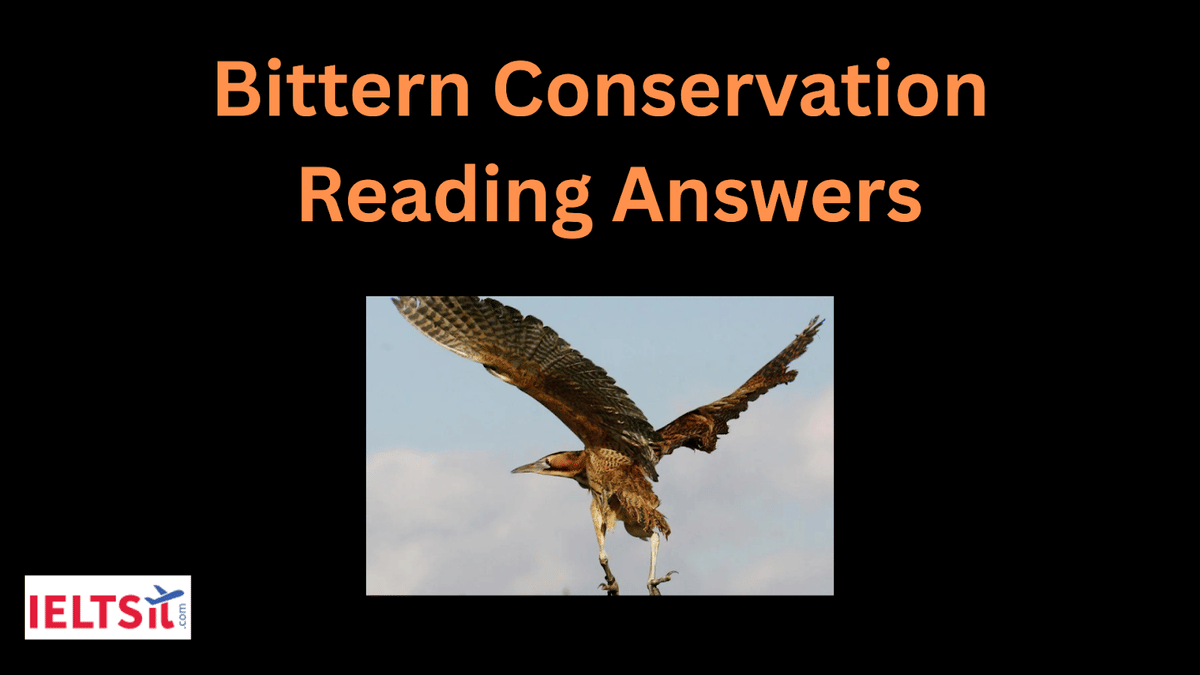
The answers for "Bittern Conservation Reading Answers" offer a comprehensive overview of Bitterns in the UK, which have declined to near extinction but have recovered significantly due to targeted scientific research and intensive reedbed habitat conservation. EU-funded projects, habitat management, and monitoring have helped stabilise and expand populations, securing a more sustainable future for the species. For additional practice with similar reading assessments, candidates can refer to the IELTS Reading Practice Test section.
Check: Get 10 Free Sample Papers
Check: Register for IELTS Coaching - Join for Free Trial Class Now
Topic:
Bittern Conservation Reading Answers
Section A:Bitterns, which are heron-like birds, once prized as a dish for medieval banquets, were considered extinct as a breeding species in the UK by the 1870s. They recolonised the UK in the early 20th century, with a peak of about 80 booming males in the 1950s, but then numbers slid to fewer than 20 in the 1990s. By 1997, the species was facing extinction in the UK again, with there being just 11 males, mainly in Norfolk and Suffolk, with a small outlying population at Leighton Moss, Lancashire. In 2007, the bittern numbers are at a record high. Ecologists attributed the rise in populations to intensive conservation efforts that have protected the birds' preferred habitat of dense, wet, reedbeds. The wildlife charity said the turnaround in the bird's fortunes had been helped by legal protection of the habitats and funding through two environmental projects under the EU Life scheme for the creation of new reedbed areas.
Section B:Bitterns have cryptic plumage and a shy nature, usually remaining hidden within the cover of reedbed vegetation. Our first challenge was to develop standard methods to monitor their numbers. The call, or boom of the male bittern is its most distinctive feature during the breeding season, and we developed a method to count them using the sound patterns unique to each individual one. This not only allows us to be much more certain of the number of booming males in the UK, but also enables us to estimate local survival of males from one year to the next.
Section C:Our first direct understanding of the habitat needs of breeding bitterns came from comparisons of reedbed sites that had lost their booming birds with those that retained them. This research showed that bitterns had been retained in reedbeds where the natural process of succession, or drying out, had been slowed through management. Based on this work, broad recommendations on how to manage and rehabilitate reedbeds for bitterns were made, and funding was provided through the EU LIFE Fund to manage 13 sites within the core breeding range. This project, though led by the RSPB, involved many other organizations.
Section D:To refine these recommendations and provide fine-scale, quantitative habitat prescriptions on the bitterns preferred feeding habitat, we radio-tracked male bitterns on the RSPB's Minsmere and Leighton Moss reserves. This showed clear preferences for feeding in the wetter reedbed margins, particularly within the reedbed next to larger open pools. The average home range sizes of the male bitterns we followed (about 20 hectares) provided a good indication of the area of reedbed needed when managing or creating habitat for this species. Female bitterns undertake all the incubation and care of the young, so it was important to understand their needs as well. Over the course of our research, we located 87 bittern nests and found that female bitterns preferred to nest in areas of continuous vegetation, well into the reedbed, but where water was still present during the driest part of the breeding season.
Section E:The success of the habitat prescriptions developed from this research has been spectacular. For instance, at Minsmere, booming bittern numbers gradually increased from one to 10 following reedbed lowering, a management technique designed to halt the drying out process. After a low point of 11 booming males in 1997, bittern numbers in Britain responded to all the habitat management work and started to increase for the first time since the 1950s.
Section F:The final phase of research involved understanding the diet, survival and dispersal of bittern chicks. To do this we fitted small radio tags to young bittern chicks in the nest, to determine their fate through to fledging and beyond. Many chicks did not survive to fledging and starvation was found to be the most likely reason for their demise. The fish prey fed to chicks was dominated by those species penetrating into the reed edge. So, an important element of recent studies (including a PhD with the University of Hull) has been the development of recommendations on habitat and water conditions to promote healthy native fish populations.
Section G:Once independent, radio-tagged young bitterns were found to seek out new sites during their first winter; a proportion of these would remain on new sites to breed if the conditions were suitable. A second EU LIFE funded project aims to provide these suitable sites in new areas. A network of 19 sites developed through this partnership project will secure a more sustainable UK bittern population with successful breeding outside of the core area, less vulnerable to chance events and sea level rise.
Section H:By 2004, the number of booming male bitterns in the UK had increased to 55, with almost all the increase being on those sites undertaking management based on advice derived from our research. Although science has been at the core of the bittern story, success has only been achieved through the trust, hard work and dedication of all the managers, owners and wardens of sites that have implemented, in some cases very drastic, management to secure the future of this wetland species in the UK. The constructed bunds and five major suices now control the water level over 82 ha, with a further 50 ha coming under control in the winter of 2005/06. Reed establishment has principally used natural regeneration or planted seedlings to provide small core areas that will in time expand to create a bigger reed area. To date nearly 275,000 seedlings have been planted and reed cover is extensive. Over 3 km of new ditches have been formed, 3.7 km of existing ditch have been re-profiled and 2.2 km of old meander (former estuarine features) has been cleaned out.
Section I:
Bitterns now regularly winter on the site and there is some indication that they are staying longer into the spring. No breeding has yet occurred, but a booming male was present in the spring of 2004. A range of wildfowl breed, as well as a good number of reedbed passerines including reed bunting, reed, sedge and grasshopper warblers. Numbers of wintering shoveler have increased so that the site now holds a UK important wintering population. Malltraeth Reserve now forms part of the UK network of key sites for water vole (a UK priority species) and 12 monitoring transects has been established. Otter and brown-hare occur on the site as does the rare plant.
Questions 14-22
The reading passage has nine sections, A-I.
Choose the correct heading for sections A-I from the list of headings below.
List of Headings
i. Collection of data on the habitat
ii. The decline of the bittern population
iii. A focus on food for young bitterns
iv. Developing new sites to improve successful breeding
v. Boom vocalizations used to evaluate population
vi. Positive outcome of bittern population and reedbed area
vii. Management technique implemented proved successful
viii. Identifying the habitat
ix. Bittern present throughout one season and into the next
x. fluctuation in bittern population
xi. Distinct boom of the male bittern
xii. Preferred habitats for female bitterns
14. Section A
Answer: x. fluctuation in bittern population
Supporting statement: “They recolonised the UK… numbers slid to fewer than 20 in the 1990s… In 2007, the bittern numbers are at a record high.”
Keywords: [recolonised, slid, record high, numbers]
Keyword Location: Section A, lines 2–6
Explanation: The section traces changes in the bittern population over time. It describes extinction, recovery, decline, and resurgence. These repeated rises and falls clearly show population fluctuation. Conservation measures are mentioned as causes, but the main focus is numerical change. Hence, fluctuation best summarizes the section.
15. Section B
Answer: v. Boom vocalizations used to evaluate population
Supporting statement: “We developed a method to count them using the sound patterns unique to each individual.”
Keywords: [boom, sound patterns, count, monitoring]
Keyword Location: Section B, lines 3–5
Explanation: This section explains how researchers monitored bittern numbers. The focus is on the male’s booming call and its use for counting individuals. Sound patterns allow accurate population estimates. The heading highlights the method used rather than the sound itself. Therefore, heading v is correct.
16. Section C
Answer: viii. Identifying the habitat
Supporting statement: “Comparisons of reedbed sites that had lost their booming birds with those that retained them.”
Keywords: [comparisons, reedbed sites, habitat needs]
Keyword Location: Section C, lines 1–3
Explanation: The paragraph explains how researchers identified suitable breeding habitats. It compares successful and unsuccessful reedbeds. The findings led to management recommendations. The main goal was understanding habitat requirements. Thus, identifying the habitat is the best heading.
17. Section D
Answer: xii. Preferred habitats for female bitterns
Supporting statement: “Female bitterns preferred to nest in areas of continuous vegetation… where water was still present.”
Keywords: [female, nest, preferred, vegetation]
Keyword Location: Section D, final lines
Explanation: Although male feeding areas are discussed, emphasis shifts to females. The paragraph explains nesting preferences and conditions needed for breeding. Female requirements are clearly highlighted. Therefore, the heading specifically about female habitats fits best.
18. Section E
Answer: vii. Management technique implemented proved successful
Supporting statement: “Booming bittern numbers gradually increased from one to 10 following reedbed lowering.”
Keywords: [management technique, increased, reedbed lowering]
Keyword Location: Section E, lines 1–3
Explanation: This section evaluates the effectiveness of management strategies. It shows numerical improvement after intervention. The focus is on results rather than planning. The success of techniques is clearly demonstrated. Hence, heading vii is correct.
19. Section F
Answer: iii. A focus on food for young bitterns
Supporting statement: “Starvation was found to be the most likely reason for their demise.”
Keywords: [chicks, starvation, diet, fish prey]
Keyword Location: Section F, lines 3–6
Explanation: The paragraph focuses on chick survival and feeding. It explains dietary needs and causes of death. Research aims to improve food availability. The emphasis is clearly on nutrition for young bitterns. Thus, heading iii fits.
20. Section G
Answer: iv. Developing new sites to improve successful breeding
Supporting statement: “A network of 19 sites developed through this partnership project.”
Keywords: [new sites, network, breeding, EU LIFE]
Keyword Location: Section G, lines 3–5
Explanation: This section discusses dispersal and breeding at new locations. It highlights site development beyond core areas. The aim is long-term population stability. Creating new breeding sites is the main theme. Therefore, heading iv is appropriate.
21. Section H
Answer: vi. Positive outcome of bittern population and reedbed area
Supporting statement: “The number of booming male bitterns… increased to 55.”
Keywords: [increased, booming males, reed establishment]
Keyword Location: Section H, lines 1–6
Explanation: The paragraph highlights overall success. It combines population growth with habitat expansion. Detailed statistics show improvement. The tone is strongly positive. Hence, the heading reflects outcomes achieved.
22. Section I
Answer: ix. Bittern present throughout one season and into the next
Supporting statement: “Bitterns now regularly winter on the site… staying longer into the spring.”
Keywords: [winter, spring, staying longer]
Keyword Location: Section I, lines 1–2
Explanation: The focus is on seasonal presence. Although breeding has not occurred, extended stays are noted. This indicates improving conditions. The heading captures continuity across seasons accurately.
Questions 23-26
Choose NO MORE THAN THREE WORDS for each answer.
23. How many bittern nests were found over the course of the research?
Answer: 87
Supporting statement: “We located 87 bittern nests…”
Keywords: [87, nests, located]
Keyword Location: Section D, line 6
Explanation: The exact number of nests is clearly stated. This figure comes from direct observation. No inference is required. Hence, the answer is precise.
24. What management technique was used to halt the drying out process of the reedbed?
Answer: reedbed lowering
Supporting statement: “Following reedbed lowering, a management technique designed to halt the drying out process.”
Keywords: [reedbed lowering, drying out]
Keyword Location: Section E, line 2
Explanation: The technique is directly named. Its purpose is also explained. This makes the answer unambiguous. Therefore, “reedbed lowering” is correct.
25. What was the main reason for chicks not surviving?
Answer: starvation
Supporting statement: “Starvation was found to be the most likely reason for their demise.”
Keywords: [starvation, demise, chicks]
Keyword Location: Section F, line 4
Explanation: The cause of death is explicitly stated. Research confirms this finding. No alternative reason is suggested. Thus, starvation is the correct answer.
26. How many new sites were developed through partnership projects?
Answer: 19 sites
Supporting statement: “A network of 19 sites developed through this partnership project.”
Keywords: [19 sites, network, partnership]
Keyword Location: Section G, line 4
Explanation: The number of sites is clearly mentioned. It refers to newly developed areas. The wording matches the question exactly. Hence, the answer is correct.
Check IELTS reading samples:
- Computer Games Reading Answers
- Gaston Community College Evening Classes Reading Answers
- Travelling Around the Country With Bus Passes Reading Answers
- Esito Dress Code Reading Answers
- Maritime Shippings Heavy Fuel Oil Debate Reading Answers
- Born to Trade Reading Answers
- Small Industry in Developing Countries
- Categorization between Monkeys and Chimpanzees Reading Answers
- Urgent Recall on Parkhurst Cat Food Reading Answers
- Human Empowerment Centre Memorandum Reading Answers
- The Price of Your Newspaper Reading Answers
- Bhimli Beach Reading Answers
- What to do When Moving Home Reading Answers
- Atlantis True Story or Cautionary Tale Reading Answer
- What Makes a Great Concert Hall Reading Answer
- DC Funds Reading Answers
- Avalanche Reading Answers
- Masley Pets Sale Reading Answers
- Workplace Harassment Reading Answers
- Poison Rain Reading Answers
- Miles Davis Icon and Iconoclast Reading Answers
- Global Response to Covid 19 Reading Answers
- Contact Lenses Reading Answers
- A buzz in the world of chemistry Reading Answers
- The Pick of This Summers Outdoor Music Festivals Reading Answers
- Newspapers Reading Answers
- Polo Reading Answers
- The Reindeer Reading Answers
- Drive on Low Beam in Fog Reading Answers
- Are You Being Bullied Reading Answers
- Theatre Reading Answers
- Can you Do Them at the Same Time Reading Answers
- Numeracy in Animals Reading Answers
- Non Pesticide Management of Crop in India Reading Answers
- Swordfish Reading Answers
- Mojito Reading Answers
- Calculating the Risk Reading Answers
- The Future of Getting Around in Cities Reading Answers
- Apollo 11 The First Moon Landing Reading Answers
- Potato Reading Answers
- Why Do Clocks go Clockwise Reading Answers
- Plastic Eating Worms Reading Answers
- Education To Be More Reading Answers
- Photosynthesis Reading Answers
- Giving Business presentations Reading Answers
- Business Continuity Planning Reading Answers
- Maintaining a Facility Reading Answers
- Roman Roads Reading Answers
- The Rise of Artificial Meat Reading Answers
- The Mystery of Monarch Butterfly Migration Reading Answers
Comments