Bacteriophages Reading Answers
Bacteriophages Reading Answers is an academic reading answers topic. Bacteriophages Reading Answers has a total of 13 IELTS questions, such as
- Do the following statements agree with the views of the writer in Reading Passage 3? Write Yes, No, or Given
- Choose the correct letter.
- Complete each sentence with the correct ending, A-G.
The IELTS Reading section is an essential part of the test that evaluates a candidate's comprehension and analysis of various passage types. You will work through a number of IELTS reading practice problems in this section that resemble actual test situations. These questions are designed to help you improve your ability to recognise essential concepts, extract particular facts, and make inferences. Practising these IELTS reading problems can help you get comfortable with the structure and increase your confidence for the exam, regardless of whether you are studying for the Academic or General Training module.
Check: Get 10 Free Sample Papers
Check: Register for IELTS Coaching - Join for Free Trial Class Now
Section 1
BACTERIOPHAGES
A viral solution to antibiotic resistance?
The use of antibiotics has entered a crisis stage. More and more antibiotic-resistant bacteria are emerging that cannot be cured if the body's own immune system cannot defeat them. It can take scientists decades to come up with a new antibiotic and get government approval. This means medicine is fighting a losing battle as bacteria are increasingly evolving to resist antibiotics. An alternative method to fight these infections might be through bacteriophages, which are viruses that prey on bacteria.
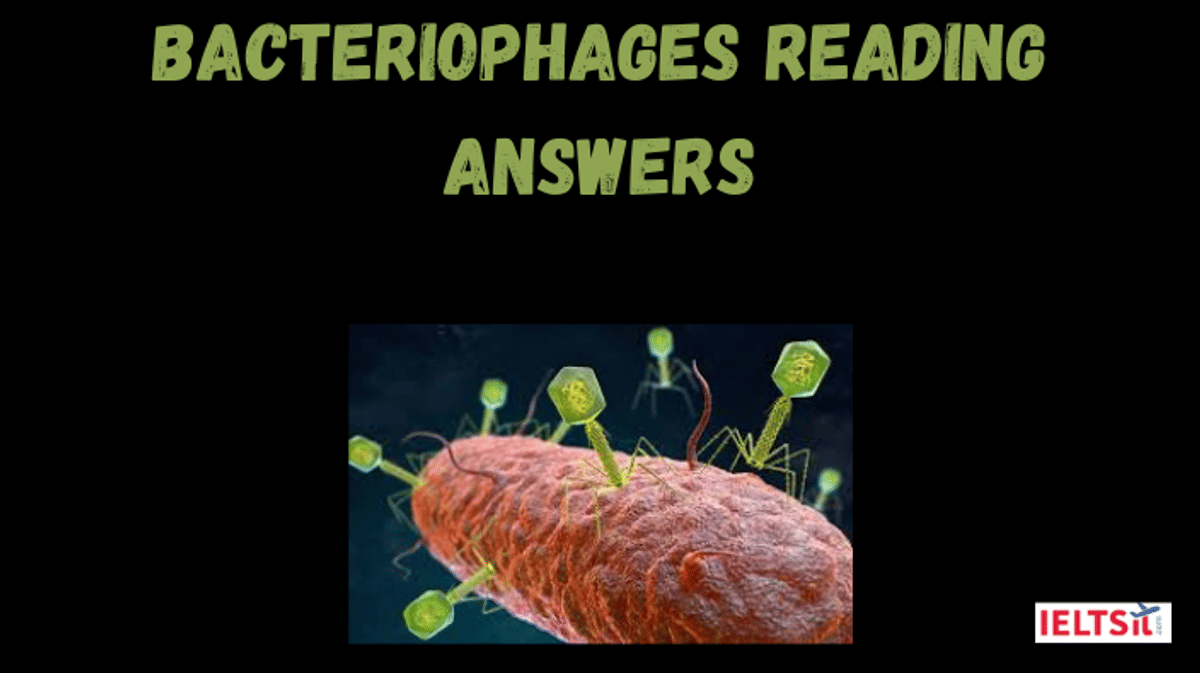
Bacteriophages, or phages, were discovered more than ten years before penicillin, and it was found they could successfully treat cholera and dysentery, though it was not well understood why at the time. Scientists observed that there was a section of the population that recovered from these illnesses independently, and they hypothesized that they had developed some way of fighting bacteria in their Intestinal tract. Faeces samples were taken from these patients and transferred into other patients. In one early study in India, the majority of people with cholera who were untreated died, while those treated with phages had a 90 per cent recovery rate. Even with this early success, phage therapy was soon forgotten when penicillin was discovered by Alexander Fleming in 1928, and antibiotics became the sole focus in the fight against bacterial infections. Perhaps one of the reasons for this was that it was not until the middle of the century that phages were first observed with an electron microscope. Before that, they were barely understood, and though used in the treatment of cholera and dysentery, scientists could only speculate as to why they had been successful. Now it is understood that phages are types of viruses that exclusively infect bacteria. Like all viruses, they reproduce by invading a host cell, replicate themselves by taking over the host cell's mechanisms, and then, when leaving the cell, tend to destroy it. This can be disastrous when human cells are infected by viruses, but in the case of phages, they only attack bacteria.
A phage begins its attack on bacteria by inserting its genetic material into its host, literally taking over the host's functions. Then the phage duplicates itself multiple times. In the final stage, the phage breaks the cell walls of the bacterial host with toxic chemicals, releasing duplicates of itself to infect more bacteria. An antibiotic kills bacteria by interfering with one or more of the processes that bacteria need to survive. As these processes are similar in many bacteria, antibiotics can kill many species of bacteria at once. While antibiotics have transformed medicine by being very effective in stopping bacterial infections, the introduction of phage therapy could have numerous advantages over antibiotics.
Each type of phage only attacks one species of bacteria and so does not damage the good bacteria living in our intestinal tracts. Called the gut microbiota or the gut biome. Each human body is populated by hundreds of microbe species, which have important functions in the body such as making nutrients the body is unable to create, controlling metabolism and protecting the gut lining. When antibiotics kill all the bacteria they come in contact with, it disrupts the delicate balance of the gut biome because beneficial gut bacteria are also killed.
Bacteria does not become resistant to phages like it does to antibiotics. This is because antibiotics disturb the cellular process of bacteria, while phages destroy the cells themselves. Something that is destroyed is no longer able to develop resistance. Bacteria are also able
to develop a protective biofilm that can protect them from antibiotics, but phages are equipped with tools that can digest it. So why are phages not being used instead of antibiotics? The main reason is that, because antibiotics have been so successful since their development, there has been little incentive to continue research on phage therapy. There are also some limitations to phages as well. Live phages can be difficult to isolate, and if the separation from surrounding matter is not completely clean, a deadly immune response in the patient could result. In addition, Phage therapy takes longer than antibiotic treatment. Due to antibiotics universally killing all bacteria, doctors can prescribe a broad-spectrum antibiotic without knowing what the offending bacteria is. In the case of phages, the bacteria not only need to be identified, but if there is currently no known phage to treat the bacteria in question, a new one has to be found. This is why phage therapy currently tends to be used for chronic bacterial infections, rather than critical, immediately life-threatening cases. As the search for new phages continues, and more and more are added to the arsenal, before long, there should be a wide enough variety of different phages discovered to combat most bacteria. Currently, it is mainly being used as a last resort for patients with antibiotic-resistant bacterial infections. As antibiotic resistance increases, phage therapy should come into its own as a leading form of treatment.
Questions 27-32
Do the following statements agree with the views of the writer in Reading Passage 3?
YES - if the statement agrees with the views of the writer
NO - if the statement contradicts the views of the writer
NOT GIVEN - if it is impossible to say what the writer thinks
27. It is impossible for medicine to keep up with the emergence of new antibiotic-resistant bacteria.
Answer: YES
Supporting statement: It can take scientists decades to come up with a new antibiotic and get government approval. This means medicine is fighting a losing battle as bacteria are increasingly evolving to resist antibiotics.
Keywords: fighting a losing battle, evolving to resist
Keyword Location: Para 1, Line 4
Explanation: The phrase "fighting a losing battle" strongly implies that medicine cannot keep pace with the bacteria's evolution.
28. Penicillin became the dominant treatment because early usage of phages was unsuccessful.
Answer: NO
Supporting statement: Even with this early success, phage therapy was soon forgotten when penicillin was discovered by Alexander Fleming in 1928, and antibiotics became the sole focus in the fight against bacterial infections.
Keywords: early success, soon forgotten
Keyword Location: Para 2, Line 8
Explanation: The text mentions the "early success" of phage therapy (90% recovery rate for cholera), which directly contradicts the idea that it was ignored because it was unsuccessful.
29. Phages were only able to be used after the invention of the electron microscope.
Answer: NO
Supporting statement: Bacteriophages... were discovered more than ten years before penicillin, and it was found they could successfully treat cholera and dysentery... Perhaps one of the reasons for this was that it was not until the middle of the century that phages were first observed with an electron microscope.
Keywords: before penicillin, middle of the century
Keyword Location: Para 2, Line 1
Explanation: Phages were successfully used to treat diseases like cholera and dysentery before the electron microscope was invented and before they were truly understood.
30. The gut biome communicates with both the nervous and digestive systems.
Answer: NOT GIVEN
Explanation: The passage lists several functions of the gut biome, but does not mention communication with the nervous or digestive systems.
31. Antibiotic therapy is faster than phage therapy because the antibiotic has already been formulated.
Answer: NOT GIVEN
Explanation: The text confirms antibiotic therapy is faster to administer (because the bacteria doesn't need to be identified), but it does not state that the speed is because the antibiotic has already been formulated.
32. It is doubtful that phage use will overtake that of antibiotics.
Answer: NO
Supporting statement: As antibiotic resistance increases, phage therapy should come into its own as a leading form of treatment.
Keywords: leading form of treatment
Keyword Location: Para 5, Line 19
Explanation: The writer suggests phage therapy will become a "leading form of treatment", which contradicts the statement that it is doubtful it will overtake antibiotics
Questions 33-37
Choose the correct letter.
33. According to the writer, antibiotics use is at a critical stage because
A. governments won't approve new strains.
B. people's immune systems have started attacking them.
C. they can't be used against resistant bacteria.
D. they will be displaced by bacteriophages.
Answer: C
Supporting statement: More and more antibiotic-resistant bacteria are emerging that cannot be cured if the body's own immune system cannot defeat them.
Keywords: antibiotic-resistant bacteria
Keyword Location: Para 1, Lines 1-2
Explanation: According to the text, the crisis is due to the emergence of resistant bacteria that antibiotics cannot cure.
34. What was an observation made by scientists about the use of phages?
A. They were created by the body.
B. They existed in patients who had recovered from illness.
C. They were caused by Illness.
D. They would only be successful in Cholera patients.
Answer: B
Supporting statement: Scientists observed that there was a section of the population that recovered from these illnesses independently, and they hypothesized that they had developed some way of fighting bacteria in their Intestinal tract. Faeces samples were taken from these patients and transferred into other patients
Keywords: illnesses independently, Faeces samples
Keyword Location: Para 2, Lines 4-5
Explanation: Phages were found in the samples of patients who had recovered, suggesting their presence was linked to recovery
35. The writer believes that phage therapy may have been ignored because
A. no one actually saw phages until the middle of last century.
B. it was thought they were a type of bacteria.
C. the use of viruses was considered dangerous.
D. they had not been effective.
Answer: A
Supporting statement: Perhaps one of the reasons for this was that it was not until the middle of the century that phages were first observed with an electron microscope. Before that, they were barely understood, and though used in the treatment of cholera and dysentery, scientists could only speculate as to why they had been successful.
Keywords: phages, electron microscope
Keyword Location: Para 2 Line 11
Explanation: Since they were "barely understood" before being seen with the electron microscope, this lack of understanding may have contributed to their neglect after penicillin's discovery.
36. Scientists now know that phages
A. reproduce by taking over bacterial cells.
B. do not contain their own DNA.
C. can be destroyed with toxic chemicals
D. kill bacteria in an identical process to antibiotics.
Answer: A
Supporting statement: Like all viruses, they reproduce by invading a host cell, replicate themselves by taking over the host cell's mechanisms, and then, when leaving the cell, tend to destroy it. A phage begins its attack on bacteria by inserting its genetic material into its host, literally taking over the host's functions.
Keywords: host cell, replicate
Keyword Location: Para 2, Lines 14-15
Explanation: The process involves the phage taking over and replicating itself using the host cell's mechanisms
37. What point does the writer make about the gut biota?
A. it is not affected by antibiotics.
B. it can be damaged by phages.
C. it is the cause of antibiotic resistance.
D. it is barely affected by phages.
Answer: D
Supporting statement: Each type of phage only attacks one species of bacteria and so does not damage the good bacteria living in our intestinal tracts. When antibiotics kill all the bacteria they come in contact with, it disrupts the delicate balance of the gut biome because beneficial gut bacteria are also killed.
Keywords: attacks one species,
Keyword Location: Para 4, Line 1
Explanation: Phages are highly specific and therefore do not harm the majority of beneficial gut bacteria, meaning the biome is "barely affected" compared to the damage caused by broad-spectrum antibiotics.
Questions, 38-40
38. Bacteria does not become resistant to phages because
Answer: B
Supporting statement: Bacteria does not become resistant to phages like it does to antibiotics. This is because antibiotics disturb the cellular process of bacteria, while phages destroy the cells themselves. Something that is destroyed is no longer able to develop resistance.
Keywords: Bacteria, antibiotics, cellular process
Keyword Location: Para 5, Lines 1-2Complete each sentence with the correct ending, A-G.
Explanation: Phages destroy the bacterial cell, and a destroyed entity cannot evolve resistance
39. Phages have been known to be dangerous because
Answer: D
Supporting statement: Live phages can be difficult to isolate, and if the separation from surrounding matter is not completely clean, a deadly immune response in the patient could result
Keywords: Live phages, deadly immune response
Keyword Location: Para 5, Lines 8-9
Explanation: According to the text, the potential danger lies in contamination during isolation, which could trigger a "deadly immune response."
40. Phages have not been used until now because
Answer: A
Supporting statement: The main reason is that, because antibiotics have been so successful since their development, there has been little incentive to continue research on phage therapy.
Keywords: successful, phage therapy
Keyword Location: Para 5, Lines 6-7
Explanation: The success of antibiotics eliminated the incentive to research and use phage therapy.
A. antibiotics have been so successful they are unnecessary.
B. a bacterial cell cannot develop resistance if it has been destroyed.
C. they are only effective if the immune system is weak.
D. they can cause an immune reaction if not prepared correctly.
E. their long-term effects are unknown.
Check IELTS reading samples:
- Volunteering with Open Doors Reading Answers
- How to Live Life Perspectives of Meaningful Living Reading Answers
- How to Succeed in Exams Reading Answers
- The Changing Role of Housewives in Modern Society Reading Answers
- Altius Offer Letter of Employment Reading Answers
- Employment Verification Information Reading Answers
- New Library Services at Brookdale Community Library Reading Answers
- The Mammals Reading Answers
- Recharger Reading Answers
- The Rise of Urban Gardening Reading Answers
- Sustainable Fashion A Shift in the Clothing Industry Reading Answers
- The Benefits of Workplace Volunteering Programs Reading Answers
- LLEWYN The Troubadour of a Lost Age Reading Answers
- Combining Passion with Work Reading Answers
- Internal Complaint Review An Understanding Reading Answers
- Understanding Economic Investments and Development Reading Answers
- The Secret Language of Trees Reading Answers
- Leaflet City Library Summer Reading Challenge Reading Answers
- Email From A Travel Agency Holiday Package Information Reading Answers
- Rental Agreement Greenlane Apartments Reading Answers
- Parkside Community Swimming Pool Guidelines Reading Answers
- Cognitive Decline and Aging Understanding the Process Reading Answers
- The Complexities of Human Memory Reading Answers
- Riverdale Textiles Employee Benefits Guide Reading Answers
- The Impact of Urban Green Spaces on Health and Society Reading Answers
- The Disappearing Art of Letter Writing Reading Answers
- Renting a Property Guidelines for Tenants Reading Answers
- Quantum Entanglement Reading Answers
- Out of Africa The Tobacco Wars New Battleground Reading Answers
- Latin Influence in English Down Reading Answers
- Beauty Through the Ages Reading Answers
- Family Transformations From Traditional to Chosen Reading Answers
- Transportation Shapes Cities Reading Answers
- Russian Archaeology Reading Answers
- Economizing the Poor Reading AnswersEconomizing the Poor Reading Answers
- The Koala Reading Answers
- Aswan High Dam Reading Answers
- The Japanese Rock Garden Reading Answers
- Its a Boy Not an Old Wives Tale Reading Answers
- Wind Power Reading Answers
- The Art of the Perfect Nap Reading Answers
- 200 years of Australian Landscape at the Royal Academy in London Reading Answers
- How Sled Dogs and Pets Respond when the Clocks Change Reading Answers
- The Benefits of Natures Fires Reading Answers
- Chilies Reading Answers
- Yoruba Town Reading Answers
- Delights of Mass Tourism reach Galapagos Reading Answers
- Damascus Reading Answers
- Fruit Picking Work in Australia Reading Answers
- Hasst Legal Services Reading Answers
Comments