Australia struggling with Skin Cancers Reading Answers
The answers for "Australia struggling with Skin Cancers " include 13 questions and are part of the assessment framework for the IELTS General Reading test. Candidates are allotted 20 minutes to complete the reading responses concerning "Australia struggling with Skin Cancers." This portion of the IELTS reading exam consists of various question formats, including write the correct letter, write NO MORE THAN THREE WORDS for each, choose THREE letters, and use NO MORE THAN TWO WORDS for each.
The answers for "Australia struggling with Skin Cancers" offer a comprehensive overview of the passage, explaining that the passage describes that skin cancer is the most common cancer, mainly caused by ultraviolet radiation, with melanoma being the most dangerous type. Awareness campaigns and preventive measures like wearing protective clothing, using sunscreen, and avoiding strong sunlight help reduce the risk of skin cancer. For additional practice with similar reading assessments, candidates can refer to the IELTS Reading Practice Test section.
Check: Get 10 Free Sample Papers
Check: Register for IELTS Coaching - Join for Free Trial Class Now
Topic:
Australia struggling with Skin Cancers Reading Answers
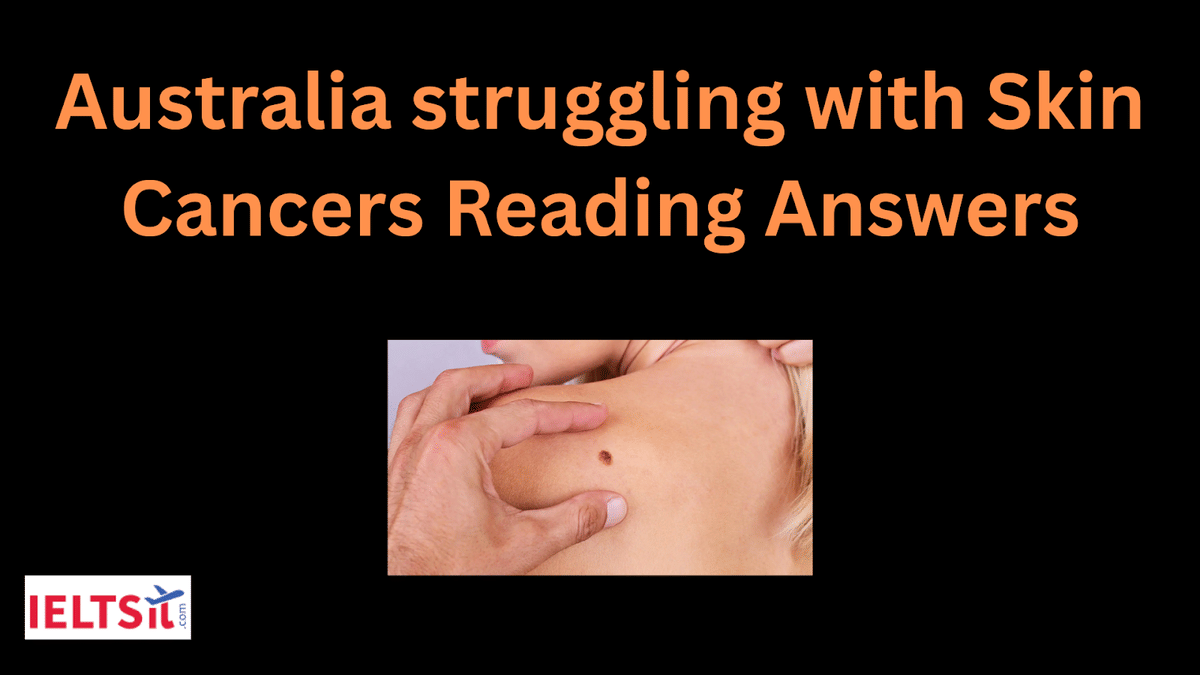
Skin cancer, malignancy in the skin, is the most common of all cancers. There are three main types of skin cancer: basal cell carcinoma, squamous cell carcinoma, and melanoma. Basal cell carcinoma, the most common type, along with melanoma, develops in the basal, or bottom layer of the epidermis, the top layer of skin. Squamous cell carcinoma, the second most common type, develops in the upper layers of the epidermis. The American Cancer Society estimates that basal cell and squamous cell skin cancers account for more than 1.3 million new cases each year, but for only 1,900 deaths in the United States. The third type of skin cancer is melanoma. It develops in the melanocytes, or pigment cells, which are found throughout the basal layer. Melanoma is the most lethal type of skin cancer and is responsible for about three-quarters of all skin cancer deaths.
Two out of three Australians will develop skin cancer, and an estimated 1,000 die from it each year. The main risk factors for skin cancer are ultraviolet radiation exposure and skin type. People who burn or freckle rather than tanning and have blond or red hair have higher risk. However, exposure also can cause skin cancers among people with darker skin. The southern United States has very high rates for the same reason. Israel also has a skin cancer problem among immigrants of European background. The rates aren't as high as in Australia because there are fewer Israelis with very light complexions. Rates in Scandinavia and Israel are similar because most Scandinavians have a more susceptible skin type, even though they are exposed to less UV radiation at home.
Because of Australia's high rate of skin cancer, the Anti-Cancer Council (ACC) of Victoria, Australia has started perhaps the most comprehensive public skin cancer education program in the world. The campaign's messages include a television ad called "Timebomb," in which a doctor removes a skin cancer nodule that has spread to the lymph node in a patient's underarm. The aim of the ad is to show that sunburn can cause far greater damage below the skin's surface than above it and may plant a skin cancer "Timebomb" that will explode some later time.
In addition to the media campaign, a program called "SunSmart" works with schools to teach children about the dangers of the sun.
It's known that 80% of lifetime sun exposure is acquired before age 18. This makes taking sensible precautions in childhood and adolescence the prime preventive measure. Eighty percent of all primary schools in the state of Victoria have a "no hat, play in the shade" policy which means the kids cannot go outdoors unless they're wearing a hat. The ACC has adapted another public education campaign originally developed in Australia and the United States. The "Slip! Slop! Slap" program offers this message to put on a shirt, slop on sunscreen, and slap on a hat to protect your skin. Other recommendations included in this campaign are: skin exposure should be minimized between the hours of 10 am and 2 pm, when the sun is at its strongest; eye protection is necessary; and sunscreen should be applied at least 15 minutes before starting any outdoor work and should then be re-applied every 2 hours.
Research is another key function of the Victoria Anti-Cancer Council. There are a number of Australian agencies and experts working in education and research domestically and worldwide. Earlier this year, for example, the Australian Cancer Society released findings from a study that many Australians still mistakenly assume sunscreen will completely protect them from sunburn and skin cancer. This misconception means they use sunscreen to prolong their time in the sun, increasing their risk of developing melanoma. Later, a leading Australian cancer specialist suggested replacing sun protection factor numbers on sunscreen products with descriptions of the level of protection, such as "low" or "ultra-high." This could reduce confusion and encourage people to use sunscreens more appropriately.
Although the Australian population is very well-informed in relation to the link between sun exposure and skin cancer, people get bored with hearing the same message again and again, so experts have to try and re-invent and recreate the prevention message on an ongoing basis. They are now attempting to influence policies in society in general to help to reduce sun exposure. For example, employers can help prevent skin cancer by rotating workers' tasks so their time in the sun is minimized; elected safety and health representatives should be consulted in formulating a policy; and new buildings need to have a certain number of car parking spaces for their own. Along those same lines, new buildings also need to have an appropriate amount of shade provided so that the avoidance of exposure to the sun is easier.
Questions 28 - 31
Which statement applies to each of the types of skin cancers that are mentioned in the passage?
Choose FOUR answers from the box and write the correct letter A-E..
A. is found in the bottom layer of the epidermis.
B. happens most frequently.
C. has about 2,000 deaths annually in the United States.
D. accounts for about 75% of skin cancer deaths.
E. is not found in the basal layer of the epidermis.
28. Basal cell carcinoma
Answer: B
Supporting statement: “Basal cell carcinoma, the most common type…”
Keywords: most common type
Keyword Location: Paragraph 1, line 2
Explanation: The passage clearly states that basal cell carcinoma is the most common type of skin cancer. This directly indicates that it happens most frequently compared to the other types mentioned. The phrase “most common type” supports the answer. Therefore, option B is correct as it reflects the frequency of occurrence of basal cell carcinoma.
29. Squamous cell carcinoma
Answer: E
Supporting statement: “Squamous cell carcinoma… develops in the upper layers of the epidermis.”
Keywords: upper layers, epidermis
Keyword Location: Paragraph 1, line 4
Explanation: The passage explains that squamous cell carcinoma develops in the upper layers of the epidermis. This means it is not located in the basal or bottom layer. Since the option states that it is not found in the basal layer of the epidermis, option E correctly applies to squamous cell carcinoma.
30. Melanoma
Answer: D
Supporting statement: “Melanoma… is responsible for about three-quarters of all skin cancer deaths.”
Keywords: three-quarters, deaths
Keyword Location: Paragraph 1, last line
Explanation: The passage describes melanoma as the most dangerous type of skin cancer. It specifically states that melanoma accounts for about three-quarters of all skin cancer deaths. This shows that melanoma has the highest death rate among the three types. Hence, option D is correct.
31. Basal cell carcinoma along with melanoma
Answer: A
Supporting statement: “Basal cell carcinoma, the most common type, along with melanoma, develops in the basal… layer of the epidermis.”
Keywords: along with melanoma, basal layer
Keyword Location: Paragraph 1, line 3
Explanation: The text explains that both basal cell carcinoma and melanoma develop in the basal or bottom layer of the epidermis. Since the question asks about basal cell carcinoma along with melanoma, option A is correct as it refers to cancers found in the bottom layer of the epidermis.
Questions 32 - 34
Write NO MORE THAN THREE WORDS for each.
32. Exposure also can cause skin cancers among people with ……………..
Answer: darker skin
Supporting statement: “However, exposure also can cause skin cancers among people with darker skin.”
Keywords: darker skin
Keyword Location: Paragraph 2, line 3
Explanation: The passage highlights that although people with lighter skin are at higher risk, ultraviolet radiation exposure can still cause skin cancer in individuals with darker skin. This directly answers the question using the exact phrase from the passage. Therefore, “darker skin” is the correct response.
33. Australia has higher skin cancer incidence rates than Israel because Israelis with light skin are ……………………….than in Australia.
Answer: fewer Israelis
Supporting statement: “The rates aren't as high as in Australia because there are fewer Israelis with very light complexions.”
Keywords: fewer Israelis, light complexions
Keyword Location: Paragraph 2, line 6
Explanation: The passage compares skin cancer rates between Australia and Israel. It explains that Australia has higher rates because Israel has fewer people with very light complexions, who are more vulnerable to UV radiation. Thus, the phrase “fewer Israelis” completes the statement correctly.
34. The rate of skin cancer incidence in Scandinavia is not as high as in Australia due to ……………
Answer: less UV radiation
Supporting statement: “Rates in Scandinavia… are exposed to less UV radiation at home.”
Keywords: less UV radiation
Keyword Location: Paragraph 2, last line
Explanation: The passage notes that people in Scandinavia are exposed to less ultraviolet radiation compared to Australia. Although their skin type may be susceptible, the lower UV exposure results in lower incidence rates. Therefore, “less UV radiation” is the correct answer.
Questions 35 - 37
Choose THREE letters.
According to the text, the Anti-Cancer Council of Victoria, Australia
A. has started a TV ad campaign to show that Australia has enough doctors to treat skin cancer patients.
B. has started public programs for skin cancer prevention.
C. has worked with schools to warn children of the danger of exposure to the sun.
D. has adopted a TV ad to teach the danger of the sun in the United States as well as Australia.
E. has a research team working to prevent skin cancers in many countries including Australia.
35. Answer: B
Supporting statement: “the Anti-Cancer Council (ACC) of Victoria, Australia has started perhaps the most comprehensive public skin cancer education program in the world.”
Keywords: comprehensive public, education program
Keyword Location: Paragraph 3, line 1
Explanation: The passage clearly states that the Anti-Cancer Council of Victoria has started one of the most comprehensive public education programs related to skin cancer. This indicates their involvement in prevention programs aimed at reducing the risk of skin cancer. Therefore, option B correctly reflects the council’s work in public skin cancer prevention.
36. Answer: C
Supporting statement: “a program called ‘SunSmart’ works with schools to teach children about the dangers of the sun.”
Keywords: works with schools, teach children
Keyword Location: Paragraph 4, line 1
Explanation: The passage mentions that the SunSmart program collaborates with schools to educate children about the harmful effects of sun exposure. This shows that the Anti-Cancer Council is directly involved in warning children about sun-related dangers. Hence, option C is the correct answer.
37. Answer: E
Supporting statement: “There are a number of Australian agencies and experts working in education and research domestically and worldwide.”
Keywords: agencies and experts, education and research, worldwide
Keyword Location: Paragraph 6, line 2
Explanation: The passage states that Australian agencies and experts are involved in research and education both within Australia and internationally. This indicates that the council contributes to research efforts aimed at preventing skin cancer across multiple countries. Therefore, option E correctly describes their research involvement.
Questions 38 - 39
Use NO MORE THAN TWO WORDS for each.
PROPOSALS FOR SKIN CANCER PREVENTION
A. Employers should help to prevent skin cancers by 38………..workers' tasks in order to minimize their time in the sun.
Answer: rotating
Supporting statement: “employers can help prevent skin cancer by rotating workers' tasks…”
Keywords: rotating workers' tasks
Keyword Location: Paragraph 7, line 3
Explanation: The passage suggests employers should reduce workers’ sun exposure by rotating their tasks. This strategy ensures that workers do not remain in the sun for long periods. Therefore, the correct word taken directly from the text is “rotating.”
B. Safety and health representatives should be consulted in formulating a policy.
C. New buildings need to have a certain number of 39…………… spaces allotted to them.
Answer: car parking
Supporting statement: “new buildings need to have a certain number of car parking spaces…”
Keywords: car parking spaces
Keyword Location: Paragraph 7, line 5
Explanation: The passage proposes that new buildings must include designated car parking spaces as part of policies to reduce sun exposure. This is mentioned directly in the prevention suggestions. Hence, the correct answer is “car parking.”
D. New buildings also need to have an appropriate amount of shade.
Question 40
Choose the correct letter.
The main topic discussed in the passage is
A. the rate of skin cancer incidence in Australia.
B. the damage caused to Australia by skin cancers.
C. the effort of Australia to reduce skin cancers.
D. a few types of skin cancers which occur in Australia
Answer: C
Supporting statement: “Because of Australia's high rate of skin cancer… comprehensive public skin cancer education program…”
Keywords: education program, prevention message
Keyword Location: Paragraph 3, line 1
Explanation: The passage mainly focuses on the measures taken by Australia, especially Victoria’s Anti-Cancer Council, to prevent and reduce skin cancer rates. It discusses awareness campaigns, school programs, research, and policy changes. Therefore, the main topic is Australia’s efforts to reduce skin cancers, making option C correct.
Check IELTS reading samples:
- Volunteering with Open Doors Reading Answers
- How to Live Life Perspectives of Meaningful Living Reading Answers
- How to Succeed in Exams Reading Answers
- The Changing Role of Housewives in Modern Society Reading Answers
- Altius Offer Letter of Employment Reading Answers
- Employment Verification Information Reading Answers
- New Library Services at Brookdale Community Library Reading Answers
- The Mammals Reading Answers
- Recharger Reading Answers
- The Rise of Urban Gardening Reading Answers
- Sustainable Fashion A Shift in the Clothing Industry Reading Answers
- The Benefits of Workplace Volunteering Programs Reading Answers
- LLEWYN The Troubadour of a Lost Age Reading Answers
- Combining Passion with Work Reading Answers
- Internal Complaint Review An Understanding Reading Answers
- Understanding Economic Investments and Development Reading Answers
- The Secret Language of Trees Reading Answers
- Leaflet City Library Summer Reading Challenge Reading Answers
- Email From A Travel Agency Holiday Package Information Reading Answers
- Rental Agreement Greenlane Apartments Reading Answers
- Parkside Community Swimming Pool Guidelines Reading Answers
- Cognitive Decline and Aging Understanding the Process Reading Answers
- The Complexities of Human Memory Reading Answers
- Riverdale Textiles Employee Benefits Guide Reading Answers
- The Impact of Urban Green Spaces on Health and Society Reading Answers
- The Disappearing Art of Letter Writing Reading Answers
- Renting a Property Guidelines for Tenants Reading Answers
- Quantum Entanglement Reading Answers
- Out of Africa The Tobacco Wars New Battleground Reading Answers
- Latin Influence in English Down Reading Answers
- Beauty Through the Ages Reading Answers
- Family Transformations From Traditional to Chosen Reading Answers
- Transportation Shapes Cities Reading Answers
- Russian Archaeology Reading Answers
- Economizing the Poor Reading AnswersEconomizing the Poor Reading Answers
- The Koala Reading Answers
- Aswan High Dam Reading Answers
- The Japanese Rock Garden Reading Answers
- Its a Boy Not an Old Wives Tale Reading Answers
- Wind Power Reading Answers
- The Art of the Perfect Nap Reading Answers
- 200 years of Australian Landscape at the Royal Academy in London Reading Answers
- How Sled Dogs and Pets Respond when the Clocks Change Reading Answers
- The Benefits of Natures Fires Reading Answers
- Chilies Reading Answers
- Yoruba Town Reading Answers
- Delights of Mass Tourism reach Galapagos Reading Answers
- Damascus Reading Answers
- Fruit Picking Work in Australia Reading Answers
- Hasst Legal Services Reading Answers
Comments