The Ring-Tailed Lemur Reading Answers
The Ring-Tailed Lemur Reading Answers is an academic reading answers topic. The Ring-Tailed Lemur Reading Answers has a total of 13 IELTS questions. In the first question set, you have to choose which paragraph contains the given statement. In the second question set given, you have to correct the option in no more than two words. In the last question set, you have to choose the correct letter, A, B, C, or D.
The IELTS Reading section is an essential part of the test that evaluates a candidate's comprehension and analysis of various passage types. You will work through a number of IELTS reading practice problems in this section that resemble actual test situations. These questions are designed to help you improve your ability to recognise essential concepts, extract particular facts, and make inferences. Practising these IELTS reading problems can help you get comfortable with the structure and increase your confidence for the exam, regardless of whether you are studying for the Academic or General Training module.
Check: Get 10 Free Sample Papers
Check: Register for IELTS Coaching - Join for Free Trial Class Now
Section 1
THE RING TAILED LEMUR
A.One of the most loved animals found in zoos is the ring-tailed lemur, noted for its long, black and white ringed tail. The popularity of the animal soared after it was featured as a main character in a series of animated films that have appeared in cinemas globally since 2005. Known scientifically as lemur catta, with the latter half of its scientific name referring to its supposed resemblance to the domestic cat. The species hails from the island of Madagascar in the Indian Ocean. In the local language of Malagasy, the ring-tailed lemur is also known as the maky or hira. Although thriving in captivity, the lemur's wild population numbers are experiencing
a downward trend, as is the case with other species endemic to the island.
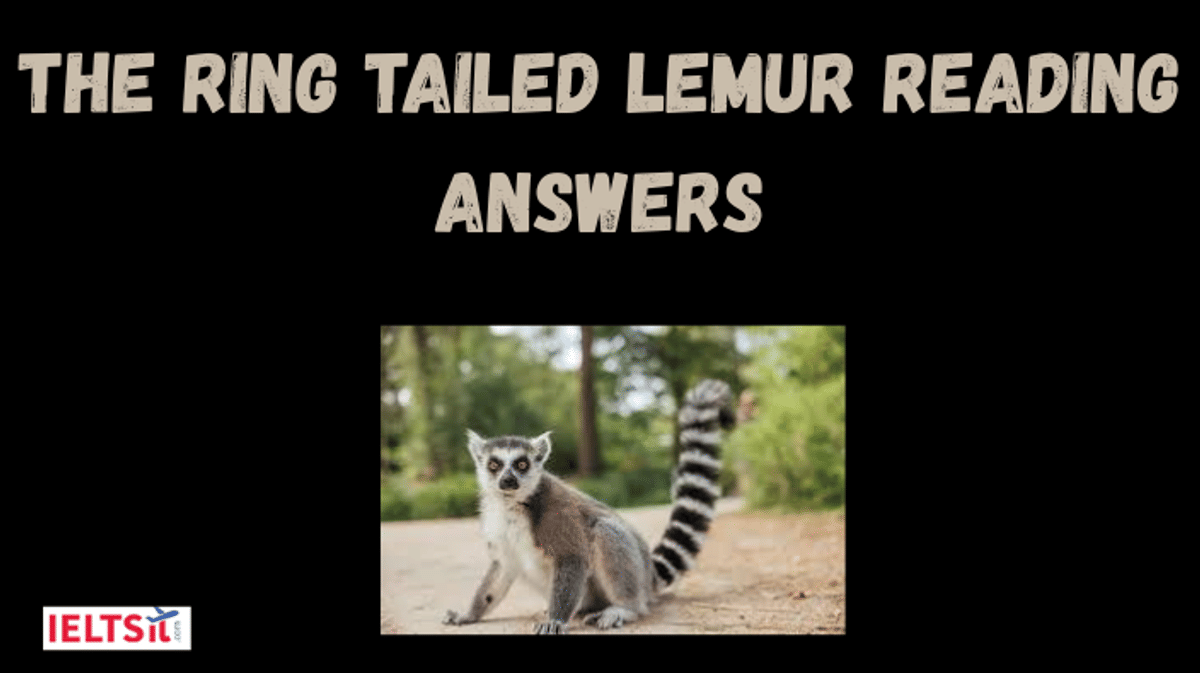
B.The ring-tailed lemur's most distinctive feature is its tail, which can grow up to 60 cm long and can have as many as 13 alternately coloured rings of fur. The lemur's face, hands. and feet are predominantly White, but the face is characterised by dark triangular patches surrounding the eyes and nose. The body of the ring-tailed lemur is usually grey or dark brown in colour, with white undersides, completing the recognisable look, whereas the exposed skin. which can be easily seen on the feet, hands, and face, is dark, almost black, in colour. The ring-tailed lemur is fairly small in comparison to many mammals, weighing in at around 22 kg, but this is relatively large compared to other lemur species. The ring-tailed lemur is mostly spotted during the day, as this is when it is most active, and it can often be seen sunbathing.
C.Due to the Isolated geographical location of Madagascar, the Island is home to a rich diversity of unique animal and plant species, and the ring-tailed lemur has made the island, as well as a few neighbouring islands, its home. The lemur appears to have settled in the south-eastern corner of the island and tends to prefer forested areas. but has been known to explore wider, open spaces. The animal strongly prefers gallery forests. which are those that form along riverbanks, but rainforests and tropical forests also provide habitats.
D.Communication between ring-tailed lemurs has provided a rich topic for study, as it is one of the most vocal primates. Scientists have classified a variety of calls used for different purposes. For example, a barking sound alerts the group to danger, whereas a howl, which can be heard kilometres away, represents a marking of territory. In addition to auditory communication, the ring-tailed lemur communicates with facial expressions, and again. Scientists have been able to identify different functions. These include different ways of baring the teeth or the movement of eyebrows to indicate friendliness or aggression. Lemurs also communicate through scent marking, and the ring-tailed lemur is no different. Scent is sprayed either to show dominance over a territory or in aggression during a fight.
E.Fights over territory are most often performed by dominant females within the group, which is also known as a troop. In fact, the troop is largely controlled by females, who take hierarchical precedence when feeding or leading the group. The social group generally consists of between 3 and 25 lemurs, averaging around 17 animals, usually headed by one dominant female. However, this does not mean that males have no ranking; the male hierarchy relies on age. whereas the female hierarchy is usually based on dominant fighting ability. This means that daughters of the dominant females are not automatically promoted to a higher position but will have to fight to reach the top. Females tend to stay in the group into which they are born, but males change troops on a regular basis, and it is not unusual for male lemurs to return to troops they have left.
F.Intelligence in primates has long been a focus of studies. especially their ability to use and create tools. Observations of ring-tailed lemurs in the wild have not revealed any evidence of tool use or tool making, but studies carried out at the Myakka City reserve in Madagascar found that lemurs were able to use some tools if they were trained to do so. Research continues into the cognitive ability of the ring-tailed lemur, but attempts are being hampered by the challenges of studying animals In Isolation from their social groups.
G.While the ring-tailed lemur is surviving well in captivity, its wild population is suffering. According to research, 95% of the wild population has disappeared since 2000. In 2017, it was reported that there were around 2,000 lemurs left in the wild. The species has been listed as endangered since 1977, but now it is likely to be listed as critically endangered because of the decline in numbers, The main reason for this population loss is habitat destruction and deforestation by humans, It has been estimated that 90% of original forests in Madagascar have been lost due to logging, mining, and conversion to agricultural land. In addition to this, drought severely affects parts of the island, and this has devastated the lemur population, with infants and females particularly at risk. Another reason for the decline in population is the hunting of the species for food or for the illegal pet trade. However, with the increase in popularity of ecotourism, essential knowledge is being provided to local residents, enabling them to care for their species and other unique animals and plants.
Questions 1-6
Reading passage 1 has seven paragraphs, A-G.
Which paragraph contains the following Information? Write the correct letter, A-G.
NB You may use any letter more than once.
1. A change in conservation classification
Answer: G
Supporting statement: The species has been listed as endangered since 1977, but now it is likely to be listed as critically endangered because of the decline in numbers
Keywords: endangered, decline in numbers
Keyword Location: Para G, Lines 4-5
Explanation: Paragraph G explicitly states that the species' conservation classification is likely to be upgraded from "endangered" to "critically endangered" due to the population decline.
2. A reference to the role of smell in lemur behaviour
Answer: D
Supporting statement: Lemurs also communicate through scent marking, and the ring-tailed lemur is no different. Scent is sprayed either to show dominance over a territory or in aggression during a fight.
Keywords: scent marking, Scent is sprayed
Keyword Location: Para D, Lines 7-8
Explanation: Paragraph D details how lemurs use scent marking as a form of communication to establish dominance or aggression, which is a key part of their behavior.
3. A reason why lemurs are popular
Answer: A
Supporting statement: The popularity of the animal soared after it was featured as a main character in a series of animated films that have appeared in cinemas globally since 2005.
Keywords: animal soared, featured as a main character
Keyword Location: Para A, Lines 2-3
Explanation: Paragraph A attributes the significant increase in the lemur's popularity to its role as a main character in animated films.
4. An explanation of the noises made by the lemur
Answer: D
Supporting statement: Scientists have classified a variety of calls used for different purposes. For example, a barking sound alerts the group to danger, whereas a howl, which can be heard kilometres away, represents a marking of territory.
Keywords: classified a variety of calls, barking sound, howl
Keyword Location: Para D, Lines 2-3
Explanation: Paragraph D explains that the lemur is a very vocal primate and gives specific examples of the sounds it makes (barking, howling) and the purposes for which those sounds are used (danger alert, marking territory).
5. A description of lemurs' chosen living spaces
Answer: C
Supporting statement: The lemur appears to have settled in the south-eastern corner of the island and tends to prefer forested areas... The animal strongly prefers gallery forests, which are those that form along riverbanks, but rainforests and tropical forests also provide habitats.
Keywords: settled, forested areas, prefers gallery forests, rainforests
Keyword Location: Para C, Lines 3-6
Explanation: Paragraph C focuses on the lemur's habitat, specifically describing the types of forests (gallery, rainforest, tropical) it prefers and where on the island it has settled.
6. A summary of how the ring-tailed lemur society functions
Answer: E
Supporting statement: Fights over territory are most often performed by dominant females within the group, which is also known as a troop. In fact, the troop is largely controlled by females, who take hierarchical precedence when feeding or leading the group... whereas the female hierarchy is usually based on dominant fighting ability.
Keywords: controlled by females, hierarchical precedence
Keyword Location: Para E, Lines 2-3
Explanation: Paragraph E details the social structure ("society") of the ring-tailed lemur, explaining the troop size, the dominance of females, how the female and male hierarchies are determined, and the general roles within the group.
Questions 7-10
Choose NO MORE THAN TWO WORDS for each.
7. What other animal do ring-tailed lemurs look like?
Answer: (DOMESTIC) CAT
Supporting statement: Known scientifically as lemur catta, with the latter half of its scientific name referring to its supposed resemblance to the domestic cat.
Keywords: lemur catta, resemblance to the domestic cat
Keyword Location: Para A, Lines 4-5
The passage explicitly states that the second part of the scientific name refers to its resemblance to the domestic cat.
8. In addition to its limbs, where else can dark skin be observed on the lemur?
Answer: (THE) FACE
Supporting statement: whereas the exposed skin. which can be easily seen on the feet, hands, and face, is dark, almost black, in colour.
Keywords: exposed skin, feet, hands, and face, dark
Keyword Location: Para B, Lines 5-6
Explanation: The passage lists the feet, hands (limbs), and face as places where dark, exposed skin is easily seen.
9. Where are the lemur-preferred forests located in south-eastern Madagascar?
Answer: (ALONG ) RIVERBANKS
Supporting statement: The animal strongly prefers gallery forests. which are those that form along riverbanks
Keywords: gallery forests, along riverbanks
Keyword Location: Para C, Lines 5-6
Explanation: The text defines gallery forests, the lemur's preferred habitat, as those that form along riverbanks.
10. What sounds do lemurs make to mark their territory?
Answer: A HOWL
Supporting statement: whereas a howl, which can be heard kilometres away, represents a marking of territory.
Keywords: howl, marking of territory
Keyword Location: Para D, Lines 3-4
Explanation: The passage directly connects the sound "a howl" with the action of "marking of territory."
Questions 11-13
Choose the correct letter, A, B, C, or D.
11. According to the passage, one of the reasons lemurs spray scent is to
A. be friendly to other animals.
B. recognise members of their own family.
C. show they are fierce fighters.
D. alert the group to danger.
Answer: C
Supporting statement: Scent is sprayed either to show dominance over a territory or in aggression during a fight.
Keywords: Scent is sprayed, aggression, fight
Keyword Location: Para D, Lines 8-9
Explanation: Spraying scent is used to show dominance or aggression during a fight, which is a display of fighting ability or fierceness.
12. The social group, known as a troop,
A. is a democracy with many leaders.
B. uses different hierarchical systems.
C. does not need to contain males.
D. has a consistent membership.
Answer: B
Supporting statement: In fact, the troop is largely controlled by females... The social group generally consists of between 3 and 25 lemurs... the male hierarchy relies on age, whereas the female hierarchy is usually based on dominant fighting ability.
Keywords: male hierarchy relies on age, female hierarchy, dominant fighting ability
Keyword Location: Para E, Lines 2 & 5-6
Explanation: The passage states that the male hierarchy and the female hierarchy are determined by different criteria (age for males, fighting ability for females), meaning the troop uses different systems for ranking its members.
13. According to the final paragraph,
A. wild lemur populations are increasing.
B. there are no original forests left in Madagascar.
C. ecotourism has eradicated the illegal pet trade.
D. there are several reasons for the declining numbers of lemurs.
Answer: D
Supporting statement: The main reason for this population loss is habitat destruction and deforestation by humans... In addition to this, drought severely affects parts of the island... Another reason for the decline in population is the hunting of the species for food or for the illegal pet trade.
Keywords: main reason, habitat destruction, deforestation by humans
Keyword Location: Para G, Lines 5-6
Explanation: Paragraph G lists habitat destruction, drought, and hunting/pet trade as distinct factors contributing to the population decline, indicating there are several reasons.
Read More IELTS Reading Related Samples
- Staff Committees and Delegation Structure Langdon Public Office Reading Answers
- Michigan Young Adults Group Connect Grow Lead Reading Answers
- Understanding CAT Food Labels Reading Answers
- Advertisement Crystelo Learning Centre Reading Answers
- The Role of Investigative Journalism Reading Answers
- The Science Behind Procrastination Reading Answers
- The Spread and Psychology of Rumours Reading Answers
- The future of Remote Work Reading Answers
- Understanding Employee Satisfaction Reading Answers
- Freelancing with Full Time Work Reading Answers
- Donton Land Organization trust Reading Answers
- Harshnars Crafts eSpecials Reading Answers
- Volunteering with Open Doors Reading Answers
- How to Live Life Perspectives of Meaningful Living Reading Answers
- How to Succeed in Exams Reading Answers
- The Changing Role of Housewives in Modern Society Reading Answers
- Altius Offer Letter of Employment Reading Answers
- Employment Verification Information Reading Answers
- New Library Services at Brookdale Community Library Reading Answers
- The Mammals Reading Answers
- Recharger Reading Answers
- The Rise of Urban Gardening Reading Answers
- Sustainable Fashion A Shift in the Clothing Industry Reading Answers
- The Benefits of Workplace Volunteering Programs Reading Answers
- LLEWYN The Troubadour of a Lost Age Reading Answers
- Combining Passion with Work Reading Answers
- Internal Complaint Review An Understanding Reading Answers
- Understanding Economic Investments and Development Reading Answers
- The Secret Language of Trees Reading Answers
- Leaflet City Library Summer Reading Challenge Reading Answers
- Email From A Travel Agency Holiday Package Information Reading Answers
- Rental Agreement Greenlane Apartments Reading Answers
- Parkside Community Swimming Pool Guidelines Reading Answers
- Cognitive Decline and Aging Understanding the Process Reading Answers
- The Complexities of Human Memory Reading Answers
- Riverdale Textiles Employee Benefits Guide Reading Answers
- The Impact of Urban Green Spaces on Health and Society Reading Answers
- The Disappearing Art of Letter Writing Reading Answers
- Renting a Property Guidelines for Tenants Reading Answers
- Quantum Entanglement Reading Answers
- Out of Africa The Tobacco Wars New Battleground Reading Answers
- Latin Influence in English Down Reading Answers
- Beauty Through the Ages Reading Answers
- Family Transformations From Traditional to Chosen Reading Answers
- Transportation Shapes Cities Reading Answers
- Russian Archaeology Reading Answers
- Economizing the Poor Reading AnswersEconomizing the Poor Reading Answers
- The Koala Reading Answers
- Aswan High Dam Reading Answers
- The Japanese Rock Garden Reading Answers
Comments