Graffiti Historical Evidence or Vandalism Reading Answers
Graffiti: Historical Evidence or Vandalism? Reading Answers is an academic reading answers topic. Graffiti: Historical Evidence or Vandalism? Reading Answers has a total of 13 IELTS questions. In the first question set, you have to choose the correct heading for each paragraph from the list of headings. In the next question set, you have to state whether the statement is yes, no, or not given according to the passage. In the last question set, you have to choose the correct letter.
The IELTS Reading section is an essential part of the test that evaluates a candidate's comprehension and analysis of various passage types. You will work through a number of IELTS reading practice problems in this section that resemble actual test situations. These questions are designed to help you improve your ability to recognise essential concepts, extract particular facts, and make inferences. Practising these IELTS reading problems can help you get comfortable with the structure and increase your confidence for the exam, regardless of whether you are studying for the Academic or General Training module.
Check: Get 10 Free Sample Papers
Check: Register for IELTS Coaching - Join for Free Trial Class Now
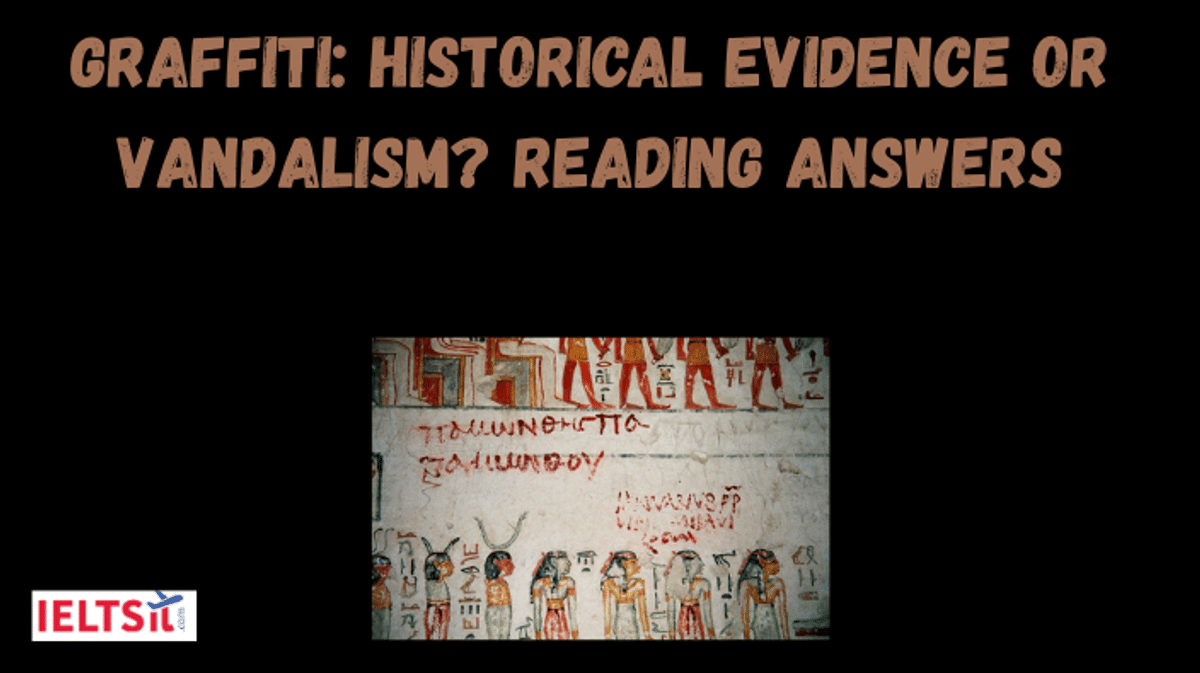
Section 1
GRAFFITI: HISTORICAL EVIDENCE OR VANDALISM?
A.Graffiti is the drawing of images or writing on walls or other public monuments and property without permission from the owners or the relevant authority. Most people might believe that graffiti is a relatively modern phenomenon, yet this practice has existed since ancient times,
from the Romans to the Greeks, right up to the modern day. However, the ongoing controversy over whether graffiti is just irresponsible vandalism or art is still debated today; graffiti can reveal much to the observer about human history.
B.Looking at graffiti can unearth snippets of information about a society at any given time. For example, when graffiti is in the form of words or verse, it can demonstrate the number of people who can read and write within a particular society. This can be discerned by analysing spelling patterns and even grammatical errors, as well as discovering how some words were pronounced. In ancient examples, graffiti is often some of the most public writing available for the wider society to see. The Romans, for instance, tended to carve graffiti into monuments and
walls, and even though the writing was simplistic, it still gives us an invaluable insight into life on the street. Historical texts may not be able to provide us with such information.
C.In some cases, the presence of graffiti gives us the only example of a particular language that exists in the modern world. Take the Safaitic language, for example. Dating from the first century BCE, Safaitic is an ancient form of Arabic and can only be found on rocks in the deserts
of Saudi Arabia, Jordan, and Syria. The inscriptions documented mainly show the authors' basic thoughts about everyday life or their genealogy, and are sometimes accompanied by rock art. The discovery of a virtually lost language was exciting for researchers, as it allowed them to
attempt to document linguistic changes over a period of time.
D.Like the Romans, the Mayans scratched their graffiti onto the surface of walls, leaving it almost impossible to erase. The graffiti of the ancient Mayans in Central America has not been studied extensively, but a closer analysis of it may help us gain a more in-depth understanding of their society. Those examples that have been studied depict scenes of everyday life as well as more ceremonial scenes. The examples include representations of humans and the prey they hunted, which could indicate how the society functioned and what food they ate. There may also be instances of instructions on how to play games, as well as instructions of a more ceremonial nature. Indeed, at certain pivotal moments in history, perhaps the only way to record events was through graffiti, such as construction worker comments before the volcanic eruption at Pompeii or names of soldiers during battles like the Egyptian campaign by Napoleon in the 1790s.
E.These ancient examples of graffiti are just a snapshot of the wealth of graffiti to be found across the globe. These very public displays of communication are a key part of understanding some of the history of societies that may not have been recorded officially. But what about
graffiti today? The method of creating graffiti may have changed from carving to using spray paint, but is it essentially the same thing? Graffiti artists of the modern era, like those before them, depict both political and social concerns with their art. Banksy, an anonymous British street artist, for example, comments on politics and social issues with his distinctive style of art and is now considered to be one of the most insightful artists of our time, with his work selling for millions. Lesser known than Banksy, but still as important, is Bambi, another British street artist. She uses her talent to portray female identity and injustices within the social and political spheres.
F.Bambi and Banksy contribute to a movement known as urban art, which first started as an underground artistic subculture, but which is now understood to be a popular art form, due to the wide recognition it has received. However, the very form of art they produce is still considered vandalism in many areas. Some people see it as a scourge on our landscape, and in some countries, it is illegal to deface public property. In some countries, local governments and councils persist in erasing any graffiti they perceive to be destructive and may even look to prosecute the artists. What is Clear, though, is that no matter your thoughts on graffiti and street art, it demonstrates public feelings and societal thoughts at the time of its creation. It can also give an indication to future generations of beliefs, lifestyles, and language, which are often not recorded in official history books.
Questions 1-6
Reading Passage 1 has six paragraphs, A-F. Choose the correct heading for paragraphs
A-F from the list of headings below. Write the correct number, i-viii.
i. One instance of a linguistic rarity
ii. The best example of a family history
iii. Levels of literacy in the public arena
iv. Similarities between ancient and modern
v. The graffiti debate continues
vi. What official records can tell us
vii. Under-studied graffiti examples
viii From small beginnings to mixed reactions
1. Paragraph A
Answer: V
Supporting statement: However, the ongoing controversy over whether graffiti is just irresponsible vandalism or art is still debated today
Keywords: ongoing controversy, still debated
Keyword Location: Para A, Lines 4-5
Explanation: Paragraph A introduces the long history of graffiti, but focuses on the current argument or debate about whether it is vandalism or art.
2. Paragraph B
Answer: III
Supporting statement: For example, when graffiti is in the form of words or verse, it can demonstrate the number of people who can read and write within a particular society.
Keywords: read and write, analysing spelling patterns
Keyword Location: Para B, Lines 2-3
Explanation: Paragraph B discusses how analyzing graffiti can reveal information about the literacy rate (the number of people who can read and write) in a society.
3. Paragraph C
Answer: I
Supporting statement: In some cases, the presence of graffiti gives us the only example of a particular language that exists in the modern world. Take the Safaitic language, for example.
Keywords: example of a particular language, Safaitic language
Keyword Location: Para C, Lines 1-2
Explanation: Paragraph C presents the Safaitic language as a unique example ("linguistic rarity") whose only modern evidence comes from ancient graffiti inscriptions.
4. Paragraph D
Answer: VII
Supporting statement: The graffiti of the ancient Mayans in Central America has not been studied extensively, but a closer analysis of it may help us gain a more in-depth understanding of their society.
Keywords: studied extensively, closer analysis
Keyword Location: Para D, Lines 1-2
Explanation: Paragraph D focuses on Mayan graffiti, noting that it has not been extensively studied ("under-studied") and that further analysis could provide valuable insights.
5. Paragraph E
Answer: IV
Supporting statement: The method of creating graffiti may have changed from carving to using spray paint, but is it essentially the same thing? Graffiti artists of the modern era, like those before them, depict both political and social concerns with their art.
Keywords: same thing, like those before them, political and social concerns
Keyword Location: Para E, Lines 5-6
Explanation: Paragraph E directly compares ancient graffiti (discussed in B-D) to modern graffiti (Banksy, Bambi), highlighting that despite changes in tools, the artists' intent to comment on political and social concerns remains the same.
6. Paragraph F
Answer: VIII
Supporting statement: Bambi and Banksy contribute to a movement known as urban art, which first started as an underground artistic subculture, but which is now understood to be a popular art form... However, the very form of art they produce is still considered vandalism in many areas.
Keywords: underground artistic subculture, popular art form, considered vandalism
Keyword Location: Para F, Lines 1-6
Explanation: Paragraph F charts the movement's evolution from an "underground artistic subculture" ("small beginnings") to a popular form, while simultaneously noting the "mixed reactions" as it is still often perceived as vandalism and is actively erased or prosecuted.
Questions 7-10
Do the following statements agree with the claims of the writer in Reading Passage I?
YES - if the statement agrees with the claims of the writer
NO - if the statement contradicts the claims of the writer
NOT GIVEN - if it is impossible to say what the writer thinks about this
7. The majority of people are wrong about the origins of graffiti.
Answer: YES
Supporting statement: Most people might believe that graffiti is a relatively modern phenomenon, yet this practice has existed since ancient times, from the Romans to the Greeks, right up to the modern day.
Keywords: might believe, modern phenomenon
Keyword Location: Para A, Lines 2-3
Explanation: The writer claims that "Most people might believe" graffiti is modern, but immediately states that this is incorrect ("yet this practice has existed since ancient times"), agreeing that the common belief about its origins is wrong.
8. Analysing graffiti is a complex and challenging task.
Answer: NOT GIVEN
Explanation: The passage states that graffiti can be analyzed (e.g., to discern literacy in Para B) and mentions the lack of extensive study on Mayan graffiti (Para D), but it never explicitly comments on whether the process of analyzing graffiti is "complex and challenging."
9. Graffiti is a useful source of information about how people once lived.
Answer: YES
Supporting statement: Looking at graffiti can unearth snippets of information about a society at any given time. ... [Roman graffiti] still gives us an invaluable insight into life on the street.
Keywords: snippets of information, society, invaluable insight, life on the street, scenes of everyday life
Keyword Location: Para B, Line 1-2, 7-8; Para D, Line 5
Explanation: The writer repeatedly emphasizes that graffiti provides valuable, unrecorded information about historical societies, giving "invaluable insight into life on the street" and showing "scenes of everyday life," confirming its usefulness as a source about how people lived.
10. Graffiti about issues that affect women is less significant than other social commentary.
Answer: NO
Supporting statement: Lesser known than Banksy, but still as important, is Bambi, another British street artist. She uses her talent to portray female identity and injustices within the social and political spheres.
Keywords: important, female identity and injustices
Keyword Location: Para E, Lines 9-10
Explanation: The writer introduces Bambi, who focuses on women's issues, and explicitly states that her work is "still as important" as that of Banksy, who comments on general political and social issues. This contradicts the statement that her work is less significant.
Questions 11-13
Choose the correct letter.
11. Although the writing in Roman graffiti is simple,
A. It is difficult to interpret.
B. it remains relatively hidden.
C. It reveals Important aspects of society.
D. it is still published in history books.
Answer: C
Supporting statement: The Romans, for instance, tended to carve graffiti into monuments and walls, and even though the writing was simplistic, it still gives us an invaluable insight into life on the street.
Keywords: simplistic, invaluable insight
Keyword Location: Para B, Line
Explanation: The passage contrasts the simplicity of the writing with the valuable information ("invaluable insight") it provides about society's daily life.
12. The writer suggests that during certain times in history, graffiti
A. was the sole method of documenting events.
B. was considered a public disgrace.
C. was erased from monuments.
D. did not incorporate the authors' names.
Answer: A
Supporting statement: Indeed, at certain pivotal moments in history, perhaps the only way to record events was through graffiti, such as construction worker comments before the volcanic eruption at Pompeii
Keywords: pivotal moments, graffiti, volcanic eruption at Pompeii
Keyword Location: Para D, Lines 8-10
Explanation: The writer explicitly uses the phrase "perhaps the only way to record events was through graffiti," suggesting it was the single method used for documentation at specific historical junctures.
13. The writer concludes by suggesting that
A. graffiti artists will be revered throughout the world.
B. graffiti will continue to leave a lasting legacy.
C. some countries will make graffiti a legal art form.
D. the general public will come to see graffiti as art.
Answer: B
Supporting statement: It can also give an indication to future generations of beliefs, lifestyles, and language, which are often not recorded in official history books.
Keywords: future generations of beliefs, lifestyles, language
Keyword Location: Para F, Lines 9-10
Explanation: The final sentence highlights that graffiti leaves behind information about society for "future generations," indicating its value as a lasting historical record or "legacy," regardless of how it is viewed today.
Read More IELTS Reading Related Samples
- Staff Committees and Delegation Structure Langdon Public Office Reading Answers
- Michigan Young Adults Group Connect Grow Lead Reading Answers
- Understanding CAT Food Labels Reading Answers
- Advertisement Crystelo Learning Centre Reading Answers
- The Role of Investigative Journalism Reading Answers
- The Science Behind Procrastination Reading Answers
- The Spread and Psychology of Rumours Reading Answers
- The future of Remote Work Reading Answers
- Understanding Employee Satisfaction Reading Answers
- Freelancing with Full Time Work Reading Answers
- Donton Land Organization trust Reading Answers
- Harshnars Crafts eSpecials Reading Answers
- Volunteering with Open Doors Reading Answers
- How to Live Life Perspectives of Meaningful Living Reading Answers
- How to Succeed in Exams Reading Answers
- The Changing Role of Housewives in Modern Society Reading Answers
- Altius Offer Letter of Employment Reading Answers
- Employment Verification Information Reading Answers
- New Library Services at Brookdale Community Library Reading Answers
- The Mammals Reading Answers
- Recharger Reading Answers
- The Rise of Urban Gardening Reading Answers
- Sustainable Fashion A Shift in the Clothing Industry Reading Answers
- The Benefits of Workplace Volunteering Programs Reading Answers
- LLEWYN The Troubadour of a Lost Age Reading Answers
- Combining Passion with Work Reading Answers
- Internal Complaint Review An Understanding Reading Answers
- Understanding Economic Investments and Development Reading Answers
- The Secret Language of Trees Reading Answers
- Leaflet City Library Summer Reading Challenge Reading Answers
- Email From A Travel Agency Holiday Package Information Reading Answers
- Rental Agreement Greenlane Apartments Reading Answers
- Parkside Community Swimming Pool Guidelines Reading Answers
- Cognitive Decline and Aging Understanding the Process Reading Answers
- The Complexities of Human Memory Reading Answers
- Riverdale Textiles Employee Benefits Guide Reading Answers
- The Impact of Urban Green Spaces on Health and Society Reading Answers
- The Disappearing Art of Letter Writing Reading Answers
- Renting a Property Guidelines for Tenants Reading Answers
- Quantum Entanglement Reading Answers
- Out of Africa The Tobacco Wars New Battleground Reading Answers
- Latin Influence in English Down Reading Answers
- Beauty Through the Ages Reading Answers
- Family Transformations From Traditional to Chosen Reading Answers
- Transportation Shapes Cities Reading Answers
- Russian Archaeology Reading Answers
- Economizing the Poor Reading AnswersEconomizing the Poor Reading Answers
- The Koala Reading Answers
- Aswan High Dam Reading Answers
- The Japanese Rock Garden Reading Answers
Comments