IELTS Band Score: Section-wise Band Score, Band Descriptors and Score Calculation
The IELTS Band Score determines a candidate’s eligibility for admission, immigration, and professional licenses across English-speaking countries. The overall IELTS Band score is calculated on a scale of 0-9.
- Every IELTS test-taker receives a band score for each of the four sections: Listening, Reading, Writing, and Speaking
- The final overall score is the average of all, and each section is graded on a scale of 0 to 9.
Achieving a high IELTS band score depends not only on English proficiency but also on understanding the IELTS scoring criteria. With increasing competition in academic admissions, PR visas, and international job markets, IELTS success has become a significant milestone for Indian aspirants. Therefore, having a clear idea of IELTS section-wise band distribution, descriptors, and evaluation parameters helps candidates plan their preparation, improve their weak areas, and increase their IELTS score.
Also Check:
- IELTS Results: Check and Understand Your IELTS Scores Online
- IELTS Score Validity: Check the Validity Period of Your IELTS TRF

What is an IELTS Band Score?
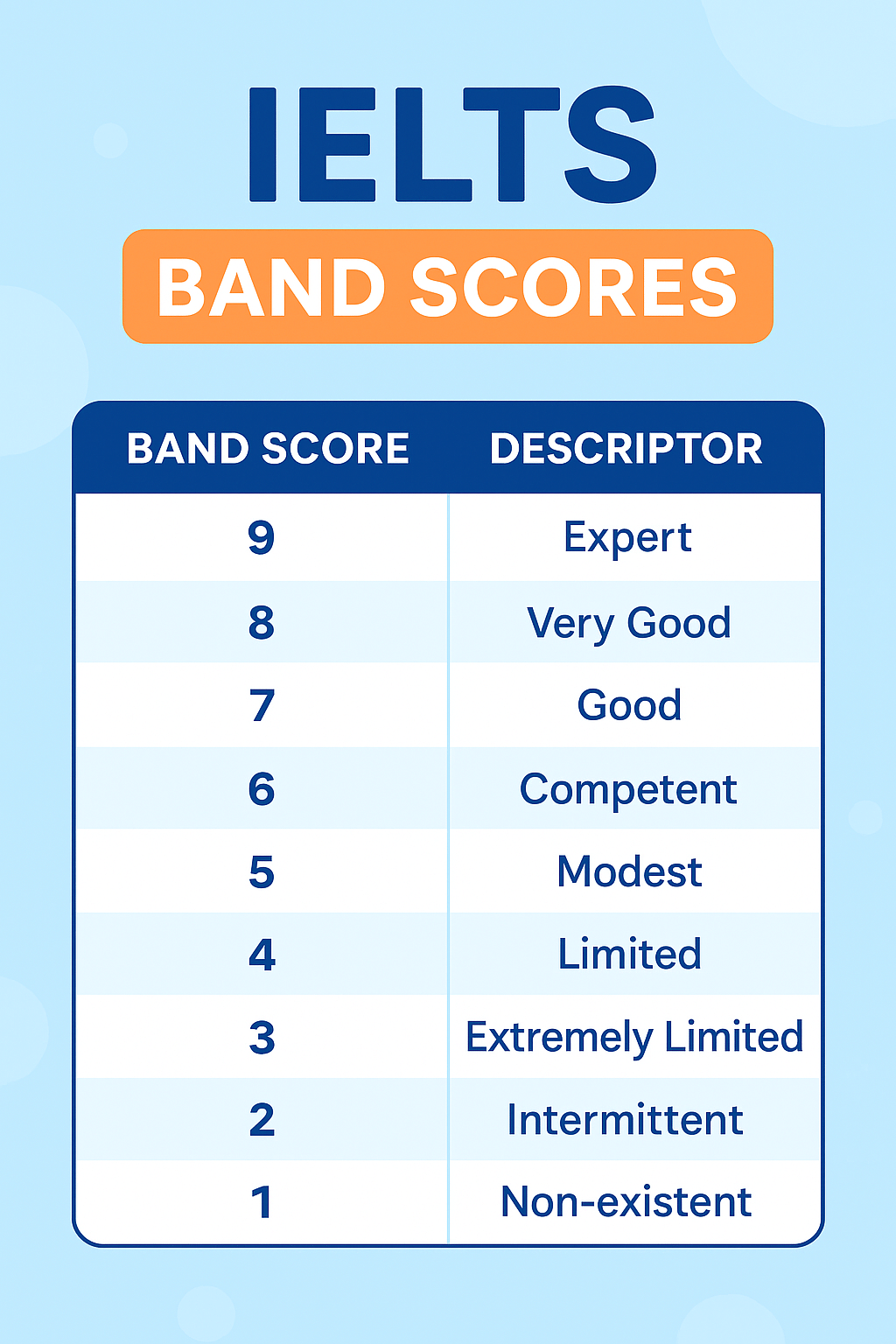
An IELTS Band Score is a 0-9 scale used to measure English language proficiency in Listening, Reading, Writing, and Speaking.
- Each skill is scored individually, and the average of all four forms the overall band score.
- Higher bands indicate better fluency, vocabulary, grammar, and comprehension.
- Universities, employers, and immigration authorities use these scores to assess whether a candidate can communicate effectively in English.
- The score helps determine eligibility for study, work, or migration abroad.
The scoring is transparent, reliable, and based on real-world communication skills. Unlike many competitive exams, IELTS provides feedback using band descriptors, which outline what a test-taker did right or wrong.
Also Check:
- IELTS Band Descriptors: Understanding IELTS Band Description
- How to Score IELTS 6.5 Band: Section-wise strategies to secure IELTS band 6.5
Check the video on IELTS band score by IELTSMaterial:
IELTS Overall Band Calculation
All IELTS scores are between 0 and 9, and each test component (Listening, Reading, Writing, and Speaking) gets a separate band score. These individual scores are averaged to determine the overall IELTS band score, which is then rounded to the nearest whole or half score. For example, if the average is not a direct .5 or whole number (e.g., 7.5), it's adjusted to the closest .5 or whole number.
| Listening | Reading | Writing | Speaking | Total | Overall IELTS Band Score |
|---|---|---|---|---|---|
| 8.0 | 7.0 | 7.5 | 7.0 | 29.5 | 7.5 |
| 6.5 | 6.0 | 6.5 | 6.0 | 25.0 | 6.5 |
| 7.0 | 6.5 | 6.0 | 6.5 | 26.0 | 6.5 |
| 5.5 | 5.5 | 6.0 | 5.0 | 22.0 | 5.5 |
Most aspirants use an IELTS band calculator / IELTS test band calculator to predict their final result.
Also Check:
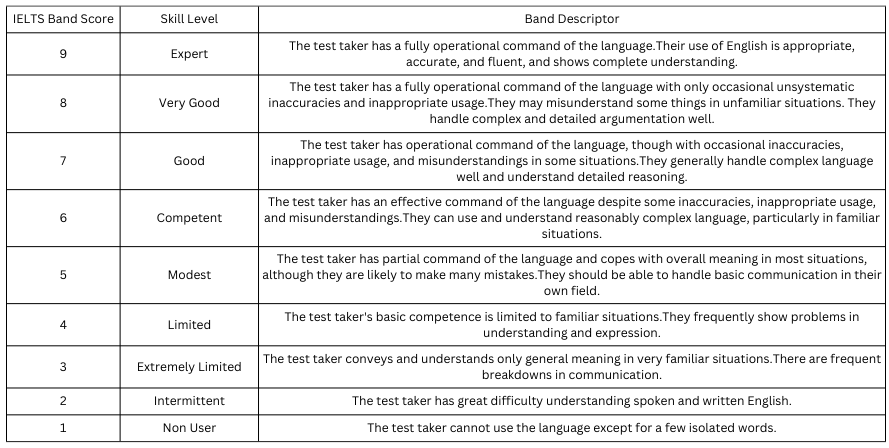
IELTS Band Score Explained
The table below shows how IELTS classifies the band scores and how you will be scored:
Also Check:
Section-wise IELTS Band Scores and Band Descriptors
IELTS Listening Band Score
The IELTS Listening test comprises 40 questions, with each correct answer awarded one mark. The overall IELTS listening scores out of 40 will be changed to the IELTS 9 band scale. For IELTS listening band Scores are reported in whole and half bands..
| Correct Answers | Listening Band Score |
|---|---|
| 39-40 | 9 |
| 37-38 | 8.5 |
| 35-36 | 8 |
| 32-34 | 7.5 |
| 30-31 | 7 |
| 26-29 | 6.5 |
| 23-25 | 6 |
| 20-22 | 5.5 |
| 16-19 | 5 |
Also Check:
IELTS Listening band Score FAQs
- How is the IELTS listening band score calculated?
The listening band score is calculated based on how many answers you get correct out of 40. Each score is mapped to a band using a fixed conversion chart to determine your final band level from 0 to 9. Even a few extra correct answers can significantly increase the band score. Accuracy and careful listening make a major difference.
- Is every question worth 1 mark?
Yes, every question carries one mark regardless of its difficulty. There are no additional marks for harder questions and no negative marking for wrong answers. Even if you are unsure, it is better to attempt all questions. Guessing can sometimes help raise your score.
- Can I wear headphones while listening?
Headphone usage depends on the test centre and country. Some centres provide personal headphones for every candidate, while others use high-quality speakers in the room. The listening conditions are standardized to ensure no candidate is at a disadvantage. Test-takers can check in advance with their centre for clarity
IELTS Reading Band Score
The IELTS Reading score pattern is similar to IELTS listening, comprising 40 questions and 1 mark for each correct answer. The IELTS Academic band score and IELTS General Training band score have distinctive exam patterns. The IELTS band score for reading is stated below:
| Correct Answers | Academic | General Training |
|---|---|---|
| 39-40 | 9 | 9 |
| 37-38 | 8.5 | 8.5 |
| 35-36 | 8 | 8 |
| 32-34 | 7.5 | 7.5 |
| 30-31 | 7 | 7 |
| 26-29 | 6.5 | 6.5 |
| 23-25 | 6 | 6 |
Also Check:
IELTS Reading FAQs
- Are spelling mistakes counted in IELTS Reading?
Yes, spelling accuracy is crucial in the listening section. Even if the answer is conceptually right, a spelling mistake leads to zero marks. Candidates should practise writing quickly and accurately to reduce errors. Using British English spelling is recommended.
- Do all questions have equal marks?
Yes, every question holds equal weight, with 1 mark per correct answer. This means you should not spend too much time worrying about any single question. Instead, it’s better to move ahead and focus on completing the full test to maximise your score. Smart time management improves accuracy and results.
- Is the Academic test tougher than the General?
Yes, the Academic Reading test is considered tougher because passages are longer, more complex, and research-based. They contain academic vocabulary and require analytical understanding. The General Reading is simpler and more practical, but scoring bands are converted differently to maintain fairness. Overall difficulty depends on familiarity with academic content.
IELTS Writing Band Score
The IELTS Writing test is taken by qualified and experienced IELTS examiners who assess the skills based on 4 criteria. The criteria for measuring IELTS Writing band and score are:
- Task Accomplishment: IELTS Writing Task 1 and IELTS Writing Task 2
- Consistency and Adherence
- Linguistic resources
- Grammatical Accuracy
| Task Type | Description | Weightage |
|---|---|---|
| Task Achievement (Task 1) | Presenting accurate informationProviding an overviewHighlighting key features/stagesSupporting detail with data | 25% |
| Task Response (Task 2) | Managing the task(answering the questions)Giving relevant main points that are supported and developedGiving a clear position (stating an opinion)Providing a conclusion | |
| Coherence and Conclusion | Organizing information/ideas into paragraphsHaving one central idea in each paragraphsUsing a range of linking devices | 25% |
| Lexical Resource | Using a range of words and paraphrasingUsing collocationsSpellingAvoid errors | 25% |
| Grammar Range & Accuracy | Using a range of sentence structuresUsing a range of grammar tensesPunctuationAvoiding errors | 25% |
Also Check:
IELTS Writing Band FAQs
- What leads to a low IELTS writing score?
A low band occurs due to weak vocabulary, repetition of ideas, lack of structure, and grammatical errors. Candidates also lose marks when they don’t address the topic or do not support arguments with examples. Task completion (Task Response) has major weightage. Improving clarity and organisation can boost the score.
- Is a bullet-point pen in IELTS writing allowed?
No, bullet points are not allowed in the IELTS essay. The writing tasks require full paragraphs with a clear introduction, body, and conclusion. Bullet-point text fails to meet the expected essay format and reduces the score under Task Response and Coherence. Maintaining an academic tone is essential.
- Does handwriting affect the IELTS Writing score?
Handwriting does not affect marking as long as it is readable. However, if the examiner cannot understand your writing, the answer may be marked wrong. Clear spacing and consistent letter formation help maintain readability.
IELTS Speaking Band Score
The IELTS speaking score calculator is slightly different as the assessment is mainly dependent on 4 criteria:
- Eloquence and Balance
- Linguistic Resources
- Grammatical correctness and
- Pronunciation
All the above 4 factors are considered before making an average and marking the IELTS speaking band score.
| Fluency | Talking at lengthTalking without pauses or hesitationsTalking without self-correctionAble to be understoodUsing linking devices |
|---|---|
| Lexical Resources | Using a range of words and paraphrasingUsing collocationsUsing less common vocabularyAvoiding errors |
| Grammar Range and Accuracy | Using a range of sentence structuresUsing a range of grammar tensesAvoiding errors |
| Pronunciation | Able to be understood throughout the testAble to use intonationAccent does not affect understandingAccurate word and sound pronunciation |
Also Check:
IELTS Speaking FAQs
- Does accent affect the IELTS speaking score?
Your accent doesn’t affect the speaking score; clarity matters most. You can request the examiner to repeat a question without penalty. Avoid memorised answers, as they are easily noticed. Speak naturally, use correct grammar, and stay coherent. Express your ideas clearly to score well in IELTS Speaking.
- Can I ask the examiner to repeat the question?
Yes, you can ask the examiner to repeat a question during the IELTS speaking test. Doing so will not affect your score, and it can help you provide a clearer and more accurate answer.
- Is memorized speech acceptable in IELTS Speaking?
Memorised speech is not acceptable in exams like IELTS speaking. Examiners are trained to detect rehearsed answers, as they often lack natural fluency and spontaneity. Using memorised responses can negatively affect your score in fluency, coherence, and pronunciation. It’s better to practice ideas and vocabulary rather than memorising exact sentences.
How to Improve Your IELTS Score or IELTS Band Score?
To estimate the IELTS score before the exam and perform better:
- Understand the IELTS band scale for each module
- Practice with real-type questions daily
- Focus on vocabulary and grammar together
- Take full-length mocks to count IELTS score progress
- Listen to English news, podcasts, and documentaries
- Write structured essays and learn natural connectors
Also Check:
- IELTS Preparation Tips: Study Materials, Coaching, and Sample Papers
- IELTS Preparation at Home: Tips, Books, and Sample Papers
Using a listening band score, IELTS band and score, and progress charts helps track improvement scientifically.
IELTS scoring is designed to reflect real English proficiency in communication. Practising consistently with awareness of marking criteria is the most reliable approach to score improvement.
Comments