Describe Your Favourite Food at a Traditional Festival or a Special Event in Your Country Cue Card
Describe Your Favourite Food at a Traditional Festival or a Special Event in Your Country IELTS Speaking Cue Card model answers have been provided below. The answers are centred upon questions - What it is, At which festival/event you eat it, How it is made and explain why you like it
What is a Cue Card: IELTS Speaking Part 2 includes cue cards containing topics on which candidates are to speak. Candidates get 2-3 minutes time to speak and 1 minute for note-taking. In IELTS Speaking part 2, candidates' proficiency in grammar and vocabulary is assessed along with their confidence to speak in English.
Check: Get 10 Free IELTS Sample Papers
Check: Register for IELTS Coaching - Join for Free Trial Class Now
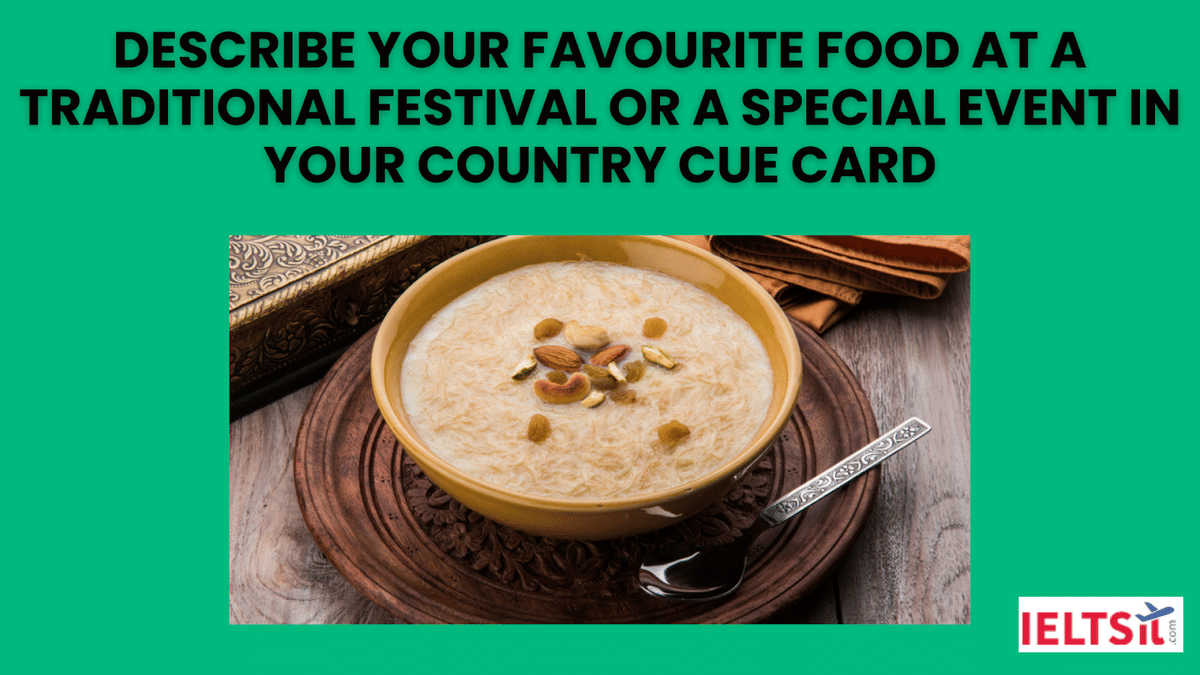
Topic: Describe Your Favourite Food at a Traditional Festival or a Special Event in Your Country Cue Card
You should say:
- What it is?
- At which festival/event you eat it?
- How it is made?
- And explain why you like it?
Answer 1:
What it is?
Payesh is one of those foods that instantly makes me think of home and tradition. It’s not just a dessert—it’s a piece of my childhood and a big part of who I am. In West Bengal, payesh is woven into the fabric of our celebrations. For my family, it’s almost a symbol of togetherness and the kind of joy that only comes when everyone’s gathered around the table.
At which festival/event you eat it?
I always look forward to payesh during Durga Puja, which is hands down the most important festival where I’m from. We make it on big days like Mahalaya and Saptami, and honestly, any special family event is a good excuse for it. During Durga Puja, payesh shows up right after prayers. We pass it around, everyone gets a bowl, and it just feels right—like the celebration isn’t complete without it.
How it is made?
Making payesh is its own kind of ritual. We use Gobindobhog rice, which smells amazing and has this unique texture. The rice cooks slowly in full-cream milk, and you have to be patient. Sugar or jaggery goes in once the milk thickens, then a handful of cashews, raisins, maybe some cardamom or a bay leaf for that extra something. The slow cooking is what makes it so creamy and rich.
And explain why you like it?
Honestly, what gets me every time is how simple payesh is, yet how comforting. One spoonful and I’m right back in those noisy, happy family gatherings. There’s also a spiritual side to it—before anyone eats, we offer it to Goddess Durga. That little tradition gives it a deeper meaning for me, turning it into more than just a sweet treat.
Answer 2:
What it is?
Biryani has always been my ultimate comfort food, especially when there’s something worth celebrating. It’s not even just the insane flavours or that smell that hits you the second the lid comes off… it’s the whole vibe. The moment someone walks in carrying that massive pot of biryani, you instantly know — okay, this is a proper occasion. The energy in the room just shifts. Everyone suddenly sits up a bit straighter, the laughs get louder, phones go down, and everything feels… brighter. Like the day just got upgraded.
At which festival/event you eat it?
I usually eat biryani at Eid, family weddings, anniversaries, or any big get-together. Someone always ends up making a massive batch, way more than we could ever finish, but nobody’s complaining. Sharing biryani just has a way of pulling everyone in. You sit down, pile your plate high, talk, joke around—suddenly, the day feels warmer and a little more memorable.
How it is made?
Why does biryani taste so good? Well, here’s how it goes. You grab some long-grain basmati rice, then marinate chicken or mutton in yogurt and a bunch of spices—cloves, cinnamon, cardamom, the works. The meat soaks up all that flavor and gets a head start cooking, while the rice simmers in its own pot until it’s almost done. Now for the magic: you layer the rice and meat in one big pot, scatter crispy fried onions on top, drizzle saffron milk, throw in some fresh herbs, and let the whole thing cook slowly. That’s when all those flavors really get to know each other.
And explain why you like it?
Honestly, I love biryani for more than just the taste or the smell—though both are incredible. For me, it means celebration and being with people I care about. Sharing a meal like that just makes every occasion brighter and way more memorable.
Answer 3:
What it is?
Modak is hands down one of my favorite festive treats. It’s a classic Indian sweet, and honestly, you’ll find it everywhere during certain festivals. Picture a soft, steamed dumpling with a sweet, coconut-jaggery filling. The texture is delicate, and it’s just sweet enough—never overwhelming.
At which festival/event you eat it?
I always eat modak during Ganesh Chaturthi. That’s the festival where people all over India celebrate Lord Ganesha. There’s this belief that modak is his absolute favorite, so everyone makes it at home as an offering. It’s almost a given—you pray, you make modaks, and then you pass them around to family, friends, and neighbors.
How it is made?
Here’s how it goes: you start with rice flour dough, and the filling is this mix of freshly grated coconut, jaggery, and a bit of cardamom for that extra kick. You cook the coconut and jaggery together until the whole kitchen smells amazing, then you shape the dough, stuff it with the filling, seal each piece with a little twist, and steam them. The steamed ones are lighter and healthier, so that’s what most families stick with.
And explain why you like it?
What I love most about modak isn’t just the taste—it’s the whole process. Making them together with family turns the kitchen into a happy, lively place. For me, modak means more than just food. It’s about devotion, family, and keeping traditions alive. That’s what makes it so special every year.
Check More IELTS Cue Cards
- Describe a Bicycle Bike Car Tour IELTS Cue Card
- Describe a Resolution you Made in The New Year Cue Card
- A City You Want To Visit IELTS Cue Card
- Describe a Popular Musical Instrument in Your Country Cue Card
- Describe a New Year Celebration That You Still Remember Cue Card
- Describe a Risk You Have Taken Which Had a Positive Result Cue Card
- A Vehicle You Would Like to Own Cue Card
- Describe A Special Day You Remember Well Cue Card
- Describe a success in your life Cue Card
- Talk about a situation when you taught something to someone Cue Card
- Describe Your Favourite Park In Your City Cue Card
- Describe A Course that Impressed You a Lot Cue Card
- Describe a Time When You Were in Trouble or When Faced Difficulty in Using The Computer Cue Card
- Describe A Time When You Were Cheated Cue Card
- Describe a Situation When You Had to be Polite Cue Card
- Describe a Country Where You Would Like To Work For a Short Time Cue Card
- What Would You Like to Change at The Place Where You Live Cue Card
- Describe A Good Decision You Made Recently Cue Card
- Describe a Piece of International News You Have Just Recently Heard Cue Card
- Talk About A Time When You Learnt Difficult Word Cue Card
- Describe The Time When You Had to Sing a Song or a Poem in Front of Public Cue Card
- Describe New Start-ups in Society Cue Card
- Describe a Time When You First Talked In a Foreign Language Cue Card
- Describe a Bag You Want To Own Cue Card
- Describe an Advertisement You Remember Well Cue Card
- Describe a Time When You Told Your Friend an Important Truth Cue Card
- Describe a Time When You Encourage Someone To Do Something That He/she Didn't Want To Do Cue Card
- Describe An Old Friend You Got In Contact With Again Cue Card
- Describe An Old Person You Know And Respect Cue Card
- Describe Your Favourite Clothes Cue Card
- Your favorite song IELTS Cue Card
- Describe a Country You Have Visited IELTS Cue Card
- Describe a Crowded Place that you have visited IELTS Cue Card
- Things you want to buy in the future IELTS Cue Card
- Person Who Has Influenced You to Do Better In Your Life IELTS Cue Card
- A TV Programme That Inspires You A Lot IELTS Cue Card
- Describe A Time Someone Or Something Made A Lot Of Noise IELTS Cue Card
- Describe a Person who has done a lot of Work to Help People IELTS Cue Card
- Describe a Place You Visited When You Were A Child IELTS Cue Card
- Describe a Course or Subject you would like to take in the Future IELTS Cue Card
- Describe An Occasion When The Weather Prevented You From Doing Something IELTS Cue Card
- Weekend that you Enjoyed and Still Remember IELTS Cue Card
- Describe Your Favourite Author Or Writer IELTS Cue Card
- Describe A Time When You Visited A Farm IELTS Cue Card
- Describe A Good Service You Received IELTS Cue Card
- Describe the Happiest Day You Had IELTS Cue Card
- Describe a Performance You Recently Watched IELTS Cue Card
- Describe Someone You Really Like to Spend Time With IELTS Cue Card
- Describe a Famous Person that You Are Interested In Cue Card
- Describe an Item on which you Spent more than Expected Cue Card
Comments