Describe a wild animal that you want to learn more about Cue Card
Describe a wild animal that you want to learn more about IELTS Speaking Cue Card model answers have been provided below. The answers are centred upon questions - What it is?, When/where you saw it?, Why you want to learn more about it? And explain what you want to learn more about it?
What is a Cue Card: IELTS Speaking Part 2 includes cue cards containing topics on which candidates are to speak. Candidates get 2-3 minutes time to speak and 1 minute for note-taking. In IELTS Speaking part 2, candidates' proficiency in grammar and vocabulary is assessed along with their confidence to speak in English.
Check: Get 10 Free IELTS Sample Papers
Check: Register for IELTS Coaching - Join for Free Trial Class Now
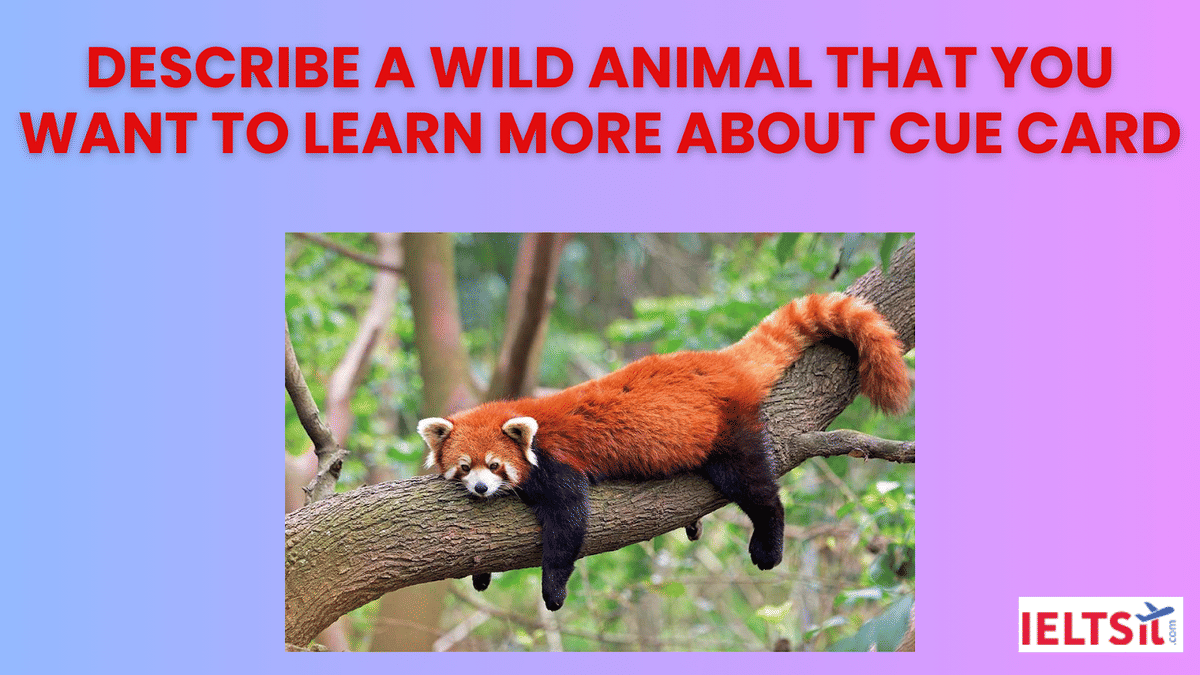
Topic: Describe a wild animal that you want to learn more about Cue Card
You should say:
- What it is?
- When/where you saw it?
- Why you want to learn more about it?
- And explain what you want to learn more about it?
Answer 1:
What it is?
I’ve always been curious about red pandas. They’re these small, fluffy creatures with a reddish coat and a tail that looks almost too big for their body. They kind of remind you of a giant panda, but honestly, they’re not even close—red pandas are their own thing, and they come from the eastern Himalayas and parts of southwestern China.
When/where you saw it?
The first time I saw one was in a documentary on TV. Later on, I spotted another during a trip to the local zoo. Right away, I was hooked. Something about the way they move—darting up trees, playing around—just draws you in. They’re adorable, but there’s something kind of mysterious about them, too.
Why you want to learn more about it?
What really gets me is that red pandas are endangered. Their homes keep shrinking because people cut down forests and the climate keeps changing. There aren’t many left, which honestly makes me want to learn everything I can about them. It’s hard to ignore an animal that’s so unique and still struggling to survive.
And explain what you want to learn more about it?
I want to know what their days look like. Sure, I’ve heard they eat bamboo, but how do they handle freezing weather? What do they do when it storms? I wonder about how they raise their young, and I’m curious about what people are actually doing to help them out in the wild.
The more I think about red pandas, the more they fascinate me. They’re rare and full of personality. Learning about them isn’t just about satisfying my curiosity—it’s a reminder of why protecting endangered animals matters in the first place.
Answer 2:
What it is?
I’ve been fascinated with the Bengal tiger my whole life. There’s just something about this large, majestic creature that draws me in every time. They’re mostly found in India and parts of South Asia, and they’re actually the national animal of India.
When/where you saw it?
The first time I ever saw a Bengal tiger, I was a teenager on a family vacation to a wildlife preserve. It was just a fleeting moment—one second it was there, moving through the trees, completely at home, and then it was gone. But that one moment has stuck with me all these years. Since then, I’ve read about tigers in documentaries and magazines, but there’s just no substitute for seeing them in the wild.
Why you want to learn more about it?
I want to learn more about Bengal tigers, not just because they’re the embodiment of strength and bravery, but because they’re actually an endangered species. Poaching and habitat destruction have put them on the endangered list. The more people learn about tigers, the more they’re likely to understand why these animals are so important to the environment.
And explain what you want to learn more about it?
I’m particularly interested in learning more about how tigers hunt and protect their territory. How do they stake their claim to the territory? What’s it like for a tiger to raise its young? And then there’s the larger issue of conservation projects such as Project Tiger. I want to learn more about how these projects work and whether or not they’re actually effective in helping the tiger population recover.
The truth is, I find Bengal tigers inspiring. They’re gorgeous, they’re powerful, and the more I learn about them, the more I want to protect the environment and get involved in conservation efforts.
Answer 3:
What it is?
One animal that fascinates me and that I would like to learn more about is the wolf. Since my childhood, wolves have seemed to me elusive and captivating-their intelligence, their social nature, and the way they move in a synchronized group. Most of them can roam around forests, mountains, and cold tundras; living and hunting in packs with a mix of strength and elegance surpassing my imagination.
When/where you saw it?
My curiosity about the wolf really blossomed after a nature documentary a few years back. It showed how seamlessly wolves hunt together and look out for one another, a highlight into the cohesion and loyalty of the pack. Never having seen a wolf in the wild, the film was able to connect me to them in a very real way. Since then, I've devoured articles and more videos to grasp the basics.
Why you want to learn more about it?
Wolves fascinate me because they are portrayed as dangerous by most people. Their reputation as savage and hostile creatures stems from exaggerated media coverage and popular films. In truth, wolves try to steer clear of us and are beneficial to nature, as they regulate the deer population, which helps the forest thrive.
And explain what you want to learn more about it?
I am especially curious about how wolves communicate with one another. Their howling is beautiful but yet, very eerie-looking to me, and I am curious to see the meaning behind their different sounds. I am especially eager to see how wolves interact with one another, how they care for their pups, and the effects of bringing wolves into a particular ecosystem.
Overall, wolves fascinate me because of their intelligence, loyalty, and social behavior. Learning more about wolves would enrich my knowledge of nature and wild animals.
Check More IELTS Cue Cards
- Describe a Time When You Tried to do Something But Were Not Very Successful Cue Card
- Describe an Ambition that You Have for a Long Time Cue Card
- Describe A Person Who Helps Others In His Or Her Spare Time Cue Card
- Describe A Law You Want To Be Enacted Or Law You Would Like To See In Future In Your Country Cue Card
- Describe Your Favourite Author Or Writer Cue Card
- Describe an Outdoor Sport you Played for the First Time Cue Card
- Describe a piece of information that you think is not correct Cue Card
- Describe a success in your life Cue Card
- Describe an Interesting Story you Have Read or Heard Cue Card
- Talk about a situation when you taught something to someone Cue Card
- Describe Your Family Cue Card
- Describe a Skill That Was Difficult For You to Learn Cue Card
- Describe a Famous Athlete You Know Cue Card
- Describe a Habit Your Friend Has and You Want to Develop Cue Card
- Describe a time when you organized a happy event successfully Cue Card
- Describe something that was broken in your home and then repaired Cue Card
- Describe a thing you cannot live without Cue Card
- Describe a gift you would like to buy for your friend Cue Card
- Describe a Difficult Thing You Did Cue Card
- Describe A Time When You Felt Proud Of A Family Member Cue Card
- Describe a Minor Accident that you had in the Past Cue Card
- Describe Something you Received for Free Cue Card
- Describe a Resolution you Made in The New Year Cue Card
- Describe a Polite Person You Met Cue Card
- Unforgettable Meal Cue Card
- Talk About a War IELTS Cue Card
- Describe a Photograph You Like IELTS Speaking
- Describe a Time You Saw Something Interesting on Social Media Cue Card
- Talk About Your Best Friend IELTS Cue Card
- A positive Change in Your Life Cue Card
- Describe a Resolution you Made in The New Year Cue Card
- Describe A Famous Person that You Are Interested In Cue Card
- Talk About A Toy You Liked In Your Childhood Cue Card
- Describe a Creative Person whose Work you Admire Cue Card
- Describe an Old Friend you Enjoy Talking With Cue Card
- Describe a Gift you would like to Buy for your Friend Cue Card
- Describe an Interesting Song Cue Card
- Describe A Difficult Decision That You Made Cue Card
- Describe an Item on which you Spent more than Expected Cue Card
- Describe A Place You Visited On Vacation IELTS Cue Card
- Describe A Time When You Felt Proud Of A Family Member Cue Card
- Describe a Special Cake You Received From Others Cue Card
- Describe An Exciting Book That You Enjoy Reading Cue Card
- Describe an Outdoor Sport you Played for the First Time Cue Card
- Describe a piece of information that you think is not correct Cue Card
- Describe a Time When Your Computer Broke Down Cue Card
- Describe a Person Who Wears Unusual Clothes Cue Card
- Describe a Healthy Lifestyle That You Know Cue Card
- Describe a Barbecue Party You Attended Recently Cue Card
- Describe a Skill You Can Teach Other People Cue Card
Comments