Describe a Historical Event that you find Interesting Cue Card
Describe a Historical Event that you find Interesting Cue Card is an IELTS Speaking topic. The IELTS Cue Card model answers have been provided below. The answers are centered upon questions: When it took place, What historic connection does it have, how it impacted the history, and explain why you find it interesting.
What is a Cue Card: IELTS Speaking Part 2 includes cue cards containing topics on which candidates are to speak. Candidates get 2–3 minutes to speak and 1 minute for note-taking. In the IELTS Speaking part 2, candidates' proficiency in grammar and vocabulary is assessed, along with their confidence in communicating in English.
Check: Get 10 Free IELTS Sample Papers
Check: Register for IELTS Coaching - Join for Free Trial Class Now
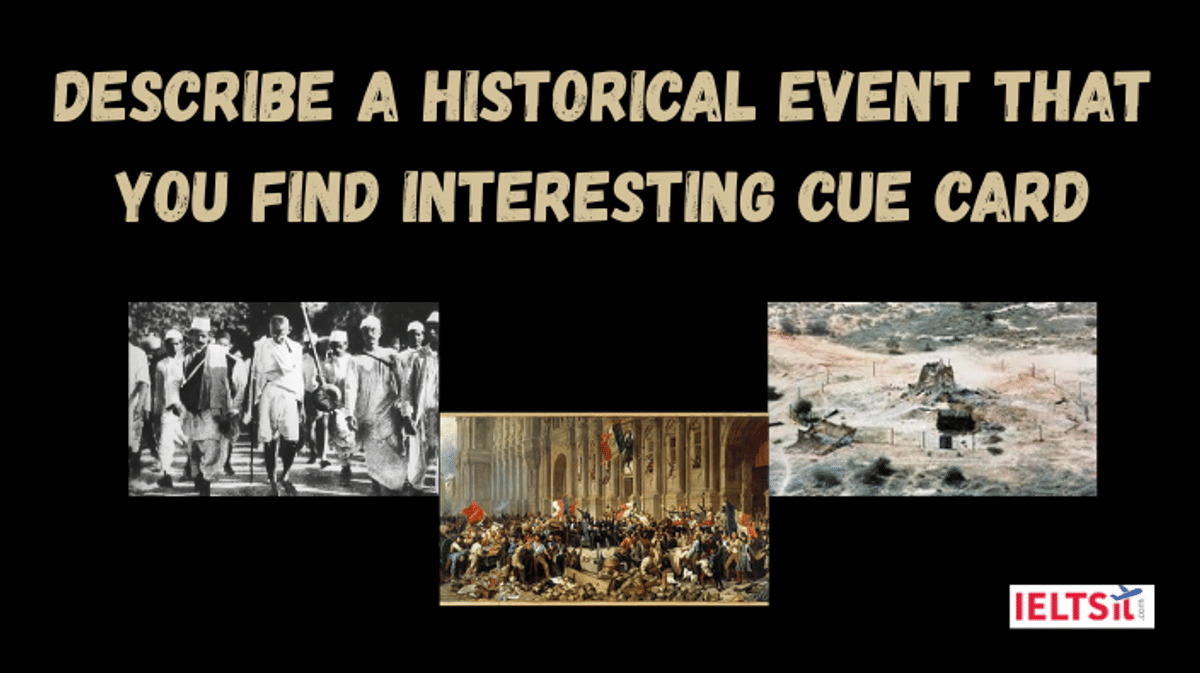
Topic: Describe a historical event that you find interesting.
You should say:
- When it took place
- What historic connection does it have
- How it impacted the history
- and explain why you find it interesting.
Answer 1
when it took place
One significant Indian historical event that I find interesting is the Quit India Movement of 1942. This movement took place during World War II, when Mahatma Gandhi called for an end to British rule in India with the slogan "Do or Die".
What historic connection does it have
The Quit India Movement was a major milestone in India's struggle for independence. It was launched at a time when Britain was preoccupied with the war, and it marked a turning point by mobilizing mass civil disobedience across the country. The movement united people from all walks of life and strengthened the resolve for freedom.
How it impacted the history
The Quit India Movement led to widespread protests and strikes, resulting in the arrest of thousands of leaders and activists. Although the British suppressed the movement with force, it significantly weakened their hold on India and accelerated the process of independence. The movement is remembered for its role in galvanizing national sentiment and pushing the British towards eventual withdrawal.
And explain why you find it interesting
This event is fascinating because it demonstrated the power of nonviolent resistance on a massive scale. Ordinary people, including students and women, played a crucial role in defying colonial authority. The movement’s legacy continues to inspire struggles for justice and freedom around the world, making it a landmark moment in Indian history.
Answer 2
when it took place
The French Revolution was a transformative period in French and world history that took place from 1789 to 1799. The revolution started with the storming of the Bastille on July 14, 1789, a symbol of royal tyranny, and led to the abolition of the monarchy and the establishment of a republic in 1792. The period included dramatic episodes such as the Reign of Terror, during which thousands were executed, and the rise of Napoleon Bonaparte, who ultimately ended the revolutionary era and became Emperor of France in 1799.
What historic connection does it have
The French Revolution marked the end of absolute monarchy in France and inspired movements for democracy, equality, and liberty across Europe and the world. It challenged the old feudal order and promoted ideas of citizenship, secularism, and popular sovereignty.
How it impacted the history
The revolution led to the spread of revolutionary ideals, the downfall of monarchies, and the rise of modern nation-states. It also influenced legal reforms, including the adoption of the Napoleonic Code, which became a model for legal systems in many countries.
And explain why you find it interesting
The French Revolution is fascinating because it demonstrated the power of collective action to overthrow centuries-old institutions and reshape society. Its legacy continues to influence political thought and social movements around the world, making it one of the most significant events in modern history.
Answer 3
when it took place
The Pokhran Nuclear Tests, also known as Pokhran-II or Operation Shakti, were a series of five nuclear weapon tests conducted by India in May 1998 at the Pokhran Test Range in Rajasthan. These tests marked India’s second round of nuclear explosions, following the first test, "Smiling Buddha," in 1974.
What historic connection does it have
The Pokhran-II tests were a major turning point in India’s strategic and international relations. By declaring itself a nuclear-armed state, India demonstrated its advanced scientific and military capabilities, asserting its position on the global stage. The tests were conducted under the leadership of Prime Minister Atal Bihari Vajpayee and were seen as a response to regional security concerns, especially the threat from neighboring Pakistan.
How it impacted the history
The tests led to immediate international condemnation, with countries like the United States, Japan, and Canada imposing economic sanctions on India. Pakistan responded by conducting its own nuclear tests, escalating tensions in South Asia and triggering an arms race between the two nations. Despite the sanctions, the tests boosted national pride and marked a shift in India’s foreign policy towards greater strategic autonomy.
And explain why you find it interesting
The Pokhran Nuclear Tests are interesting because they combined scientific achievement with geopolitical consequences. They not only changed India’s status in the world but also highlighted the delicate balance between national security and global peace efforts in a volatile region. The tests continue to influence India’s defense policies and international relations to this day.
Check More IELTS Cue Cards
- Describe a time when you forgot something important Cue Card
- Describe A Person Who Likes To Travel By Plane Cue Card
- Talk About a War IELTS Cue Card
- Describe a Photograph You Like IELTS Speaking
- Describe a Time You Saw Something Interesting on Social Media Cue Card
- Talk About Your Best Friend IELTS Cue Card
- A positive Change in Your Life Cue Card
- Describe a Resolution you Made in The New Year Cue Card
- Describe A Famous Person that You Are Interested In Cue Card
- Talk About A Toy You Liked In Your Childhood Cue Card
- Describe a Creative Person whose Work you Admire Cue Card
- Describe an Old Friend you Enjoy Talking With Cue Card
- Describe a Gift you would like to Buy for your Friend Cue Card
- Describe an Interesting Song Cue Card
- Describe A Difficult Decision That You Made Cue Card
- Describe an Item on which you Spent more than Expected Cue Card
- Describe A Place You Visited On Vacation IELTS Cue Card
- Describe A Time When You Felt Proud Of A Family Member Cue Card
- Describe a Special Cake You Received From Others Cue Card
- Describe An Exciting Book That You Enjoy Reading Cue Card
- Describe an Outdoor Sport you Played for the First Time Cue Card
- Describe a piece of information that you think is not correct Cue Card
- Describe a Quiet Place You Like to Spend Your Time in Cue Card
- Describe One of Your Grandparents' Job Cue Card
- A Person who can speak a Foreign Language Cue Card
- A Vehicle You Would Like to Own Cue Card
- Person Who has Influenced You to do Better in Your Life Cue Card
- A TV Programme That Inspires You A Lot Cue Card
- A City You Want To Visit Cue Card
- Describe Something Special you Want to Buy in the Future Cue Card
- Describe an Exciting Sport You Know About Cue Card
- Describe a Country You Have Visited Cue Card
- Describe a Crowded Place that you have visited Cue Card
- Describe Your Favorite Song Cue Card
- A Person With Interesting Ideas Cue Card
- Describe Something You Can Make By Yourself Cue Card
- Describe a Wedding Ceremony You Attended Cue Card
- Describe Your Favorite TV Program Cue Card
- Describe a Family Member You Spend the Most Time With Cue Card
- Describe A Popular Product From Your Hometown Cue Card
- Describe a Time You Missed an Appointment for Something Cue Card
- Describe a Popular Musical Instrument in Your Country Cue Card
- Talk About a War IELTS Cue Card
- Describe a Photograph You Like IELTS Speaking
- Describe a Time You Saw Something Interesting on Social Media Cue Card
- Talk About Your Best Friend IELTS Cue Card
- A positive Change in Your Life Cue Card
- Describe a Resolution you Made in The New Year Cue Card
- Describe A Famous Person that You Are Interested In Cue Card
- Talk About A Toy You Liked In Your Childhood Cue Card
Comments