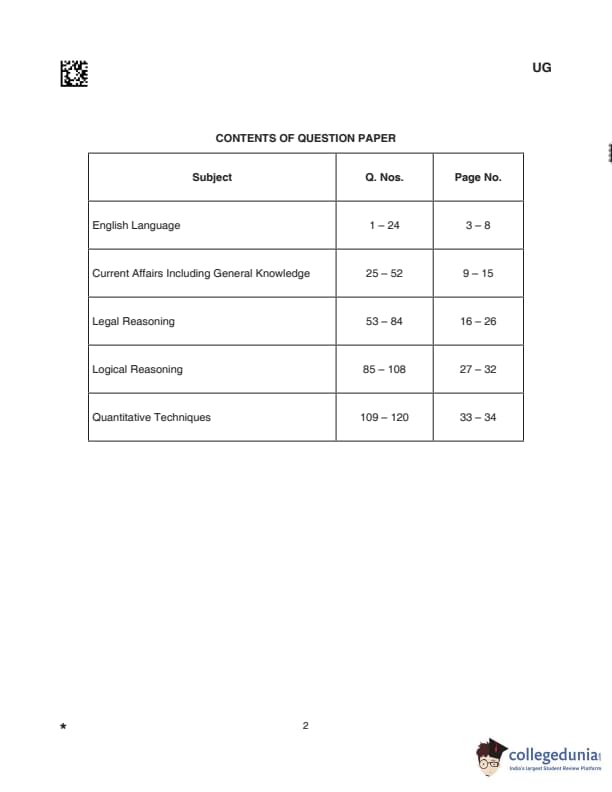
CLAT 2024 UG Question Paper Set A with Answer Key and Solution PDF is available for download. The exam was conducted by the Consortium of NLUs on December 3, 2023. Candidates were required to answer a total of 120 objective-type questions carrying 1 mark each covering five major sections: English Language, Current Affairs & General Knowledge, Legal Reasoning, Logical Reasoning and Quantitative Techniques.
CLAT 2024 UG Question Paper with Solution PDF- Set A
![]()
CLAT UG 2024 Questions with Solution (Set A)
Question 1:
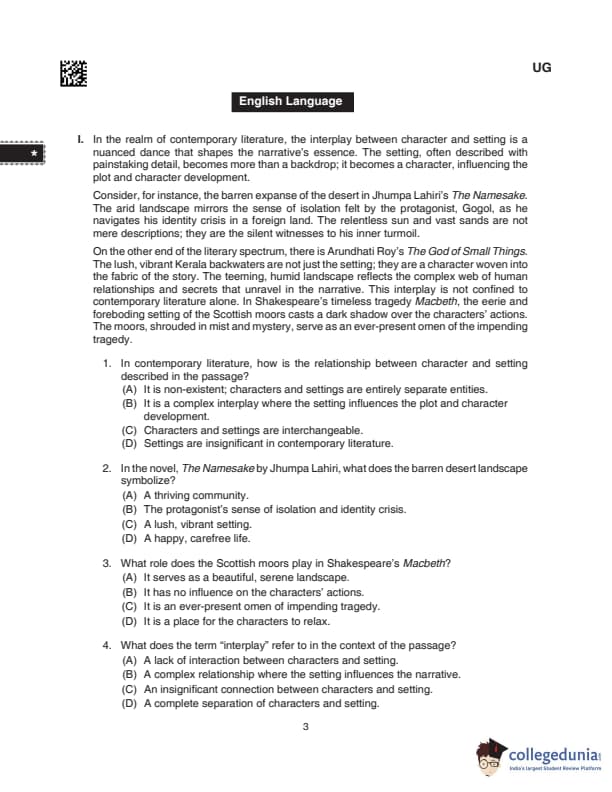
In contemporary literature, how is the relationship between character and setting described in the passage?
- (A)Non-existent; characters and settings are separate entities.
- (B) A complex interplay where the setting influences plot and character.
- (C) Characters and settings are interchangeable.
- (D)Settings are insignificant in literature.
Question 2:
In The Namesake by Jhumpa Lahiri, what does the barren desert landscape symbolize?
- (A)A thriving community.
- (B) The protagonist’s sense of isolation.
- (C) A lush, vibrant setting.
- (D)A happy, carefree life.
Question 3:
What role do the Scottish moors play in Shakespeare’s Macbeth?
- (A)Beautiful, serene landscape.
- (B) No influence on characters.
- (C) An omen of impending tragedy.
- (D)A place for relaxation.
Question 4:
What does the term "interplay" refer to in the passage?
- (A)A lack of interaction.
- (B) A complex relationship where setting influences narrative.
- (C) Insignificant connection.
- (D)Complete separation.
Question 5:
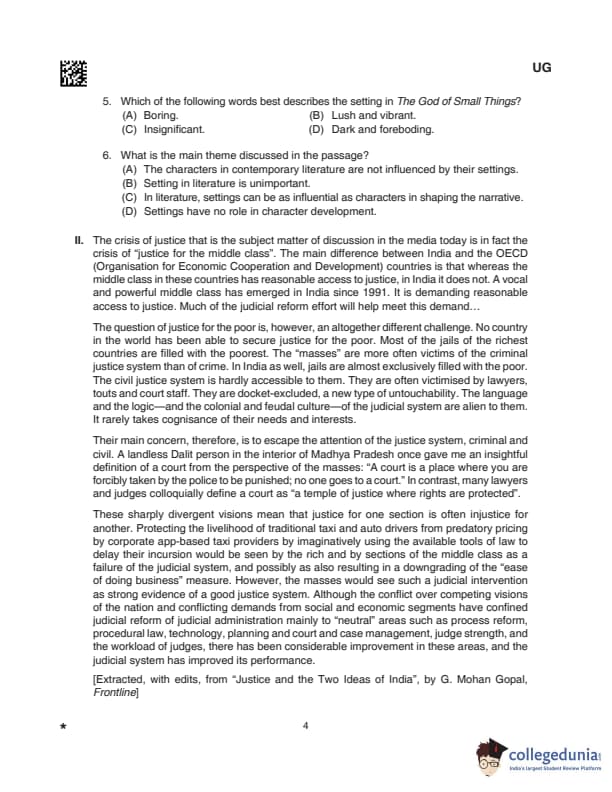
Which of the following best describes the setting in The God of Small Things?
- (A)Boring.
- (B) Lush and vibrant.
- (C) Insignificant.
- (D)Dark and foreboding.
Question 6:
What is the main theme discussed in the passage?
- (A)Characters are not influenced by settings.
- (B) Setting is unimportant in literature.
- (C) Settings influence characters as much as other characters.
- (D)Settings have no role in character development.
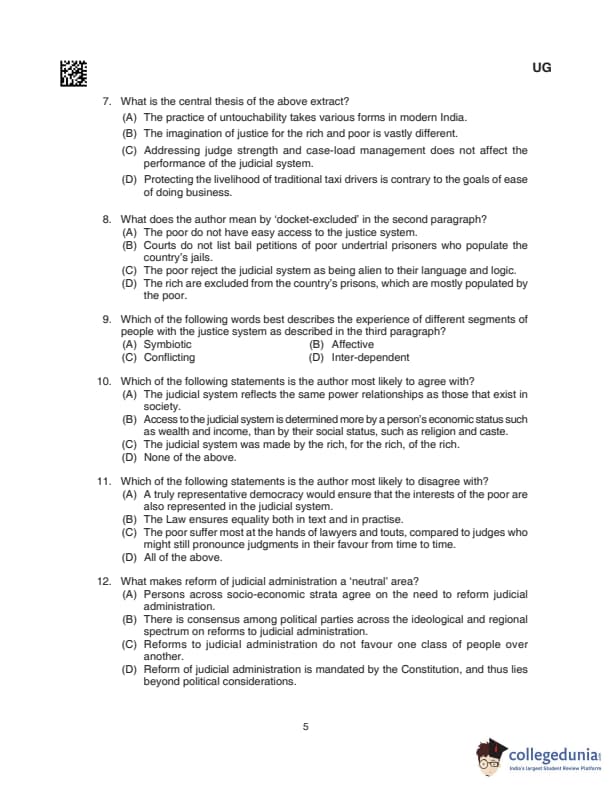
Question 7:
What is the central thesis of the above extract?
- (A)Untouchability takes various forms.
- (B) Rich and poor have different ideas of justice.
- (C) Case management doesn’t affect judicial performance.
- (D)Protecting livelihoods opposes ease of doing business.
Question 8:
What does "docket-excluded" refer to?
- (A)Lack of access to justice for the poor.
- (B) Exclusion of bail for the poor.
- (C) Rejection of judicial system by the poor.
- (D)Exclusion of the rich from prisons.
Question 9:
Which word best describes the experience of different segments with the justice system?
- (A)Symbiotic
- (B) Affective
- (C) Conflicting
- (D)Inter-dependent
Question 10:
What does the author imply about the judicial system?
- (A)Reflects power relationships.
- (B) Access is based on wealth.
- (C) Made for the rich.
- (D)None of the above.
Correct Answer: (A)
View Solution
The justice system reflects the same power dynamics as society.
Question 11:
What statement is the author most likely to disagree with?
- (A)Representative democracy ensures interests of the poor in the judiciary.
- (B) Law ensures equality in text and practice.
- (C) The poor suffer most at the hands of touts.
- (D)All of the above.
Question 12:
What makes judicial reform of administration a ‘neutral’ area?
- (A)Agreement across socio-economic classes.
- (B) Political consensus on reform.
- (C) Reforms do not favor any class.
- (D)Constitution mandates judicial reform.
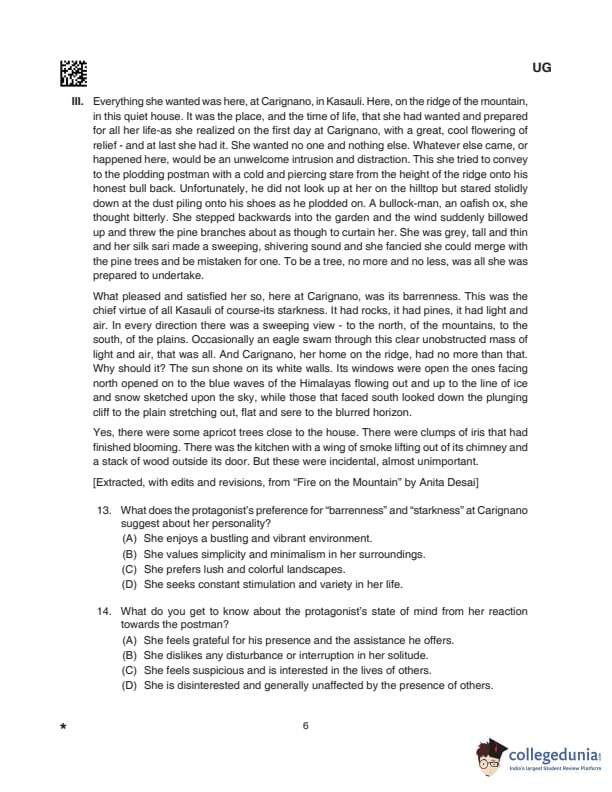
Question 13:
What does the protagonist’s preference for “barrenness” and “starkness” suggest?
- (A)Enjoys vibrant environments.
- (B) Values simplicity.
- (C) Prefers lush landscapes.
- (D)Seeks constant stimulation.
Question 14:
What does the protagonist’s reaction towards the postman reveal?
- (A)Gratitude for his presence.
- (B) Dislikes disturbance.
- (C) Suspicion of others.
- (D)Indifference to others.
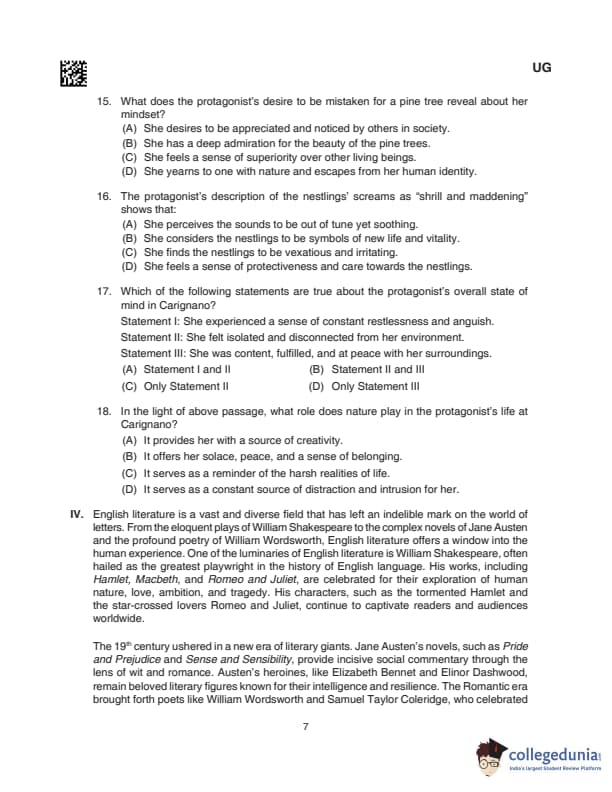
Question 15:
What does the protagonist’s desire to be mistaken for a tree signify?
- (A)Desire for societal appreciation.
- (B) Admiration for nature’s beauty.
- (C) Feels superior to others.
- (D)Yearns for unity with nature.
Question 16:
What does the protagonist’s description of nestlings’ screams as “shrill and maddening” reveal?
- (A)Finds it soothing.
- (B) Views nestlings as symbols of life.
- (C) Finds them vexing.
- (D)Feels protective of them.
Question 17:
What best describes the protagonist’s state of mind in Carignano?
- (A)Constant restlessness and anguish.
- (B) Isolation and disconnection.
- (C) Only isolation.
- (D)Contentment and peace.
Question 18:
What role does nature play in the protagonist’s life at Carignano?
- (A)A source of creativity.
- (B) Offers solace and belonging.
- (C) Reminder of harsh life realities.
- (D)Source of distraction.
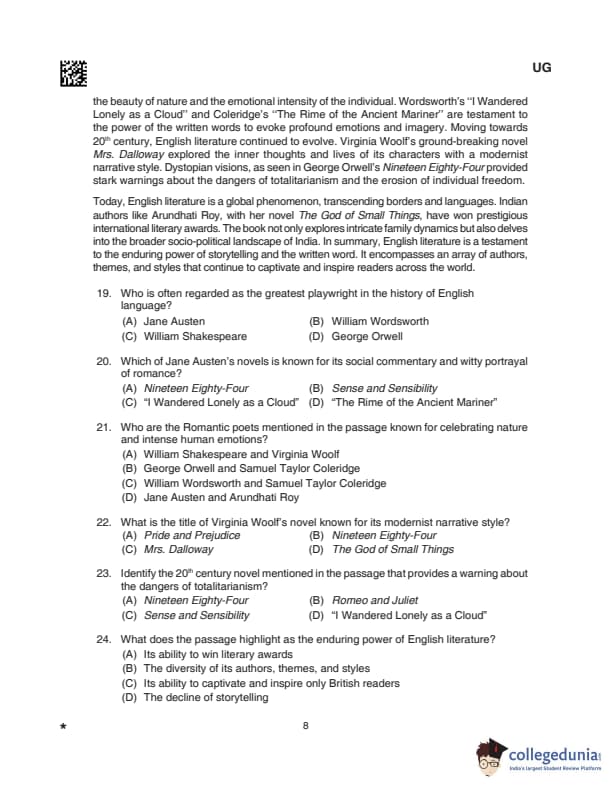
Question 19:
Who is often regarded as the greatest playwright in the history of the English language?
- (A)Jane Austen
- (B) William Wordsworth
- (C) William Shakespeare
- (D)George Orwell
Question 20:
Which of Jane Austen’s novels is known for its social commentary and witty portrayal of romance?
- (A)Nineteen Eighty-Four
- (B) Sense and Sensibility
- (C) I Wandered Lonely as a Cloud
- (D)The Rime of the Ancient Mariner
Question 21:
Who are the Romantic poets known for celebrating nature and human emotions?
- (A)Shakespeare and Woolf
- (B) Orwell and Coleridge
- (C) Wordsworth and Coleridge
- (D)Austen and Roy
Question 22:
What is the title of Virginia Woolf’s novel known for its modernist narrative style?
- (A)Pride and Prejudice
- (B) Nineteen Eighty-Four
- (C) Mrs. Dalloway
- (D)The God of Small Things
Question 23:
Identify the 20th-century novel that provides a warning about the dangers of totalitarianism.
- (A)Nineteen Eighty-Four
- (B) Romeo and Juliet
- (C) Sense and Sensibility
- (D)I Wandered Lonely as a Cloud
Question 24:
What does the passage highlight as the enduring power of English literature?
- (A)Winning awards
- (B) Diversity of authors and themes
- (C) Appeal only to British readers
- (D)Decline of storytelling
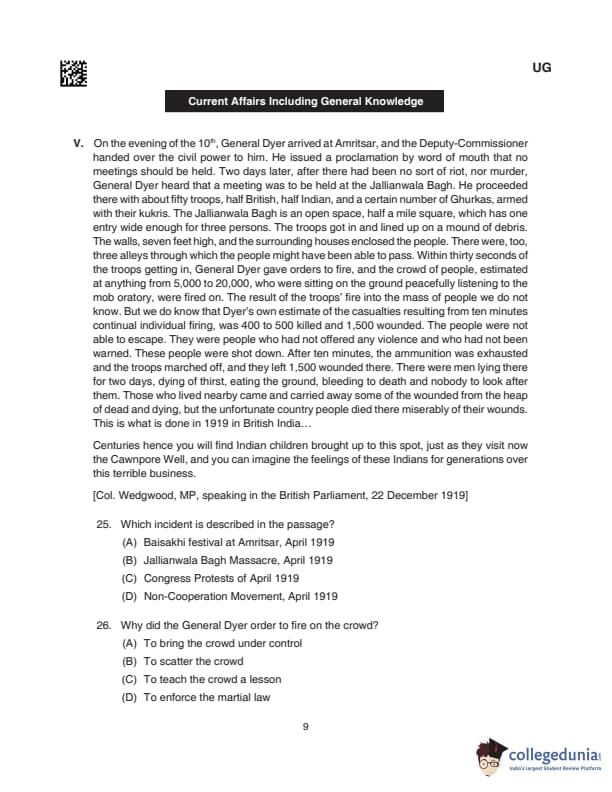
Question 25:
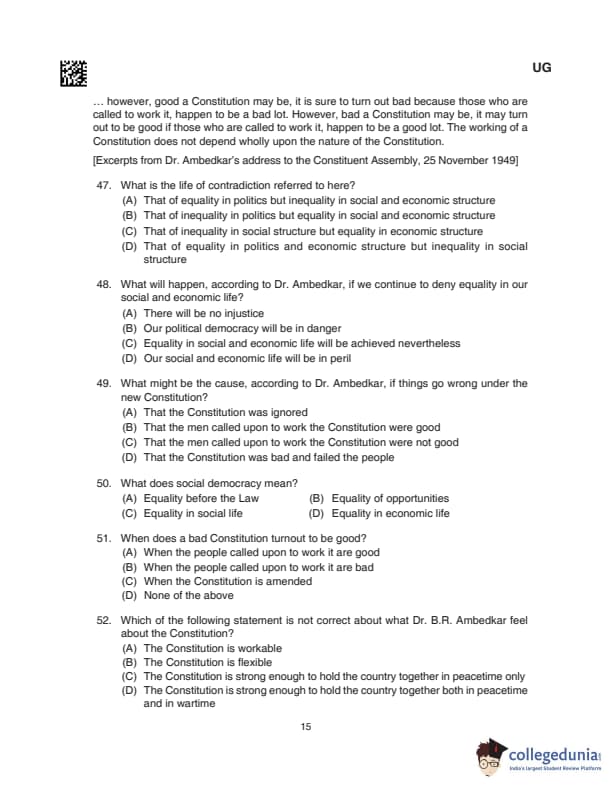
Which incident is described in the passage?
- (A)Baisakhi festival at Amritsar, 1919
- (B) Jallianwala Bagh Massacre, 1919
- (C) Congress Protests, 1919
- (D)Non-Cooperation movement, 1919
Question 26:
Why did General Dyer order to fire on the crowd?
- (A)To bring the crowd under control
- (B) To scatter the crowd
- (C) To teach the crowd a lesson
- (D)To enforce martial law
Question 27:
What was the intention of the speaker?
- (A)To praise General Dyer
- (B) To expose the deeds of General Dyer
- (C) To gain sympathy for the victims
- (D)All of the above
Question 28:
After the incident, who helped the injured and dying people?
- (A)The army
- (B) The police
- (C) Civil administration
- (D)Nearby residents
Question 29:
What would be the feelings of Indian children brought to the Jallianwala Bagh site?
- (A)Friendliness toward British rule
- (B) Bitterness about British rule
- (C) A sense of helplessness
- (D)None of the above
Question 30:
What was General Dyer’s full name?
- (A)Reginald Murree Harry Dyer
- (B) Reginald Royce Harry Dyer
- (C) Reginald Edward Harry Dyer
- (D)Reginald Coleman Harry Dyer
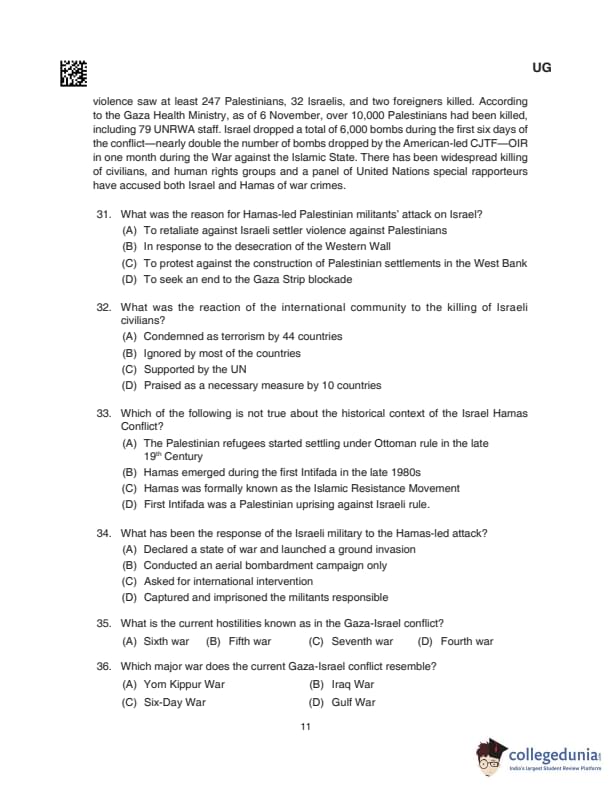
Question 31:
What reason did Hamas give for its attack on Israel?
- (A)Retaliation against settler violence
- (B) Desecration of the Western Wall
- (C) Protest against Palestinian settlement construction
- (D)End the Gaza Strip blockade
Question 32:
What was the international reaction to the killing of Israeli civilians?
- (A)Condemned as terrorism by 44 countries
- (B) Largely ignored
- (C) Supported by the UN
- (D)Praised by 10 countries
Question 33:
Which statement about the historical context of the Israel-Hamas conflict is NOT true?
- (A)Palestinian refugees settled under Ottoman rule
- (B) Hamas emerged during the first Intifada
- (C) Hamas was known as the Islamic Resistance Movement
- (D)The first Intifada was against Israeli rule
Question 34:
What was the Israeli military response to the Hamas-led attack?
- (A)Declared a state of war and launched a ground invasion
- (B) Only conducted aerial bombardment
- (C) Asked for international intervention
- (D)Imprisoned the responsible militants
Question 35:
What is the current hostilities in the Gaza-Israel conflict known as?
- (A)Sixth war
- (B) Fifth war
- (C) Seventh war
- (D)Fourth war
Question 36:
Which major war does the current Gaza-Israel conflict resemble?
- (A)Yom Kippur War
- (B) Iraq War
- (C) Six-Day War
- (D)Gulf War
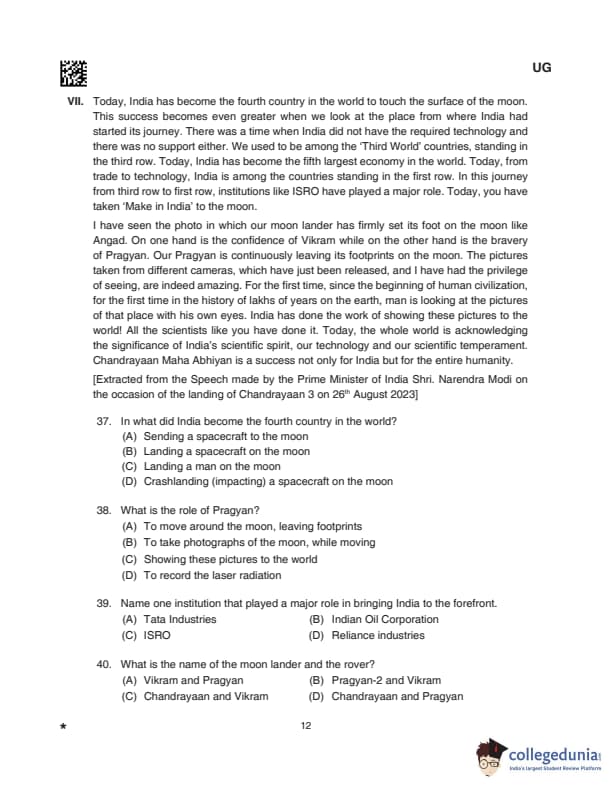
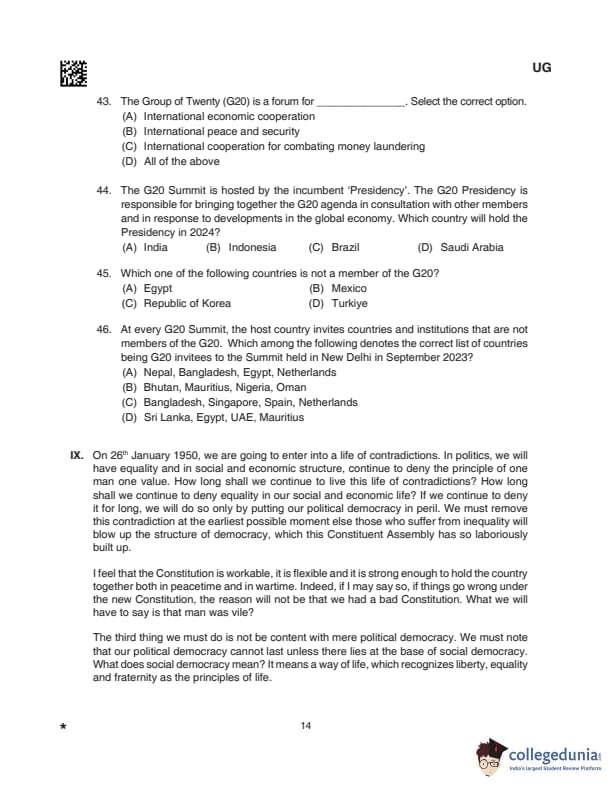
Question 37:
In what did India become the fourth country in the world?
- (A)Sending a spacecraft to the moon
- (B) Landing a spacecraft on the moon
- (C) Landing a man on the moon
- (D)Crashlanding a spacecraft on the moon
Question 38:
What is the role of Pragyan?
- (A)Move around the moon
- (B) Take photographs
- (C) Show images to the world
- (D)Record laser radiation
Question 39:
Name one institution that played a major role in bringing India to the forefront.
- (A)Tata Industries
- (B) Indian Oil Corporation
- (C) ISRO
- (D)Reliance Industries
Question 40:
What are the names of the moon lander and the rover?
- (A)Vikram and Pragyan
- (B) Pragyan-2 and Vikram
- (C) Chandrayaan and Vikram
- (D)Chandrayaan and Pragyan







Comments