CAT 2023 Slot 3 Question Paper VARC: Download Question Paper PDF with Answer Key and Solutions
CAT 2023 Slot 3 VARC Question Paper is available here for free download. CAT 2023 Slot 3 paper has been conducted on November 26 from 4.30 PM to 6.30 PM. CAT 2023 Slot 3 question paper VARC comprises 24 questions to be attempted in 40 minutes. According to initial students reaction, CAT 2023 Slot 3 VARC was easy to moderate.
| CAT 2025 Question Paper available for download- Check Here |
CAT 2023 Slot 3 VARC Question Paper with Solutions PDF
| CAT 2023 VARC Question Paper PDF | CAT 2023 VARC Answer Key PDF | CAT 2023 VARC Solution PDF |
|---|---|---|
 |
|
|
CAT 2023 Slot 3 VARC Questions with Solutions
| Question | Correct Answer | Solution |
|---|---|---|
| The author advises poor but archaeologically rich source countries to do all except: 1. Allow foreign analysis and exhibit finds. 2. Adopt China's collaborative approach. 3. Find ways to attract foreign funding. 4. Fund institutes in other countries. |
4 | The author suggests that poor but archaeologically rich countries should consider collaborative strategies to attract foreign resources and expertise for archaeological research, similar to China’s approach. However, there is no mention of these countries directly funding foreign institutions to carry out excavations in their territory. Instead, the focus is on leveraging foreign partnerships to benefit from advanced methods and increase discoveries while retaining their archaeological findings within the country. Therefore, option 4 is not aligned with the author’s recommendations. |
| Archaeological sites are important to some source countries because they: 1. Are subject to patrimony laws. 2. Symbolize Western imperialism. 3. Generate future funds. 4. Boost tourism. |
4 | The passage indicates that archaeological sites hold significance beyond their historical value for many source countries. These sites can enhance cultural pride and, more importantly, attract tourists, providing an economic boost for the local economy. The author emphasizes that patrimony laws are meant to preserve such sites and ensure that the economic benefits (like tourism revenue) remain within the country, making option 4 the most accurate answer. |
| Which statement would undermine the passage's central idea? 1. UNESCO funds poor, archaeologically rich countries. 2. Western countries must apologize for past looting. 3. Affluent source countries can fund their own excavations. 4. Economically deprived countries display their own antiques. |
1 | If UNESCO were actively financing archaeological projects in economically challenged but archaeologically rich countries, the need for those countries to rely on international partnerships for funding would be reduced. The passage argues that restrictive cultural property laws can discourage foreign investment in excavations. Therefore, UNESCO’s financial support would weaken the passage’s central point about the adverse effects of patrimony laws by addressing the funding issue, making option 1 the correct answer. |
| Which statement expresses the paradox of patrimony laws? 1. Aimed at protecting cultural property, they reduce discoveries. 2. Intended to protect property, they withhold treasures. 3. Protect property but reduce business for auctioneers. 4. Protect property but lead to site neglect. |
1 | The passage explains a paradoxical effect of patrimony laws: while they are designed to safeguard cultural heritage from exploitation by foreign entities, they inadvertently lead to fewer archaeological discoveries. This happens because these laws discourage foreign entities from investing in excavation projects, thus reducing the potential for unearthing new artifacts. The contradiction between the intended preservation and the unintentional restriction of new discoveries best fits option 1. |
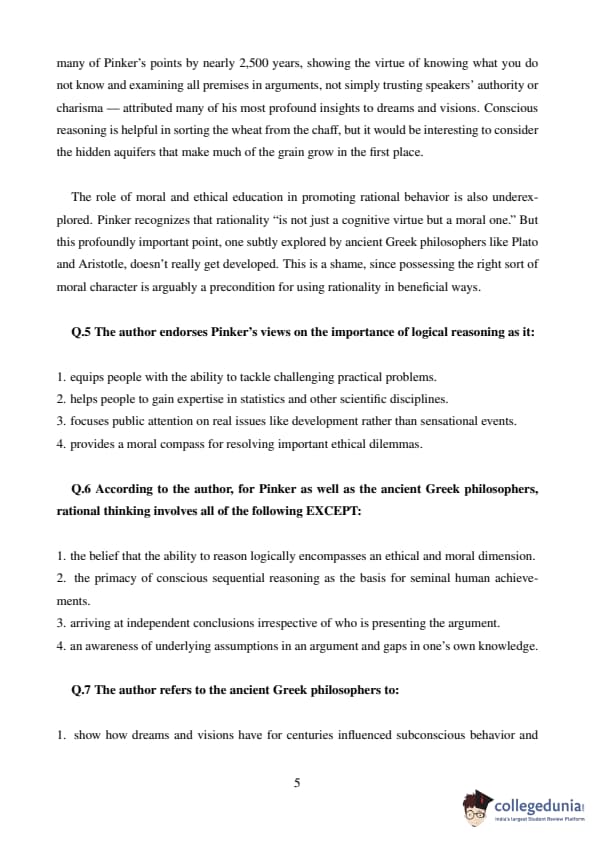
| The author endorses Pinker’s views on the importance of logical reasoning as it: 1. Equips people with the ability to tackle practical problems. 2. Helps people gain expertise in statistics and scientific disciplines. 3. Focuses public attention on real issues rather than sensational events. 4. Provides a moral compass for ethical dilemmas. |
1 | The author appreciates Pinker’s emphasis on logical reasoning and its relevance in solving practical issues. By mastering rational tools, individuals are better equipped to address complex challenges in real-life contexts such as medicine, law, and finance. Although Pinker covers various benefits, the author highlights the practical application of these tools in navigating real-world problems, making option 1 the most accurate response. |
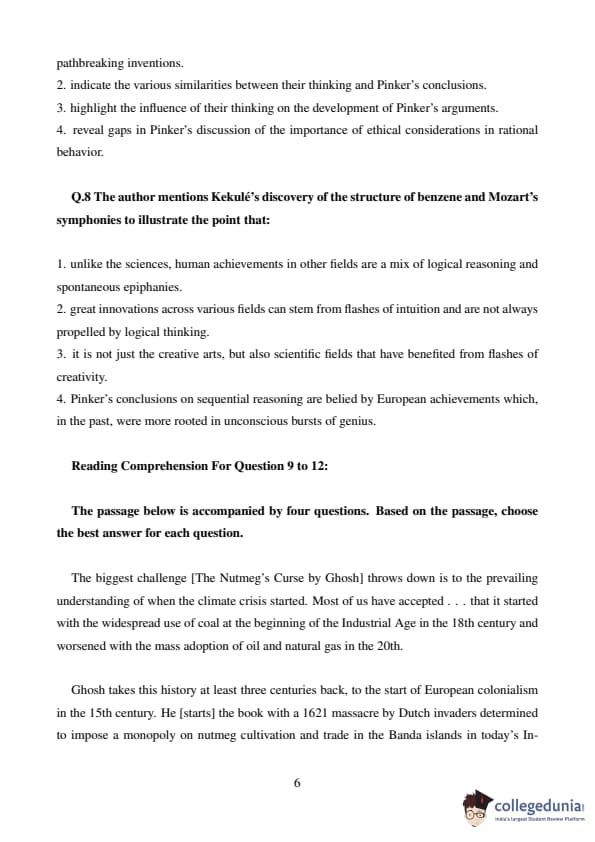
| According to the author, for Pinker as well as the ancient Greek philosophers, rational thinking involves all of the following EXCEPT: 1. Belief in a moral dimension to logical reasoning. 2. Primacy of conscious reasoning in human achievements. 3. Independent conclusions irrespective of argument presenter. 4. Awareness of assumptions and knowledge gaps. |
2 | While Pinker and the ancient philosophers value rational thinking, the author points out that many human achievements arise not solely from conscious, sequential reasoning but also from sudden insights and intuition. The author describes Pinker’s focus on logic but notes that historical breakthroughs often stem from epiphanies rather than step-by-step reasoning. Therefore, option 2, emphasizing the primacy of conscious reasoning, does not fully align with the author’s viewpoint. |
| The author refers to the ancient Greek philosophers to: 1. Show how dreams and visions influenced inventions. 2. Indicate similarities between their views and Pinker’s. 3. Highlight influence on Pinker’s arguments. 4. Reveal gaps in Pinker’s discussion of ethics in rationality. |
4 | The author uses references to Greek philosophers to illustrate that Pinker’s work overlooks the ethical considerations in rational behavior, which these philosophers thoroughly examined. The passage suggests that understanding rationality isn’t only about cognitive skill but also involves a moral component, which Pinker does not explore in depth. Thus, option 4 is the best answer. |
| The author mentions Kekule’s discovery of benzene's structure and Mozart’s symphonies to illustrate that: 1. Sciences and arts benefit from reasoning and insights. 2. Innovations arise from intuition, not just logic. 3. Creativity supports both sciences and arts. 4. Pinker’s view on logic is contradicted by European achievements. |
2 | The examples of Kekule’s and Mozart’s achievements highlight that profound human creativity often comes from moments of intuitive insight rather than linear reasoning. The author uses these instances to show that while logic is important, many breakthroughs emerge from intuition and creativity, not sequential thought alone. This aligns with option 2. |
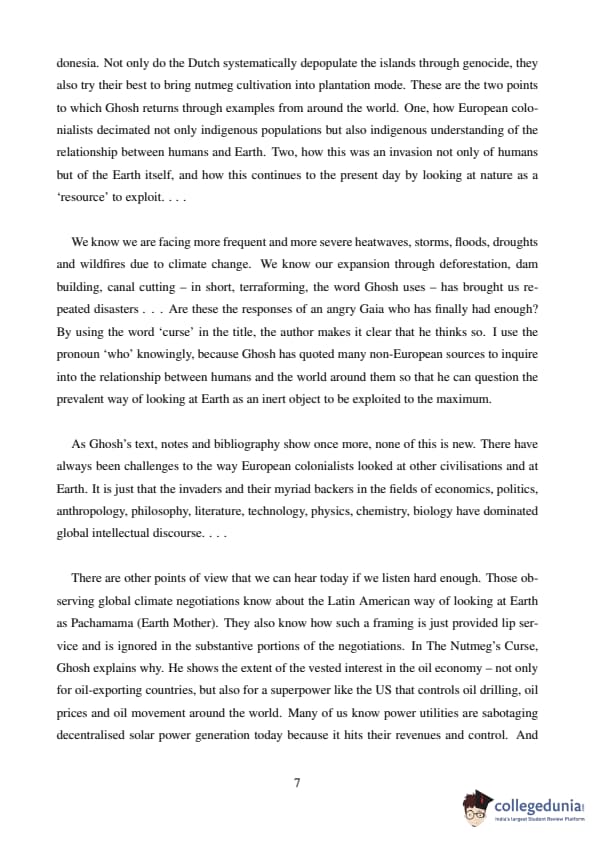
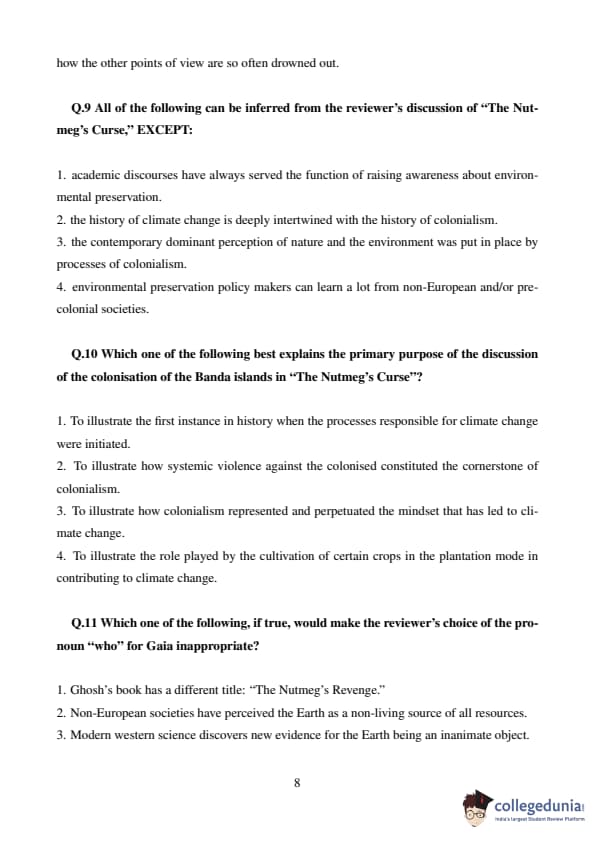
| All of the following can be inferred from the review of "The Nutmeg’s Curse," EXCEPT: 1. Academic discourses raise awareness about environmental preservation. 2. Climate change history is linked to colonialism. 3. The current view of nature originates in colonialism. 4. Policymakers can learn from non-European societies. |
1 | The passage suggests that academic discourses have often reinforced colonial viewpoints rather than consistently promoting environmental awareness. Though critiques of colonialism exist, the author argues that colonial influences still dominate, overshadowing alternative perspectives on environmental preservation. Thus, option 1 does not align with the passage’s stance, as it implies consistent environmental advocacy in academia. |
| What is the main purpose of discussing the Banda islands' colonization in "The Nutmeg’s Curse"? 1. To show the first instance of processes leading to climate change. 2. To illustrate how colonialism relied on systemic violence. 3. To show how colonialism perpetuated a mindset causing climate change. 4. To explain how plantation agriculture contributed to climate change. |
3 | The Banda islands’ example demonstrates how colonial violence and exploitation fundamentally altered human relationships with nature, fostering a mindset of dominance over the environment. This colonial mentality, according to Ghosh, set the foundation for environmental exploitation that continues today, leading to climate change. Therefore, option 3 best captures the author’s purpose in discussing the Banda islands. |
| Which would make using “who” for Gaia inappropriate? 1. Ghosh titles his book differently. 2. Non-European societies view Earth as non-living. 3. Science proves Earth is inanimate. 4. Human activities directly cause climate change. |
2 | If non-European societies viewed Earth as an inanimate entity, the use of "who" to personify Gaia as a living being would contradict Ghosh’s intention to depict Earth as a responsive entity. The author’s choice of “who” reflects a perspective that Earth has agency and emotions. Option 2 is therefore correct because it would invalidate this portrayal. |
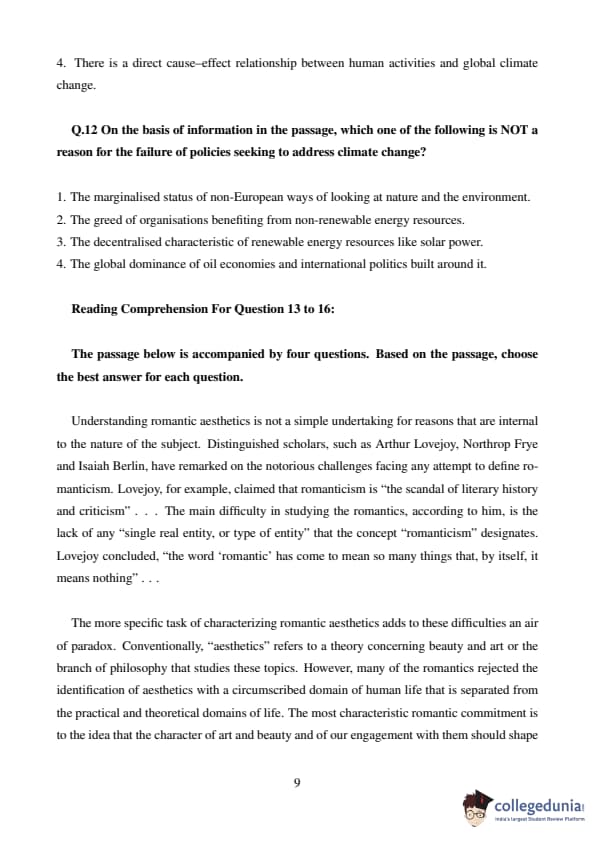
| Which is NOT a reason for the failure of climate policies according to the passage? 1. Marginalized non-European views. 2. Greed of non-renewable energy organizations. 3. Decentralized nature of solar power. 4. Dominance of oil economies. |
3 | The passage suggests that decentralized renewable energy sources, like solar power, face opposition from organizations invested in centralized non-renewable energy sources. However, decentralization itself is not a reason for the failure of climate policies. Instead, policies fail due to powerful interests that undermine sustainable initiatives. Therefore, option 3 is the correct answer. |
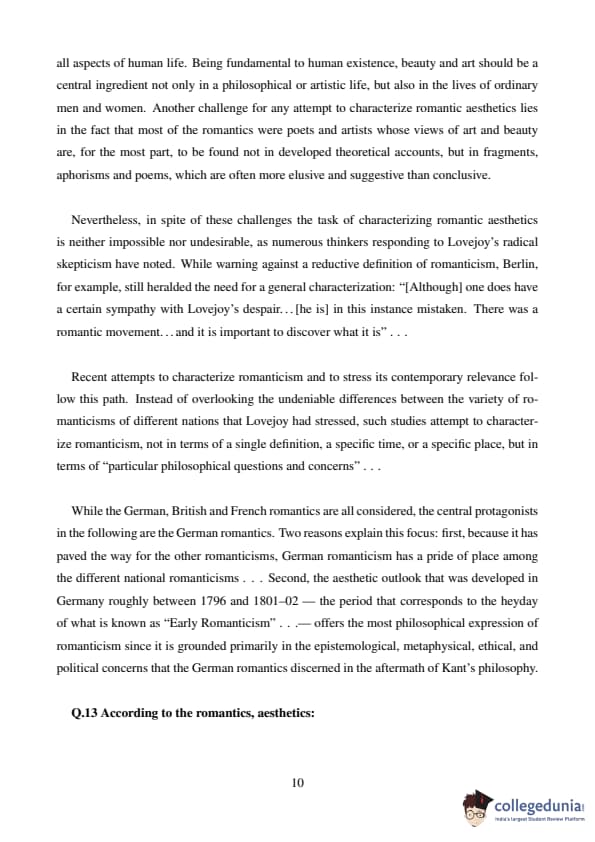
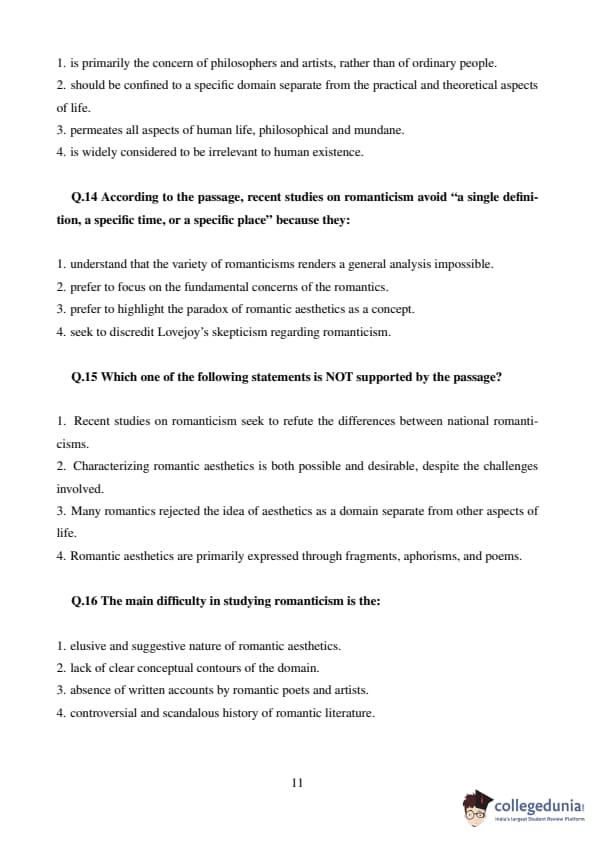
| According to the romantics, aesthetics: 1. Is mainly for philosophers and artists. 2. Should be separate from practical life. 3. Influences all areas of human life. 4. Is irrelevant to human existence. |
3 | The passage indicates that romanticism values aesthetics as an integral part of life, impacting not only philosophical pursuits but also the everyday lives of individuals. The romantics believed that beauty and art should shape all human experiences, which aligns with option 3. |
| Recent studies on romanticism avoid "a single definition, a specific time, or a specific place" because they: 1. Recognize general analysis as impossible. 2. Focus on core philosophical concerns. 3. Highlight the paradox of romantic aesthetics. 4. Discredit Lovejoy’s skepticism. |
2 | The passage explains that recent studies attempt to define romanticism by examining its essential philosophical questions and concerns rather than focusing on fixed definitions or historical limitations. These studies aim to explore romanticism’s broader themes, making option 2 the best answer. |
| Which statement is NOT supported by the passage? 1. Recent studies refute differences between national romanticisms. 2. Characterizing romantic aesthetics is possible and desirable. 3. Many romantics reject the separation of aesthetics from life. 4. Romantic aesthetics are expressed in fragments and poems. |
1 | The passage states that recent studies acknowledge the differences between national romanticisms and do not attempt to refute them. Instead, they seek to explore the broader concerns shared by various forms of romanticism. Therefore, option 1 is unsupported by the passage. |
| The main difficulty in studying romanticism is the: 1. Elusive nature of romantic aesthetics. 2. Lack of clear conceptual boundaries. 3. Absence of written accounts. 4. Controversial history of romantic literature. |
2 | The passage emphasizes that defining romanticism is challenging because it lacks clear conceptual boundaries, which makes it difficult to categorize. The term "romanticism" has been used in many ways, leading to ambiguity and complexity in its study. Option 2 captures this central issue. |
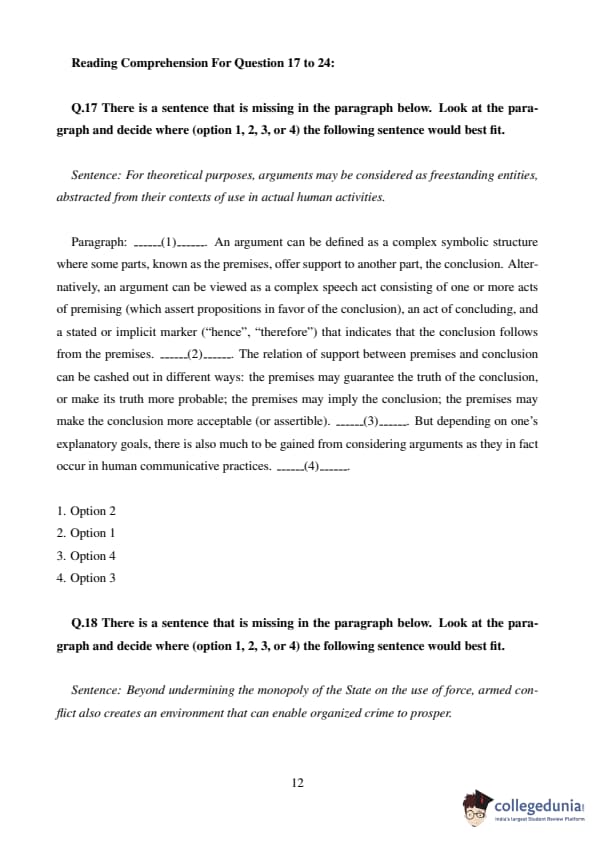
| Where does the sentence best fit in the paragraph? Sentence: For theoretical purposes, arguments may be considered as freestanding entities, abstracted from their contexts of use in actual human activities. Options: 1. Position 1 2. Position 2 3. Position 3 4. Position 4 |
3 | The sentence provides a theoretical perspective, introducing the idea of arguments as abstract entities. Position 3 is ideal because it precedes the discussion on the practical use of arguments, creating a logical transition from theory to practice. Thus, option 3 is correct. |
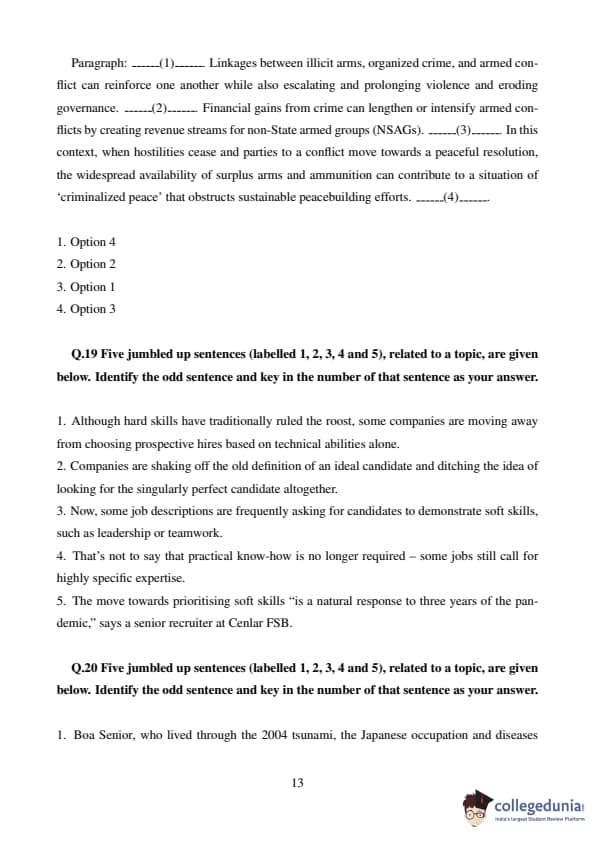
| Where does the sentence best fit in the paragraph? Sentence: Beyond undermining the monopoly of the State on the use of force, armed conflict also creates an environment that can enable organized crime to prosper. Options: 1. Position 1 2. Position 2 3. Position 3 4. Position 4 |
3 | The sentence logically fits before discussing the specific impacts of armed conflict and organized crime. Position 3 allows it to serve as a transition between broader context and specific consequences. This placement enhances the flow of ideas, making option 3 the best choice. |
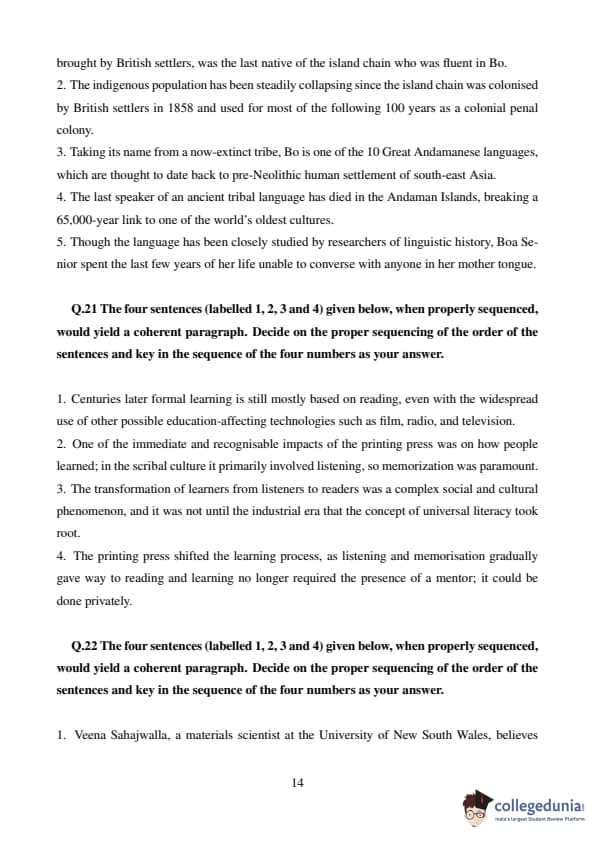
| Identify the odd sentence from the following jumbled sentences: 1. Hard skills traditionally ruled hiring decisions. 2. Companies are moving away from ideal candidate profiles. 3. Job descriptions now emphasize soft skills. 4. Practical skills are still needed for specific jobs. 5. Soft skills prioritization is a natural post-pandemic response. |
2 | Sentence 2 is the odd one out because it shifts focus from specific skill types (hard or soft) to a general shift in hiring philosophy. Other sentences emphasize the changing focus on soft skills, making 2 unrelated to the main theme. |
| Identify the odd sentence from the following jumbled sentences: 1. Boa Senior was the last fluent Bo language speaker. 2. Indigenous population decreased due to colonization. 3. Bo is one of the 10 Great Andamanese languages. 4. The last speaker’s death broke a cultural link. 5. Researchers studied the language, but Boa could not converse in it. |
2 | Sentence 2 is the odd one out because it focuses on the historical impact of colonization on the indigenous population rather than the preservation or study of the language. The other sentences emphasize the language and its last speaker, making 2 unrelated. |
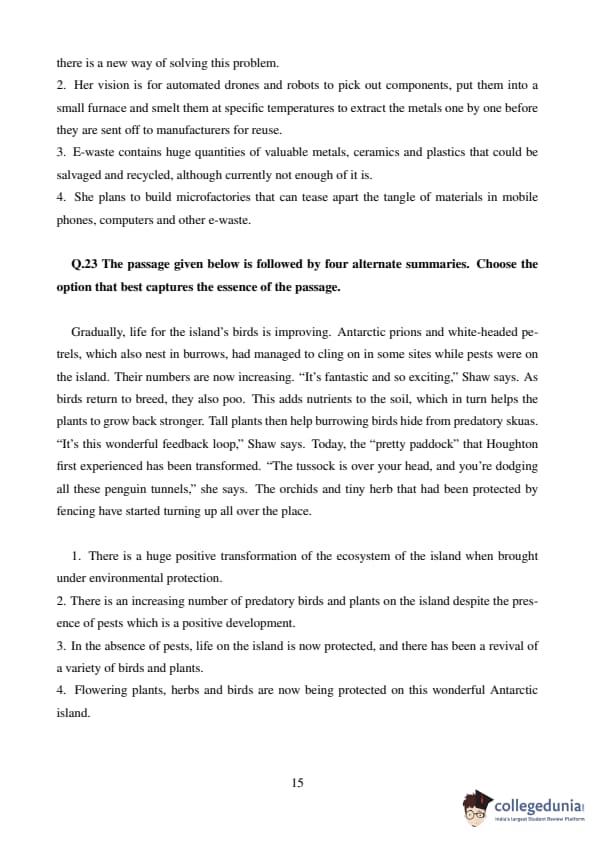
| Identify the proper sequence of sentences to form a coherent paragraph: 1. Learning is based on reading, even with new technologies. 2. The printing press shifted learning from listening to reading. 3. Transformation to readers was a complex change. 4. Printing press made learning private, without a mentor. |
2431 | The logical order begins with the historical role of the printing press (2), then explains the shift in learning (4), followed by the transformation process (3), and finally the persistence of reading as the primary learning mode (1). Thus, the sequence is 2431. |
| Identify the proper sequence of sentences to form a coherent paragraph: 1. Sahajwalla sees a solution to e-waste recycling. 2. She envisions automated drones and robots for recycling. 3. E-waste has valuable metals and plastics for recycling. 4. She plans microfactories to separate e-waste materials. |
3142 | The sequence starts by introducing e-waste (3), followed by Sahajwalla’s innovative solution (1), her plan for microfactories (4), and details of using robots and drones for processing (2). This forms a cohesive explanation of her recycling vision. |
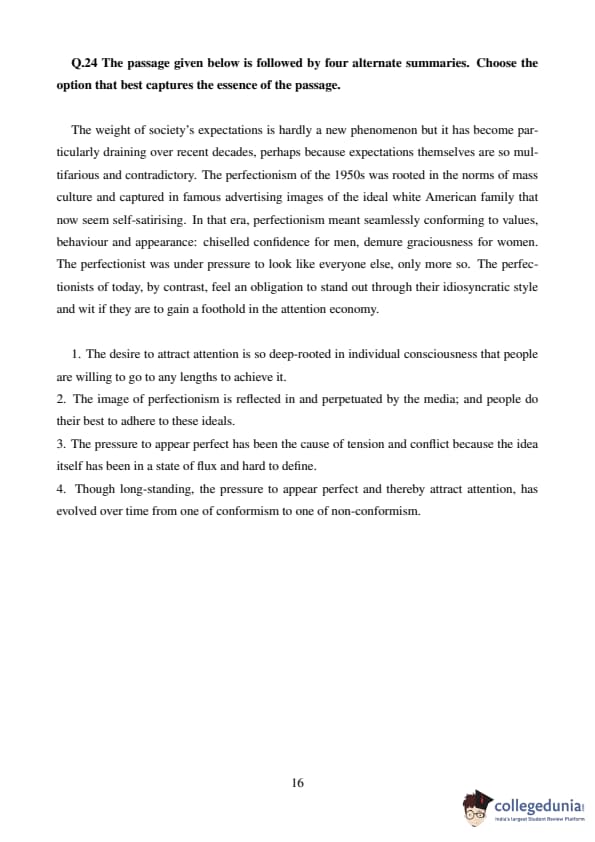
| Select the best summary: “Life for island birds is improving as pests are eliminated, leading to nutrient-rich soil, which promotes plant growth and provides bird protection. Shaw notes how plants now thrive, hiding burrowing birds from predators, completing a feedback loop." |
3 | Option 3 captures the restoration of the island ecosystem by eliminating pests, leading to the revival of birds and plants. The summary reflects the cycle of benefits brought by environmental protection measures on the island. |
| Select the best summary: “Societal perfectionism evolved from 1950s conformism to today’s emphasis on individual expression, driven by diverse expectations and pressures to attract attention.” |
4 | Option 4 accurately reflects the passage’s discussion of evolving societal standards, contrasting the 1950s ideal of uniformity with today’s expectation of unique self-expression. It encapsulates the shift from conformism to individualism. |
*The article might have information for the previous academic years, please refer the official website of the exam.
Comments